
This article contains lore based on real-life sources from Mongol mythology as introduced in God of War Laufey
| “ | "Would you like to see how hard it is to die here, godling? I can show you." | ” |
―Begtse to Laufey. | ||
Begtse (Tibetan: བེག་ཚེ) is the Pre-Buddhist Mongolian, and later Tibetan Buddhist, God of War set to appear God of War Laufey.
In the God of War Series
God of War Laufey
At some point, Begtse died and found himself in the Everywhen, where he formed a partnership with the Egyptian Goddess of War, Sekhmet, taking over charge of the Everywhen.[1]
Appearance
Begtse appears as an imposing warrior deity with a demonic and terrifying appearance. His gigantic body is covered in scarlet skin resembling scales or natural armor plates. His ferocious face features several piercing eyes, long curved tusks, and a row of sharp fangs that accentuate his menacing aspect. Large horns protrude from his skull, adorned with human skulls, while a thick, black mane with fiery highlights encircles his head like a crown of fire.
His powerful musculature is partially protected by richly decorated armor featuring golden ornaments inspired by Mongolian and Buddhist art. His shoulder guards, sculpted with the likenesses of fantastical creatures, are covered in dark feathers. A wide belt adorned with a golden demonic mask completes his equipment, along with ropes and ritual fabrics symbolizing his sacred role.
Personality
At first glance, he appears to be a brutal individual who takes pleasure in violence.
Powers and Abilities
- Immortality: As a god, Begtse is naturally immortal; only divine forces and weapons are capable of killing him.
Mongolian & Tibetan Mythology
.jpg)
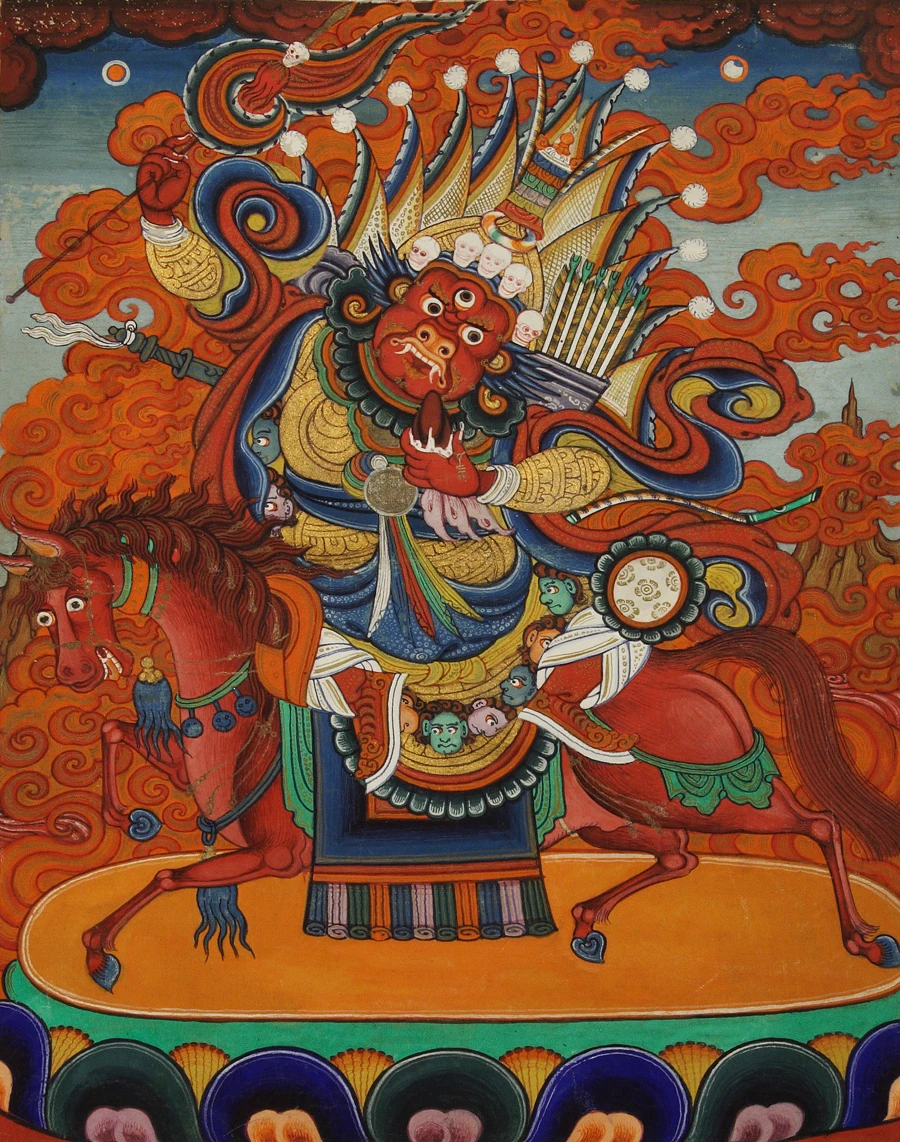
Thangka depiction of Begtse
Begtse is a Dharmapala, a type of wrathful god, and a lord of war in Buddhism, but was originally a pre-Buddhist war god in Mongolia. Researchers believe that Begtse was originally an ancient pre-Buddhist deity. He was introduced into the pantheon of wrathful deities by the 3rd Dalai Lama in the mid-16th century.
Begtse is depicted as red-skinned and orange-haired, with two arms unlike with other dharmapalas who have four or six arms), and three blood-shot eyes. He is usually depicted wearing a chainmail shirt and a helmet adorned with a crown of five skulls and four banners at the back. holding a sword in his right hand while his left hand holds a heart. His right arm holds a bow and arrow and a halberd with a banner.
He is usually accompanied by his consort, Rikpay Lhamo, and his general Laihansorgodog, while surrounded by Begtse's satellites, the twenty-nine butchers.
He has been known since the mid-16th century, when he was declared the chief protector of the Dalai Lamas and Tashi Lhunpo Monastery . He is also the guardian of the Tibetan government's treasury. According to legend, the Begtse tantra was brought by Padmasambhava , who taught its sadhana to one of his closest 25 disciples, Namkhai Nyingpo. This sadhana was hidden in Samye Monastery , where it was later discovered. Therefore, Begtse is widely venerated not only in the Gelugpa school but also in the Nyingma school . Tibetans believe that prayers to Begtse destroy enemies, obstacles on the Path, and protect from fear and danger.
The legend tells of two brothers, the elder of whom was a follower of the Dharma, while the younger was not. The younger refused all of the elder's entreaties, but finally offered to become a Buddha, and he would become a defender of the faith. After many reincarnations, the elder became Shakyamuni, and the younger was born to a copper-haired yakshasa from a red coral egg that Shiva (according to another version, Hayagriva) broke with his trident. The god was born in full armor and armed. Shiva asked him who he was, and he identified himself as the embodiment of speech, Yamantaka.
According to legend, he was the king of the demons, but in 1577 he was tamed by the 3rd Dalai Lama and turned to the side of the Dharma, retaining his properties. In the Khori-Buryat epic, Begtse is mentioned among the demons that Gesar defeated. In other versions of the myth, Gesar himself is the incarnation of Begtse.[2][3]
Trivia
TBA
Gallery

References
- ↑ Youtube: God of War Laufey - Cory Barlog Interviews Game Director at 14:25
- ↑ Буддизм. Словарь. [Buddhism. Dictionary.] edited by Zhukovskaya N.L., Ignatovich A.N., Kornev V.I. M., 1992
- ↑ Мифы народов мира [Myths of the Peoples of the World] edited by Tokareva S.A. - M., Soviet Encyclopedia, 1987 - vol. 1 - 671 p.