| “ | Mother! What's happening outside? The people! The fires! | ” |
―Calliope, moments before death. | ||
Calliope (Greek: Καλλιόπη) was the beloved daughter of Kratos and Lysandra. She, along with her mother, were unknowingly killed by Kratos as part of Ares' plot to harden Kratos' heart in order to make him the "perfect warrior" with no ties to the mortal realm. Unfortunately for the God of War, Calliope's death would only serve as the driving force behind Kratos' desire to kill Ares in retribution for his fallen family.
Quick Answers
Who are the parents of Calliope in God of War?

How did Calliope, Kratos' daughter, die?
What impact did Calliope's death have on Kratos' actions in God of War?
Who was responsible for the death of Kratos' daughter, Calliope?
What is the relationship between Calliope and Atreus in God of War?
Etymology
The name Καλλιόπη "Calliope" meant "beautiful voice", appropriate for the Muse of epic or heroic poetry.
Personality
Calliope was considered an enigma in Sparta, unlike many of the other children who were often taught to be ruthless, sadistic, and cruel: Calliope was extremely innocent almost to the point of naïvety. Like Lysandra, Calliope was one of the few people who was not intimidated by Kratos and actually loved him greatly.
Even after her death by Kratos, Calliope still showed that she loved him and was quick to embrace him.
After she was abandoned by Kratos while he was in Elysium Fields, Calliope fell into a deep depression, losing all interest in her flute, and presumably abandoned it just as he had abandoned her.
History
Early History
| “ | You will die... and Calliope will live! | ” |
―Kratos, fighting the Hades Phoenix. | ||
Calliope was born and raised in Sparta, living with her mother, Lysandra, in the country. At birth, it was revealed that Calliope suffered from a skin disease set out by Ares, which deemed her weak on in the eyes of Spartan Law and sentenced her to be sacrificed. She was only saved from her fate when Kratos set out on a quest for Ambrosia, after he consulted a healer who gave him The Fire of Apollo. The healer was hinted to be a disguised Zeus, who was Calliope's Grandfather.
By the time Kratos returned to Sparta, he narrowly saved Calliope from being thrown to her death. Though the King of Sparta insisted that the law be upheld, Lysandra pleaded for Calliope's life and reasoned that if they could prove that a sip of Ambrosia could save a life, then he would have the final sip. Convinced, the King upheld his promise to Kratos, who then used the Ambrosia and cured Calliope.
While Calliope was easily frightened by Kratos' violent nature, in truth, Calliope, along with Lysandra, were the only people who did not fear him. She was quite close to her father, and always anxiously awaited Kratos' return from his campaigns to protect Sparta. On one such occasion, Kratos spent enough time with Calliope that he was able to carve a flute for her to play. As Calliope reached adolescence, she became an extremely talented flute player and composed many lilting and emotional melodies.
Calliope's Flute
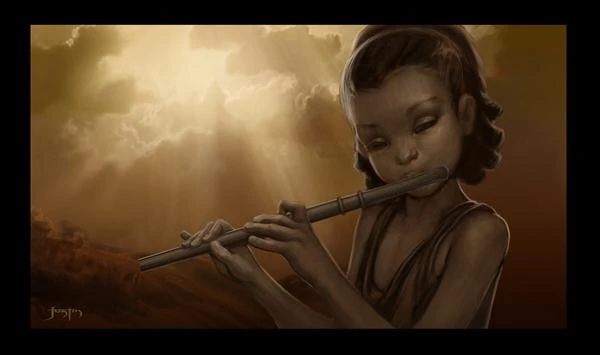
Calliope playing her flute.
Calliope's Flute was a standard wooden flute. Kratos carved it for Calliope in the past, in one of the times that he stayed long enough to see her between wars. In God of War: Chains of Olympus, Kratos was often "haunted" by a strange flute melody. Eventually, he recognized it as the melody from Calliope's Flute.
One day, Calliope had neglected her chores to help an elder named Ismene, whom her mother Lysandra does not have a good relation with. After an argument with her mother, Calliope ran away to the hilltop to her father's shield, trying to justify that her duty was to help all Spartans, not just her own family. When Kratos confronts her, he decides to tell her a story about his time in the Agoge with his brother Deimos and to understand the meaning of word and theme of duty. In the process of telling the story, Kratos carved the wooden flute for her as a gift.
Death
Both Calliope and Lysandra were in a village of worshippers for Athena when Kratos and a battalion of his soldiers arrived. Since he declared his allegiance to Ares, Kratos then ordered his men to destroy the village and leave no survivors. Kratos then decided to personally enter the Temple of Athena, and brutally slay all within with the Blades of Chaos. Kratos' blood frenzy made him blind to whom he killed, until it was too late; Calliope and Lysandra, were brought to the temple by Ares, and were both killed by Kratos. It was revealed that it was Ares' manipulation in order to make Kratos the ultimate warrior that led to Calliope's and Lysandra's deaths, since he thought that Kratos' Family had held him back. Ever since the massacre, Kratos endured immense depression and guilt and continually sought forgiveness and freedom from his nightmares for his actions on that day.
Post-Mortem
After her death, Calliope, instead of being condemned to be among the rest of the departed souls in the Underworld, was allowed to live among the pure souls of the Elysium Fields, at the base of the Pillar of the World. Calliope lived well among the lush and peaceful surroundings, and was even allowed to wander beyond Elysium's boundaries, throughout the nearby Temple of Persephone, and took to playing her flute on the dock to the River Styx.
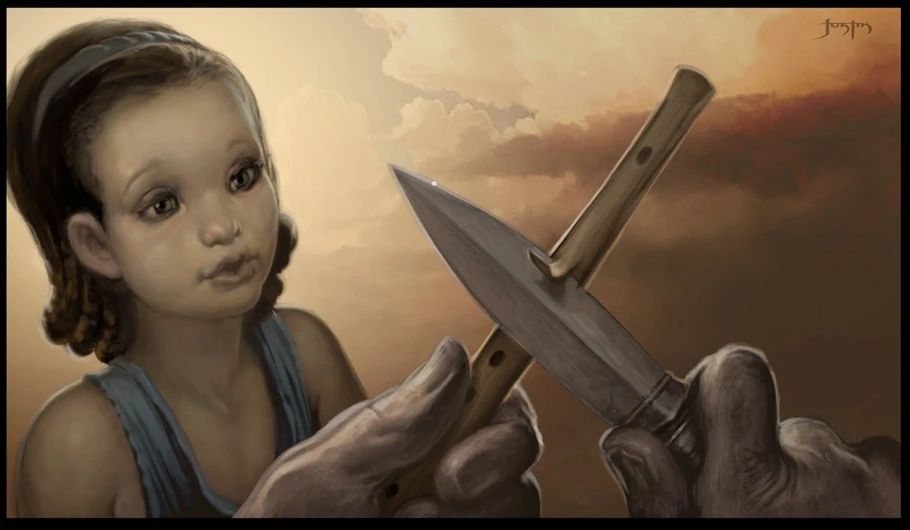
Calliope watching her father carve her a flute.
When Helios, the God of the Sun, was torn from the sky by Atlas, his Fire Steeds drove the Sun into the Earth, which plunged the entire world into darkness. Without Helios, Morpheus was unopposed, sought to seize permanent power, extended his black grip over the land, and enveloped all in darkness. The power of Morpheus affected even Kratos, who became haunted by a strange lingering melody. Kratos could sense that it was familiar, and eventually realized that it was Calliope's song, having been allowed to come through the black fog of Morpheus all the way from the Underworld.
Kratos continued to hear the music on his quest to liberate Helios from Atlas' grip. His journey eventually took him into the Underworld, and, eventually to the Temple of Persephone. Kratos then spotted Calliope on the temple docks, playing her flute. He called out to her, but Calliope merely turned around and re-entered the Temple. Kratos desperately followed Calliope throughout the temple, and eventually found Elysium's divine gates. Kratos then consulted with Persephone, and, at that time, resolved to simply abandon mankind and the Gods to their fate at Morpheus' hands so that he could spend the rest of his days in peace with his daughter. After he gave up all of his magical abilities and weapons, and, in turn, his sins, Kratos became worthy of Elysium and was allowed to enter.
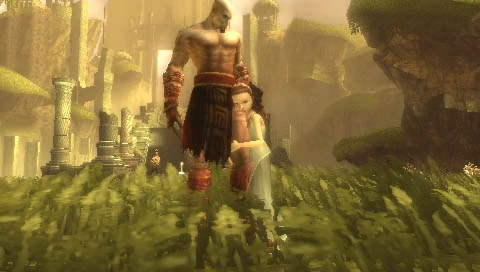
Kratos reluctantly forced to push Calliope aside in order to save her.
Upon arrival, Kratos and Calliope were then happily reunited. The reunion was cut short, however, as Persephone revealed the scope of her plans to use Atlas to destroy the Pillar of the World, which would destroy both Earth and Mount Olympus, and kill all life. When Kratos realized that Elysium would fall too and that Calliope would die again, he charged at the Goddess, and stated that he would not lose his child again. However, Kratos was easily knocked away as Calliope ran to his side. Kratos knew that in order to stop Persephone's plan, he would be forced to make the impossibly painful decision to forever forsake his place with Calliope and reluctantly pushed her aside. Calliope was helpless to watch as Kratos massacred all the other souls in Elysium; he regained all of his abilities in the process, and became the Ghost of Sparta once again. Calliope then broke down at the sight of a reborn Kratos as he departed to face and defeat both Atlas and Persephone.
After Kratos ended Persephone's life and bound Atlas to a fate of having to carry the Earth upon his shoulders forever, a depressed Calliope was seen, having lost the will to play the flute which Kratos gave her.
Later Appearances
| “ | "There was another. Before Atreus?" "Her name was Calliope." "Calliope..." |
” |
―Freya and Kratos | ||
Images of both Calliope and Lysandra were created in a twisted illusion by Ares, during his final battle with Kratos, in an attempt to break Kratos' spirit by forcing him to witness their deaths once more. Kratos, however, was determined not to let them die again, and, beating the odds, defeated and killed an army of his Doppelgängers, and saved his family in the process. Ares, however, responded to his victory by re-taking control of the Blades of Chaos that he had bestowed on Kratos years ago, and commanded them to impale Calliope and Lysandra, which then slain them both. While distraught, Kratos broke through the illusion and avenged both himself and his family upon Ares by killing him and took his throne as the new God of War.
In God of War II, Gaia, in a very short moment, used a vision of Calliope to speak to Kratos when he was impaled by Zeus.
In God of War III, during Zeus' battle with Kratos, Zeus sent Kratos plummeting into his own Psyche. As a result, Kratos was again forced to relive his own fears and nightmares. Under the guidance of Pandora, Kratos eventually encountered Calliope and Lysandra. Finally freed from his own torment, Kratos hugged his family and allowed both himself and his family to forgive him for his actions. Kratos then broke free of Zeus' hold, and killed him.
A note left by Calliope was also found near The Three Judges, which read:
"The fires! The people screaming! I was so scared. Why didn't Father protect us? The Judges say I have to go now to Elysium and that it will be nice there. I miss my family."
Centuries after her death, when traveling in the Nine Realms and Vanaheim specifically, Kratos confided to the goddess Freya about Calliope, after she angrily asked him how he could know the pain of losing a child as she lost Baldur, retelling the events of her and Lysandra's deaths at Kratos' hands after he was tricked by Ares, to Freya's shock.
Whilst traversing Valhalla, Kratos would come across the flute he made for Calliope, having been materialized by the realm to test the god of war. Kratos confided in Mimir about his reunion with his daughter in the Elysium Fields and how he ultimately had to leave her there, lest she and the rest of Greece have been destroyed by Persephone and Atlas's machinations. Kratos also revealed that he had often thought of Calliope after leaving his homeland; at first, he regretted leaving her and, at the time, would have allowed Atlas and Persephone to destroy all existence in exchange for spending mere hours with her. That feeling, as well as Calliope's song, only went away after he met Faye. He adds that he continues to think of her in Elysium, hoping that she found peace.
Gallery


Trivia
- Calliope appeared at Kratos' death in Bit of War.
- Since Kratos was a Demigod, and Lysandra was Mortal, Calliope was 1/4 God, and 3/4 Human.
- Calliope’s flute melody was composed by Gerard Marino.
- Calliope would have been an adult when Kratos started his revenge on the Olympians. Since Calliope was approximately 8 when she died, she was killed six months before Kratos started to serve the Gods, plus 10 years of servitude to Zeus and the Gods of Olympus and 12.6 years of Kratos being the God of War. That meant that Calliope was (chronologically) 31 by the end of God of War III.
- Calliope appeared in the Super Bowl Trailer for God of War: Ascension, 'From Ashes'.
- It was unknown if Calliope returned to life when the Gods were defeated. It also was unknown if the souls of the Elysium Fields were able to come back like the ones in the Underworld were able to.
- Stig Asmussen, former Game Director for God of War III, indicated that Calliope and Lysandra could be anywhere in a Game Directors conference from 2011. Calliope may be in Elysium or she may not be.
| |||||||||||||||||||||||||||||
| |||||||||||||||||||||||||||||
| |||||||||||||||||||||||||||||
| |||||||||||||||||||||||||||||