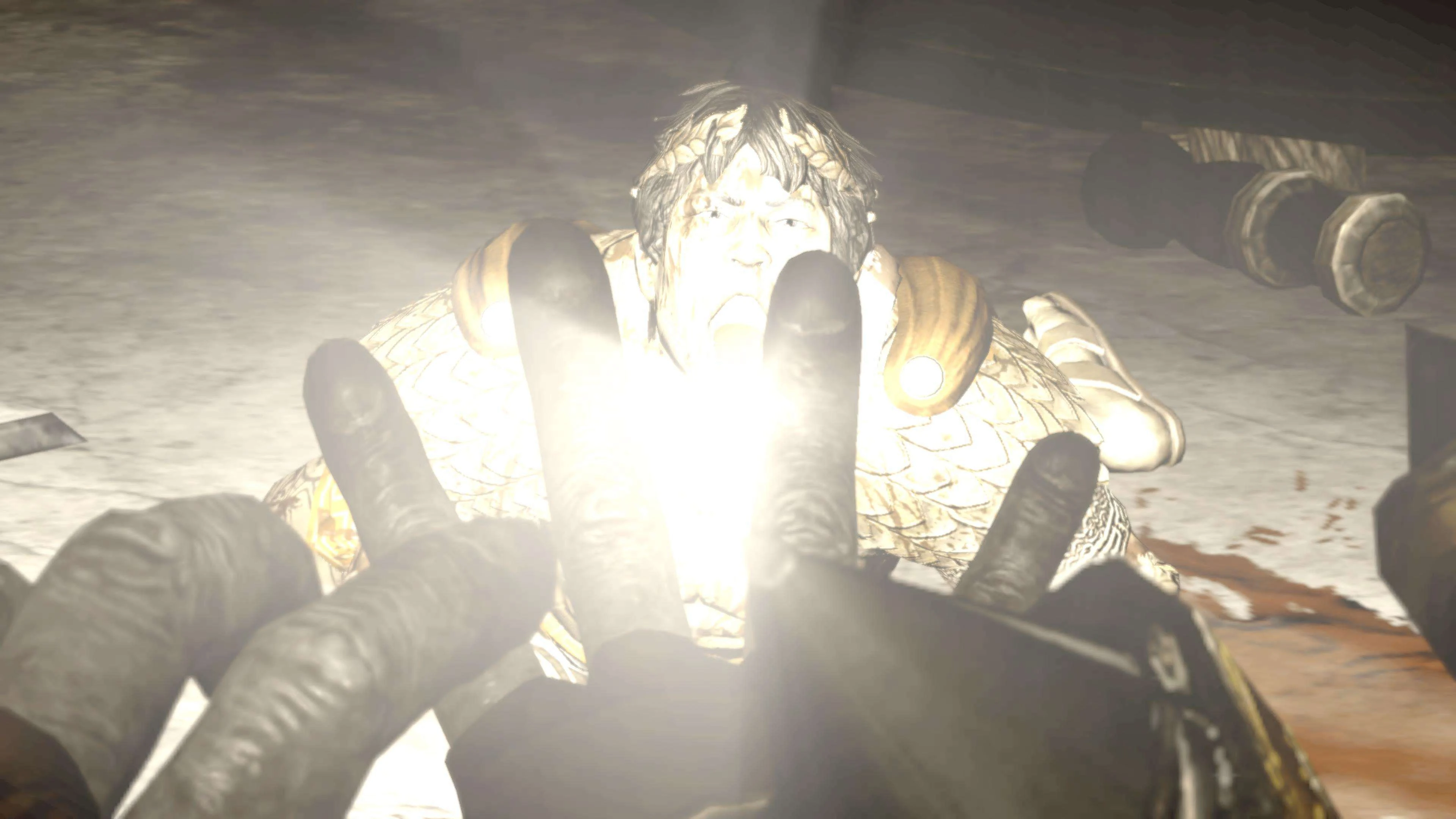

This article contains lore based on real-life sources of the Greek mythology as introduced from the God of War Greek era.
| “ | Behold the glory of Helios! | ” |
―Helios | ||
Helios (Greek: Ἥλιος) was the Titan God of the Sun and Guardian of Oaths. He is a major background character God of War: Chains of Olympus, a major antagonist in God of War III and a minor but key character in God of War: Ragnarök: Valhalla.
Helios was one of the strongest Gods within the lands of Greece, since he is the sun itself. He is the son of Hyperion and Theia, being only surpassed by Poseidon, Hades, Zeus and Ares.
Quick Answers
Who are the parents of Helios, the Titan God of the Sun?

Why did the character Kratos kill Helios in God of War III?
What are the physical traits of Helios as depicted in Greek mythology?
Who is the sister of Helios in Greek mythology?
What is the significance of the 'head of Helios' in the God of War series?
In Greek Mythology
In the Greek Mythology, the Sun was personified as Helios. Helios was the All-Seeing God of the Sun and was called upon witness when needed by the Gods. He was a son of the Titan Hyperion and Theia, brother of the Goddesses Selene, the Moon, and Eos, the Dawn and the father of Circe, Goddess of Magic. The names of these three were also the common Greek words for Sun, Dawn and Moon. Helios was imagined as a handsome God crowned with the shining aureole of the sun, who drove the Sun Chariot across the sky each day to earth-circling Oceanus and through the world-ocean returned to the East at night. Homer described Helios's chariot as drawn by his Fire Steeds. Still later, the horses were given fiery names: Pyrois, Aeos, Aethon, and Phlegon.
Although born a Titan, Helios is never depicted in the gigantic form of his parents.
As time passed, Helios was increasingly identified with the God of Light, Apollo, but the two remained separate beings. Helios' mythological Roman equivalent is Sol.
In the God of War Series
Early life
Helios was the son of the celestial Titans Hyperion and Theia and brother to Selene and Eos. Not much is known about his life in that ancient age. His father was the Titan of the Sun and one of the most powerful Titans in Cronos' pantheon.
The First Titanomachy
In Atlas' flashback of the Great War of the Gods and the Titans, Helios can be seen fighting alongside Hermes against the Titans during the final battle. The son of Hyperion, along with his sister Eos betrayed his kin, his father and his king, either convinced by fate and prophecy like his fellow defector Prometheus, or by an desire to usurp his father and take his place as one of the most worshipped and respected Gods, much like his cousins, the sons of Cronos were trying to do to their father.
God of the Sun
After the defeat of the Titans, his father Hyperion was thrown into Tartarus and the Primordial Fire left him, becoming one with Helios from that point forward. As the Gods of Olympus took control of the cosmos and established their rule, Zeus welcomed the new Sun God into the pantheon as a major and honored God.
Every morning, he would start his journey on his Sun Chariot, banishing the great and terrible Nyx from the night-sky. On his daily journey, nothing on Earth would escape his notice, not even the affairs and secrets of his fellow gods.
During the reign of Olympus, no deity in Greece, except Zeus, the Rain Bringer himself, was more revered and worshipped by all than Helios for his life-giving light. During the legendary Trojan War, Helios was called upon to banish a primeval evil from the world.
As a celestial deity, Helios was associated with the practice of magic among the mortals. His daughters Circe and Pasiphae were infamous witches across all of Greece. Most of the magic and rituals practiced by the Greeks, revolved around appeasing and beseeching the Gods, often in the name of solar and lunar deities for favor and blessings or divine interference.
Much like his younger cousins Zeus and Poseidon, the God of the Sun had many mortal offspring, with many becoming Kings or powerful mages and witches.
Wager with the Gods
Helios appeared in the God's wager, with a champion of his own. Although endowed with powers similar to Helios' own, his champion was killed in battle by Kratos.
Helios' Abduction
Helios was kidnapped by the mighty Titan Atlas by orders of the Goddess Persephone, who felt betrayed by the Gods for being forced to stay with her husband Hades, God of the Underworld, six months out of every year. His disappearance allowed Morpheus, the God of Dreams, who had been alerted of Persephone's plan, to take over the Mortal Realm and cast the Gods into a deep slumber. Helios was taken to the Underworld, where Atlas tried to use his power to destroy the Pillar of the World- and with it, the rest of the world and Mount Olympus and the Gods with it.
Before this plan could be fully achieved, Helios was saved by Kratos, who defeated Persephone and chained Atlas to the world in the Pillar's place. During the battle with Persephone, Helios was held in Atlas' hand, forming of an orb of light. The ray of sunlight he radiated was used by Kratos to weaken Persephone. After his final battle and Kratos returning Helios to the sky but fell off Helios' Chariot and nearly hit a cliff, though he was saved by the Gods. On the cliffs, an unconscious Kratos was stripped of his items by Helios and Athena.
Helios, praised his actions and grateful for Kratos' rescuing him, showed pity for his sacrifices, suggesting helping him further, only for Athena to disagree, claiming that "He'll live. They must."
Further Appearances
While Helios does not appear in person in Ascension, God of War, Ghost of Sparta or God of War II (save the ending cutscene), technically he is always visible whenever the Sun is in the sky.
In the novelization of the first God of War, Helios is briefly considered by Kratos to be perhaps allied with Ares, as one of the Parthenon's of Athens was burning "with the fury of a new Sun". The political intrigues of Mt. Olympus were mysterious and deadly for any mortals involved, but the Ghost of Sparta was not worried.
Two statues of the Sun God do appear in God of War II. The first is the great Colossus of Rhodes, which, after being brought to life by Zeus, Kratos fought and destroyed. The second was found in the Garden of the Gods, as Kratos traveled through the Palace of the Fates.
Helios briefly appears in person at the end, during the council of the Gods on Olympus, along with Hermes, Hades, Poseidon and Zeus. He is one of the first witnesses of the rescued Titans, his former family ascending Mount Olympus, led by Gaia and Kratos, who wanted revenge on Zeus for betraying him.
The Second Titanomachy
| “ | The Titans will fail again! | ” |
―Helios. | ||
The Gods quickly took action to defeat the Titans once again. Helios jumped onto his Sun Chariot and began attacking Gaia, throwing a fireball, combusting a fallen tree to prevent Kratos from escaping the undead soldiers that swarmed the Titaness' shoulder. Afterwards, Helios was also seen battling the Titan of Destruction, Perses, and successfully dislodged him off the mountain.
Helios again confronted Perses on the slopes of Olympia, holding an advantage over the Titan because of the blinding light he emitted. He occasionally aided the minions of Olympus fighting Kratos, throwing fireballs into the area. After having fought his way through the hordes, Kratos used a ballista to damage Helios' Sun Chariot, causing him to fly straight into Perses' hand. Perses then crushed Helios with his Chariot and threw him far into the city.
After traveling through the ruined city, Kratos discovers Helios once again; severely injured from being both crushed in Perses' hand and thrown into the city, rendering him unable to lift himself off the ground. A battalion of Olympus Sentinels converged on the wounded Helios, forming a shield that Kratos could not damage due to their Onyx shields. Kratos managed to break their shields by taking control of a Cyclops which had also arrived to assist Helios, using its club to batter through their defenses before ripping the Cyclops' eye socket out and killing it.
Death
Helios, pleading for his life, reminded Kratos of the debt he owed the mortal for saving him from Atlas years ago (in Chains of Olympus), and promised to repay Kratos if his life was to be spared as his life was spared from Atlas by Kratos. Kratos immediately demanded the location of The Flame of Olympus. Helios stated he would never reach it or kill Zeus and that he would forfeit his life trying; to which Kratos replied that his life is not the one Helios should worry about. Helios subsequently unleashed the power of the Sun, in an attempt to blind Kratos. Kratos, however, was able to block the light with his hands, slowly advancing towards the Sun God. When he got within range, Kratos began violently stomping his head, after which Helios begged him to stop.
Helios lies by telling Kratos that he would have to bathe in the Flames of Olympus in order to obtain its power. Kratos immediately saw through Helios' deceit however, yelling that Hephaestus had told him that the Flame would kill all who touched it. Helios tried to defend himself by claiming that Hephaestus was lying himself, as the "freak" had fallen from the graces of Olympus, so why would the Ghost of Sparta believe Hephaestus's word over a unfallen deity's like himself; Kratos retorted that it was exactly why he believed the God of Smith, for Hephaestus has nothing to gain or lose by lying to the Spartan, as they had both fell from Olympus' grace and therefore on even grounds.

Helios' brutal death
Failing to convince Kratos, and with a final gaze of defiance at the Spartan, Helios sternly told Kratos his death would not lead him to Zeus, only for Kratos to reply that is where he was wrong. Kratos then grabbed his head, and started to pull it fiercely, Kratos then, delivered a powerful hit on Helios' neck, breaking it, and then grabbed the God of the Sun's head again and started to pull it with all his might, Helios screamed in pain as Kratos brutally tore off his head, killing him. Helios' severed head screamed in pain and anger as Kratos observed it. With the God of the Sun's death, clouds blocked the sun, bringing darkness and storms across Greece.
Kratos would then use the late God's head to discover several secrets, blind enemies, and unlocking new paths throughout Olympus, as well as the Underworld. Most importantly, he used it to temporarily blind Cronos twice during his battle with the Titan. In the final battle against Zeus, the God of the Sun's head, while undamaged, has its light dimmed when Zeus destroyed Kratos' equipment except for the Boots of Hermes, the Blades of Exile and the Blade of Olympus.
What happened with Helios's head after Kratos has departed from Greece is unknown, but it has most likely rotted after some time and disappeared after some time has passed.
In Valhalla
| “ | Congratulations, old friend! You really are going places in Valhalla... | ” |
―Helios to Kratos | ||
An illusion of Helios, still a disembodied head but very much lucid, appears in in God of War Ragnarök: Valhalla. While in Valhalla, Mimir was teleported to a "forest" while the disembodied head of the Sun God took his place. Compared to the compassionate Mimir, Helios constantly mocks Kratos, confronting him over his past actions. Kratos forces Helios instead to assist him in combat as Mimir did. While in an illusionary version of the Chamber of Sacrifice in Pandora's Temple, Kratos locks him in a cage, much to Helios' dismay, as Kratos, remembering well from his past, has to make a sacrifice in order to access the next area. After fighting countless hordes of Undead Legionnaires, Kratos brings Helios to the fire mechanism that was used for the sacrifice but when he hesitated to do so, Helios was replaced by Mimir in the cage.
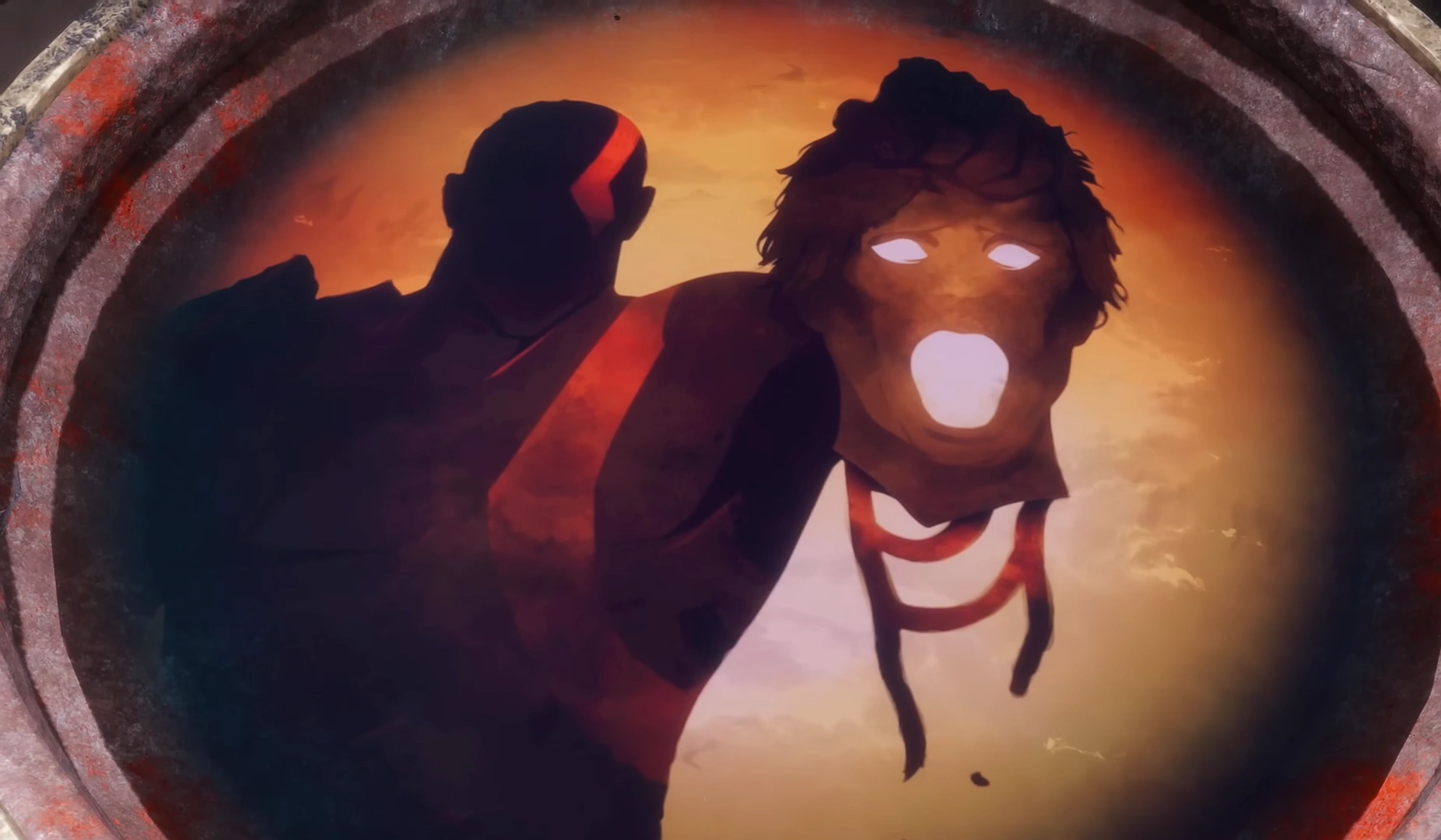

Helios takes Mimir's place again when Kratos to a pocket memory of the Olympian arena. Upon returning to the Chamber of Sacrifice, instead of placing Helios in the cage from earlier, Kratos instead places himself in the cage and offers himself as the sacrifice. Upon this, Kratos was teleported to another pocket area and Helios is replaced by Mimir again. Later, in the Helheim Sanctuary, Helios once again replaces Mimir. Returning to the pocket version of the Olympian arena, Kratos uses the ascending sands and returns to Týr with Mimir returning. At a big bowl of water, when a broken and damaged version of Helios' Shield was magically lowered into the water, an image of Helios' brutal death is shown. When Mimir notes to Kratos that his technique has improved immeasurably, the Spartan notes that he needed the Sun God's power to secure vengeance against the Gods of Olympus. Helios' voice bitterly tells him that not tearing his head off was an option and reminds Kratos that depriving Greece of the sun caused perpetual cold and darkness. Crops could not grow again, and Greece was ravaged by famine, angrily telling Kratos that he didn't care.
Personality
Helios was very proud of his status as "God of the Sun", as he was the one keeping external threats, such as Morpheus, away from Olympus. He also shows an honorable side, as he wanted to compensate Kratos for saving him from Atlas. However, after being consumed by the evils of the Pandora's box, Helios became arrogant and manipulative, as when he tried to manipulate Kratos into touching the Flames of Olympus and called Hephaestus a "freak" who was cast aside.
Powers & Abilities
| “ | FEEL THE POWER OF THE SUN! | ” |
―Helios attacking Kratos. | ||
As the God of the Sun and easily one of the most important deities in the Greek Pantheon, Helios is implied to be an incredible force to be reckoned with. He may have presumably possessed all of the standard abilities of a God, including immortality, enhanced physical abilities, and great endurance, however as a natural born Titan, he presumably possesses greater abilities. Although while this may indeed be the case, Helios himself does not receive an opportunity to display many of these traits, as his appearances in God of War III were rather brief and did not involve any scuffles with Kratos.
Since he is the literal aspect of the Sun, should Helios be destroyed or abducted, this would cause the Sun to be blocked out by heavy rain clouds and violent storms and even disappear entirely (as shown by his death at the hands of Kratos and his abduction in Chains of Olympus). In addition to all of his primary powers and abilities, Helios also possessed an immense flying chariot with flaming horses that he would ride with very masterful skill into battle at great speeds. He was also in possession of his trademark Sun Shield (worn on his left forearm), which he could use to deflect any oncoming attacks.
- Photokinesis/Heliokinesis: As the personification and Titan God of the Sun, Helios naturally has control over different aspects of the sun, such as fire or more specifically sunlight; He also displays the ability to unleash an incredibly bright light from his body which he could use to utterly blind his enemies and illuminate even the most darkest of places (as demonstrated by Kratos using his decapitated head as a makeshift lantern). His solar powers are so strong that they can even forcefully banish Nyx, a Primordial Goddess, and illuminate the infiniteUnderworld.
- Pyrokinesis: Helios was shown to be able to hurl massive blasts of light at his foes that would explode in fiery glory that proved to be very effective when he is seen battling the Titan Perses at different points in the game.
- Prayer Empowerment: As with all the Olympians, Helios gains power through worship and sacrifices. It is stated that he was behind only Zeus in mortal worship due to his life-giving Sunlight. Even the dead in Hades prayed to him during God of War III to stop Kratos’ cataclysmic rampage.
- Banishment: During the Trojan War, Helios was called upon to banish a primeval evil from this realm.
- Clairvoyance (during daytime): Helios knows and sees all that transpires on the Earth during his journey and was able to tell Demeter of her daughters abduction.
- Superhuman Durability: However, out of all the abilities he apparently possessed, quite possibly the most prominent attribute displayed by Helios is immense physical durability, as he was shown to have been able to survive being both crushed in Perses' fist and even thrown at presumably high speeds into a mountainside (although he did suffer from some injuries as a result of this). This proves that Helios, at full strength, was a truly powerful opponent to face and would have most likely put up a rather impressive fight should he have had the opportunity to face the Ghost of Sparta in a more proper setting where the odds would have been more evenly matched.
Gallery
God of War: Lost World

God of War III


.jpg "Helios (comics).jpg (257 KB)")
God of War Ragnarök: Valhalla


Concept Art


Trivia
- He is voiced by Dwight Schultz in Chains of Olympus and by Crispin Freeman in God of War III, where his face is modeled after Freeman's. Freeman returned to voice the illusion of Helios in God of War Ragnarök: Valhalla, where his likeness was once again used.
- In Chains of Olympus, Helios' abduction led to the disappearance of the Sun from the sky. In God of War III, Kratos killed Helios by ripping his head off, causing the sun to be blocked by dark clouds, and an endless torrent of rain to pour down, then followed by thunderstorms and tornadoes. In the demo version however, after Kratos rips Helios' head off, the sky seems to have been spared from any changes.
- During God of War III, its seen that Helios can both drive the Sun Chariot in the Heavens and be present on Earth and fight the Titans at the same time. That may be similar to Zeus, who has several split roles which allow him to focus on his many duties of maintaining mortal existence, like hospitality and justice.
- Despite Helios' major role in Chains of Olympus, he does not make any actual appearances until the post-credit cutscene and is only shown from the knees-down.
- Helios has unique blood as his blood possesses golden sparkling sunlight. This is seen after Helios was wounded by Perses.
- Right in front of Helios, while lying wounded on the rooftop, lies the Sun Shield Kratos used in Chains of Olympus, which can be retrieved as a Godly Possession.
- In a form of cruel irony, Helios' death actually did lead Kratos to Zeus, since the Spartan used the God's head as a lantern to light his way through Olympus.
- The Evil that infected Helios is most likely Deceit, since he lied to Kratos about The Flame of Olympus.
- Even though appearing in very few mythology stories, he was still regarded as the God of the Sun, with the Colossus of Rhodes being built in his image on the eponymous island, where he was worshiped and said to be born.
- Helios and his sisters, Eos and Selene, are cousins of Zeus, Poseidon, Hades, Demeter, Hera, and Hestia, since Hyperion and Cronos were brothers.
- In the God of War II ending cutscene, where Zeus gathers his fellow Gods to face Kratos' threats, Helios's appearance is slightly different. He gains a helmet in God of War III and his armor is brighter.
- Similar to Athena, Helios once sided with Kratos, aiding him in his quest to stop Persephone. They later turned against him when Kratos sought to kill Zeus after being betrayed. Though, Athena after her death would eventually help Kratos destroy Zeus even if it was clear she was infected by Greed.
- In one of the "Making of..." videos for God of War Ascensions multiplayer, a model for an armored man bearing a shield can be seen in front of the fifth pillar. It is believed this may have been Helios but it unknown why he was cut from the game.
- If one looks carefully, Helios appears to have the edges of a sun tattoo showing over his breastplate, and on his arms and legs.
- Ironically, Kratos had blocked the sun and killed the same God who he had saved and had restored the sun in Chains of Olympus.
- When Kratos uses Helios' Head, the faint screams of the God can still be heard coming from the decapitated head. A possible conclusion from this is that Helios is somehow still alive as a disembodied head which may also explain how his head is still able to create sunlight whereas the other God's powers become inert after death.
- Helios and Hera are currently the only antagonists and only Gods who did not have a battle with Kratos; they were already weakened by a Titan and drinking respectively by the time they were found.
- Helios revealed he hates Sirens because he doesn't like their song attacks.
| |||||||||||||||||||||||||||||
| |||||||||||||||||||||||||||||
| |||||||||||||||||||||||||||||
| |||||||||||||||||||||||||||||