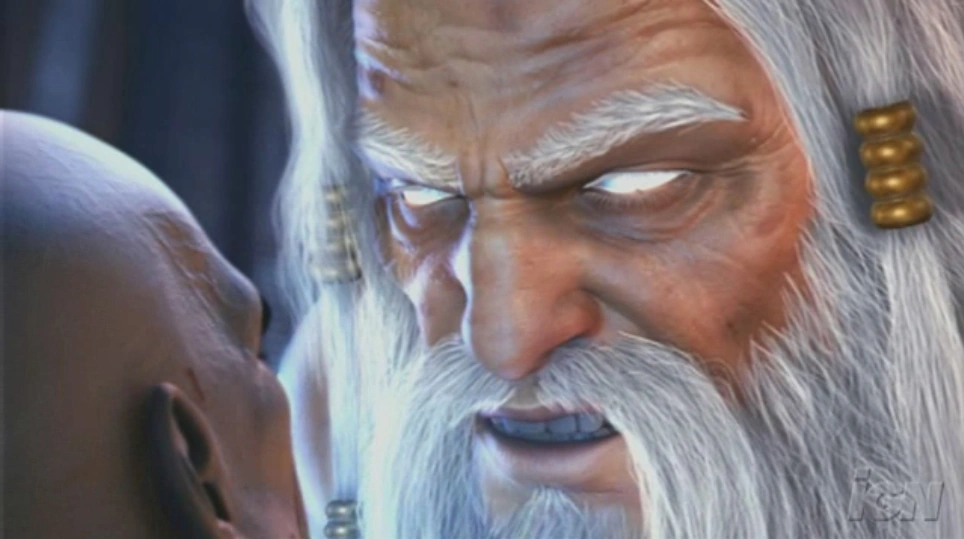

This article contains lore based on real-life sources of the Greek mythology as introduced from the God of War Greek era.
| “ | My brothers. We were forged in victory. A victory that ended the great war and brought forth the reign of mount Olympus. Born from the depths of the underworld, rooted in the river of souls, our mountain emerged out of the chaos. As it grew, so too did the might of the Olympians. We created a world of peace, a world of prosperity. A world that lives in the shadow and safety of my mountain. A mountain that has come to be the absolute measure of strength and power. Now, on this day, that power is to be tested. The mortal, Kratos, seeks to destroy all that I have wrought. Brothers, put aside the petty grievances that have splintered us for so long. We will unite. We will stand together. And I will wipe out this plague! Olympus will prevail! | ” |
―Zeus to his fellow gods, Poseidon, Hades, Helios and Hermes. | ||
Zeus (Greek: Ζεύς/Δίας) was the King of Olympus and the ruler of the Greek Pantheon, as well as the God of the Sky, Thunder, Lightning, Storms, Hospitality and Heavens. Youngest son of the Titans Cronos and Rhea, he was the brother of Hades, Poseidon as well as Demeter, Hestia and Hera - whom he would also wed. He fathered a line of all-powerful deities such as Athena, Ares, Hephaestus, Persephone, Zagreus, Aphrodite, Artemis, Apollo, Hermes and Dionysus as well as many mortal children such as Hercules, Kratos, Deimos, Perseus, Pollux, Peirithous, Minos and countless others.
Destined to overthrow his mighty father and bring forth the reign of the Olympian Gods, Zeus rescued his siblings from Cronos and engaged the Titan Gods into a cataclysmic conflict that would shape Greece itself. Victorious thanks to the superior powers of the Gods and the Blade of Olympus, Zeus banished the Titans into the Tartarus for eternity, while he would decide the fate of the world with his brothers Hades and Poseidon. Zeus would ultimately get the lion share by becoming the King of the Gods. However, the Great War against the Titans also unleashed the most dangerous evils upon the world, and Zeus commanded his son Hephaestus the creation of the legendary Pandora's Box, powerful enough to contain them.
Born from the depths of the Underworld and rooted in the River Styx, the mighty Mount Olympus emerged from the Chaos and was to become the golden heaven from where Zeus now ruled over both his fellow gods and mortals alike, a testament of his new power as the ruler of Olympus and God of the Heavens. He notably oversaw the creation of the Chain of Balance who further linked the fate of the Underworld to Olympus itself, and commanded the creation of Pandora's Temple on the very back of Cronos in order to protect the Pandora's Box, on the advice of Hephaestus.
Zeus is introduced in God of War (2005) as a minor supportive character under the guise of the Grave Digger, notably giving Kratos the means to escape the Underworld. He also grants the Spartan a fraction of his godly powers in the form of Zeus' Fury, and witnesses the Ghost of Sparta becoming the new God of War when the latter is offered the seat of Ares. But the opening of the Pandora's Box had dire consequences upon the Pantheon as a whole and Zeus himself fell prey to one of the evils contained within; Fear itself. A fear of the marked warrior foretold the destruction of Olympus.
This is why Zeus then returns in God of War II as the main antagonist of the series. Now aware of the threat posed by his son, the King of the Gods tricked Kratos into giving up most of his godly powers into the Blade of Olympus to allow him defeat the mighty Colossus of Rhodes. Taking advantage of the severely weakened Spartan, Zeus demanded unwavering loyalty - a request deemed unacceptable by Kratos. The King of Olympus then promptly killed the Ghost of Sparta, promising him that he would never challenge Zeus' power.
However, Kratos managed to change his fate with the help of the Titans and by defeating the Sisters of Fate, returning in time to prevent his death at the hands of Zeus. The latter engaged the Ghost of Sparta in a fierce duel that would have ended by the death of Zeus, had Athena not intervened to sacrifice herself. The King of the Gods forcefully fled to Olympus and urged his brothers to fight in what would become known as the Second Titanomachy. Zeus makes his final appearance in God of War III, uniting all of Olympus against Kratos and the Titans in a desperate attempt to change the course of history. He notably witnesses his fellow brothers and gods fall one after the others at the hands of his son, unleashing waves of cataclysms upon the Greek World in the process. Zeus confronts his son for the control of Pandora, but following an absolutely brutal fight he ironically ends up impaled by the very blade he used to kill the Spartan.
But the King of Olympus wasn't going down that easily, and under his astral form he finally overpowered Kratos, using fear to annihilate his opponent. However, the latter had deep inside him a power that Zeus could not fight off: Hope. Understanding that everything was lost and having given up the will to fight his son, Zeus finally accepted his fate and merely let Kratos beat him to death, paying the ultimate price for the countless and unforgivable mistakes of a depraved and dysfunctional family. The death of Zeus unleashed complete Chaos upon the Greek World, now without purpose and in a state of utter destruction. However, the demise of Olympus combined with the power of Hope released by Kratos upon the survivors paved the way for the rebirth of a world with very few surviving deities left.
Quick Answers
What is Zeus the god of in Greek mythology?

Who are the parents of Zeus in Greek mythology?
Who are the siblings of Zeus?
Who did Zeus marry in Greek mythology?
Who are some of the all-powerful deities fathered by Zeus?
Greek Mythology
In Greek Mythology, Zeus was the King of the Gods, ruler of Olympus, and God of the Sky, Heavens, and Lightning. Zeus was youngest of his six siblings. His symbols were the Lightning bolt, the Eagle, the Oak Tree and the Bull. Zeus was the youngest son of Cronos and Rhea. He was very well known for his erotic escapades with beautiful mortal women, resulting in many godly and heroic offspring, including Athena, the Graces, the Horae, the Litae, the Muses, the Moirai, Ares, Hephaestus, Enyo, Eris, Eileithyia, Hecate, Hebe, Angelia, Aphrodite, Persephone, Zagreus, Artemis, Apollo, Hermes, Dionysus, Perseus, Heracles, Arcas, Pollux, Helen, Minos, Rhadamanthus, Sarpedon, Aeacus, Damocrateia, Pandia and many others. When the loss of his older siblings by their father Cronos became too great for Rhea to bare any longer, she hid him from Cronos far away, giving him a stone to swallow instead. Once grown, the young God sought to free his siblings and overthrow his father. Disguised as a cup-bearer, Zeus mixed a brew into Cronos' wine, causing him to vomit up the stone that had taken his place, and then his siblings. Overthrowing the Titans, Zeus castrated Cronos and banished him to Tartarus. Later drawing lots with his brothers Poseidon and Hades to determine who would rule the skies, oceans, and the Underworld, Zeus won the sky, and became the King of Olympus.
Some sources claim that Zeus is technically the eldest, due to being the only child to not be kept from the world and trapped in their father's stomach, though this is disputable, and some claim fabricated by Zeus himself to lend validity to his claim to the sky before he and his brothers decided to draw lots.
His counterpart in Roman Mythology is Jupiter and was known as Ba'al Hadad to the Canaanites/Israelites, in Norse Mythology, his counterpart is Odin or Thor.
In the God of War Series
Birth
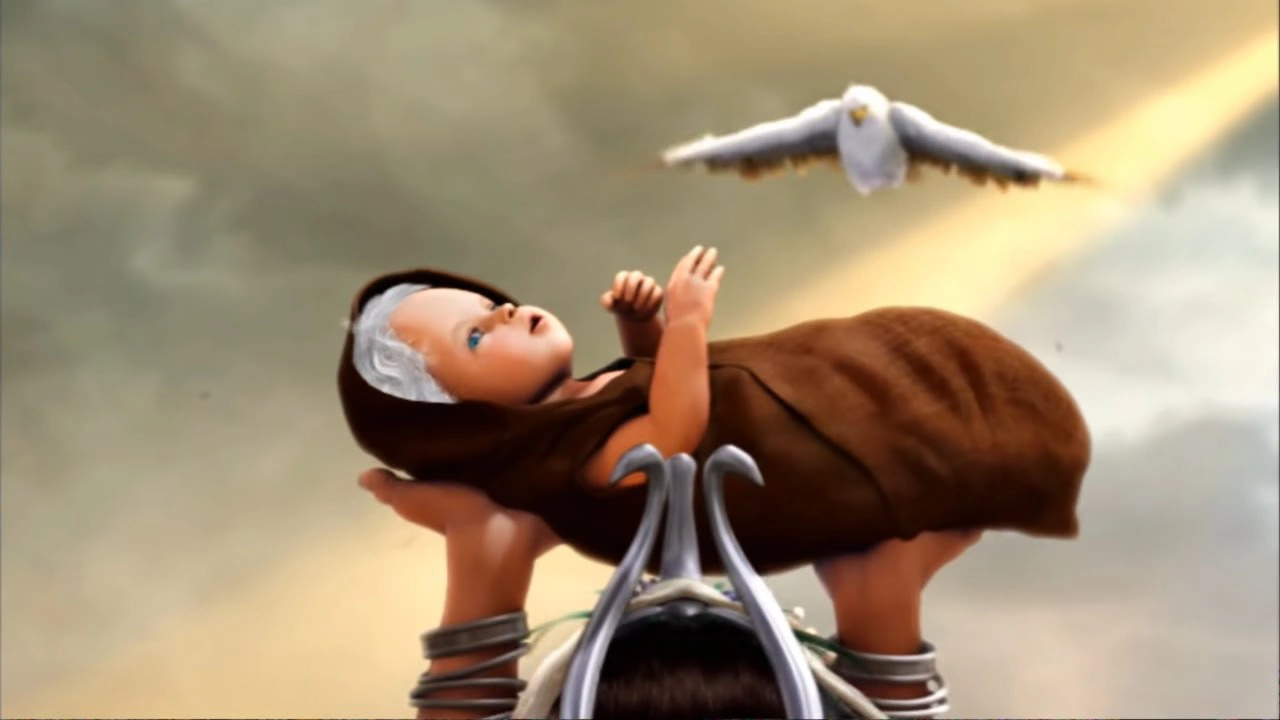
An infant Zeus is taken away by an eagle at his mother's command.
During the reign of the Titans, Cronos was informed of a prophecy foretelling his eventual downfall at the hands of one of his own sons. To prevent this fate, Cronos swallowed all of his children, one by one.
When Zeus was born, his mother Rhea was distraught at the loss of her first five children and devised a trick to save him by letting an eagle carry the baby Zeus to safety, while he was replaced by a stone wrapped in cloth which Cronos devoured, having mistaken it for Zeus. The eagle then carried the infant Zeus to Gaia so that he would be raised and blessed with the strength to stand up to Cronos. During this time, Zeus developed a deep hatred for his father, and looked forward to the day he would finally release his siblings; one of Zeus' drawings inside Gaia portray him opening Cronos's belly and setting them free.
The Great War
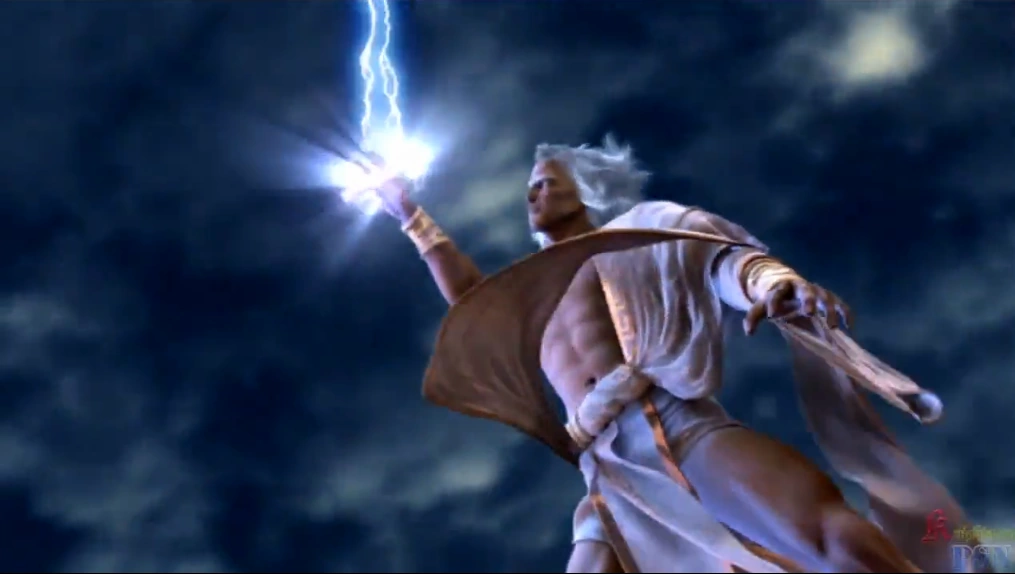

Zeus during The Great War
As he came of age, Zeus decided to put his plans into action. Zeus freed his siblings and declared war on all of the Titans, thus betraying Gaia. The new rulers of Greece, the Gods, calling themselves Olympians, fought against their predecessors with great ferocity and power. The battle between the Gods and the Titans formed the landscape of Greece, shaking the earth with massive earthquakes and crumbling mountains. To end the war, Zeus created the all-powerful Blade of Olympus, which was used to banish the Titans to the foulest pits of Tartarus. Zeus was wise to not repeat his fathers sin of kin-slaughter and spared Cronos life, in hopes of not provoking Gaia's immortal curse for those who slay their family. However, the Evils borne from the war posed another threat to Olympus, so Zeus commissioned Hephaestus, the Smith God, to build Pandora's Box in order to house the Evils. Unbeknownst to him, Athena called forth a power that transcended any God, Hope, and placed it inside the box to counteract the Evils should the box ever be opened. When Zeus asked Hephaestus where to hide the box, the Smith God suggested that it should be placed on the back of Cronos. Using the architect Pathos Verdes III, he constructed an enormous temple to house the box and then chained it to the Titan's back, sentencing him to wander the Desert of Lost Souls for all eternity. Little did the great Zeus know that the events that had just transpired would eventually doom him.
After the Great War
Becoming the King of the Olympian Gods
| “ | Is this the best you can do, Father!? You send a broken mortal to defeat ME!? The God of War!? | ” |
―Ares. | ||
The gods chose Mount Olympus as their official residence, and the Elder Cyclopes built magnificent palaces there for them all. As a result, the gods started to call themselves the Olympians. Shortly thereafter, Zeus had a private meeting with his brothers, Poseidon and Hades, and the three brothers agreed to divide the world between themselves. Although it was Hades' birthright (as Kronos' eldest son) to be named his father's successor, he agreed to divide the Titan King's former domain with his brothers. Hades received the Underworld, Poseidon seized the seas and Zeus claimed the heavens as his domain. Shortly after this division, the three sons of Kronos came to be known as "The Big Three." However, Zeus' authority was recognized as superior to that of his brothers (probably due to him freeing his brothers and sisters), and so he became the king of the Olympian gods.
Marriage to Metis
Zeus took his childhood sweetheart Metis as his wife after the Titanomachy. Metis had served the King of Olympus as his adviser and mentor for much of his life. When his wife was pregnant, Zeus learned from her that she would give birth to two children; first a daughter and then a son who would one day overthrow him. Like his father and grandfather before him, Zeus tried to forestall this fate and, as Metis was about to give birth to their daughter, he tricked her into transforming into a fly and promptly swallowed her. Trapped inside Zeus, Metis gave birth to their daughter, Athena. Centuries later, after he had married Hera, Zeus suffered an unbearable headache and to relieve him of it, Hephaestus split Zeus' head open, and Athena, the goddess of wisdom and warfare, sprang forth.
Relationship with Demeter
Shortly after ending his marriage with the Metis, Zeus courted his lovely sister Demeter. After transforming into a serpent, he successfully impregnated her. Zeus and Demeter's affair resulted in a beautiful daughter named Persephone. After the birth of Persephone, Zeus courted and impregnated Demeter again, resulting in a beautiful son named Zagreus. Though their relationship eventually ended, Demeter was still overjoyed as she loved Persephone and Zagreus dearly and would spend all her spare time with them. Their daughter, Persephone, grew up without want, always staying close to her mother, and later became the goddess of springtime and flowers, and her mother even shared some of her power over the earth with her. Their son, Zagreus, was closer to his father, acquiring a personality carefree attitude and his father's charm, however, Zagreus still spent a lot of time with his mother and sister. Demeter cherished her children as the most important thing in her life, and spent all of her time with them.
Meets Callisto
At some point, Zeus had an affair with a mortal woman named Callisto. The circumstances are unknown, but the affair resulted in two sons. The oldest one was Kratos, a mighty warrior with unstoppable rage and ambition. Hera, displeased with Zeus for fathering yet another illegitimate child and (correctly) predicting that his existence would eventually doom Olympus, demanded that he kill the boy immediately after his birth. Zeus, at this point still a somewhat benevolent and caring figure, took pity on the child and refused. Around the same time, however, the Oracle foretold that one of Zeus' sons, a "marked warrior", would rise up against the King of the Gods and kill him. Noticing the strange birthmarks on the youngest son of Zeus and Callisto, Deimos, he sent Ares and Athena to Sparta in order to capture the boy and bring him to Thanatos.
Later on in Kratos' life, Zeus is implied to have met him personally during The Wager of the Gods. Kratos had encountered a mysterious Healer who supplied him with Apollo's Flame, which the Spartan needed for his trip to save his ill daughter. A major hint that it was by the Healer calling Kratos "my foolish son" and warning him that gods will impede him.
Years later, Kratos had brutally slain his own family in blind anger due to a scheme by Ares, the newly christened "Ghost of Sparta" pledged to serve the Gods of Olympus, including his father Zeus, in the hopes that they would relieve him of his nightmares. This can be compared to the fate of his half-brother Hercules, who had also killed his family in a madness caused by Hera.
About halfway through Kratos' penance, Zeus was one of the many Gods that fell victim to an enchanted slumber, orchestrated by Morpheus when the Sun God, Helios, was kidnapped by the Titan Atlas. Kratos eventually discovered that this was the work of Persephone, who intended to use the Sun God to empower Atlas in order to destroy the Pillar of the World and bring an end to all life, as well as her own suffering. Fortunately for Zeus and the other gods, Kratos was able to defeat the Queen of the Underworld and save Helios, returning him to the sky and forcing Morpheus to retreat. What they did not know was that Kratos had been forced to relinquish any hopes of reuniting with his beloved daughter in the process of saving the world, pushing his disillusionment with the Gods ever closer to open hatred and rebellion.
Near the end of Kratos' service, Ares besieged the city of Athens in the hopes of gaining Zeus' favor over his sister, Athena. Zeus, having forbidden the Gods from waging war on each other and fearing the possibility that Ares might be the "Marked Warrior" who would overthrow Zeus, allowed Athena to receive help from Kratos. Athena told him that killing Ares would complete his penance and rid him of his past sins. During his quest, Kratos met Zeus himself within the damaged city of Athens, where he was given Zeus' Fury, the ability to wield and throw powerful lighting bolts. In addition, Zeus took on the mortal guise of a Grave Digger and created a portal to the Underworld via a grave he claimed to be digging for Kratos, allowing the Spartan to escape the realm of the dead (after Ares impaled the Spartan with a pillar) late in his adventure.
Retrieving Pandora's Box from Kratos' dead corpse, Ares yelled to the skies, cursing his father for constantly favoring Athena and asking Zeus if he could finally see what his son was capable of. Ares declared that he would not hesitate to use the Box against Olympus itself, only for Kratos to return from the Underworld and use a bolt of Zeus' Fury to reclaim it. Kratos opened the ancient artifact and harnessed its power to kill Ares, his former master. Zeus and the Gods guided Kratos to kill Ares, as they had incorrectly believed that he was the only real threat to Olympus. The Olympians rewarded Kratos by forgiving him for the crime of killing his own family (although, to Kratos' dismay, they were unable to remove the horrible memories from his mind), and made him the new God of War.
Zeus' Betrayal
- See also: God of War: Betrayal and God of War II
It was believed that Deimos is the Marked Warrior so it is very possible that Deimos' death and Kratos' destructive and aggressive behaviour led Zeus into believing that Kratos is the Marked Warrior who would seek revenge against the Gods of Olympus and one day destroy them. Another moment which led Zeus betray Kratos is when Kratos told Athena that the Gods would pay for that... Even though Kratos did not know that the grave digger was actually Zeus, he was there when Kratos exclaimed these words. Later on in Rhodes, Zeus tricked Kratos, told him to cast his powers into the Blade of Olympus and with that act, Zeus found a way to take it and kill Kratos as long as his powers would not be inside Kratos himself.
- Zeus: "You must vow to forever serve me!"
- Kratos: "I serve no one!"
- Zeus: "Then you leave me no choice!"
It is later revealed that Zeus and the other Gods had fallen prey to the Evils locked away in Pandora's Box after Kratos opened it to kill Ares. Apparently, Zeus didn't realize that if Kratos used the Box, the Evils would be released onto them; he had instead hoped that the Evils would fuel Kratos. As a result, Zeus was overwhelmed by his personal plague: Fear. Overcome with extreme paranoia and frightened by Kratos' increasingly destructive behavior, Zeus soon realized that Kratos would be the one to perpetuate the cycle of son killing father. Just as Cronos killed Ouranus, and as Zeus himself defeated Cronos, the King of the Gods expected that Kratos, infuriated by the revelation that not even the Gods could end his nightmares, would kill Zeus.
Some point after Ares' death, Zeus confronted his son Hephaestus and brutally interrogated him, after suspecting that the Smith God lied to him by stating that storing Pandora's Box at Pandora's Temple on the back of Cronos was the best option, when really, the Flame of Olympus was the most crucial place to store the box with Hephaestus' forged daughter, Pandora, being the key to the flames. As punishment for his deceit, Hephaestus was banished to Tartarus by Zeus as well has having his daughter, Pandora, taken away by the latter. With Pandora's Box retrieved by Kratos from its temple, Zeus would also have his father Cronos spend the remainder of his eternity tortured in the foulest regions of Tartarus.
Zeus' fears were further exacerbated by Kratos' open defiance of the other Gods, ignoring their demands that he cease his relentless conquest and destruction of Greece. During Kratos' attack on Rhodes, Zeus devised a scheme that would put an end to Kratos' reign. He disguised himself as an eagle and drained a portion of the new God of War's power, transferring it to the Colossus of Rhodes. This caused the statue to come alive and attack the now mortal-sized Kratos, who initially believed that Athena was the one who betrayed him. Zeus further took advantage of the situation by tricking Kratos into infusing the rest of his god powers into the Blade of Olympus, the weapon that brought an end to the Great War of the Gods and Titans. Upon doing so, Kratos destroyed the Colossus with ease, but was crushed under the crumbling statue's hand soon afterwards, weakening the Spartan to the brink of death. Thus, in order to survive, he needed to retrieve the Blade, which had been knocked out of his grasp by the falling Colossus.
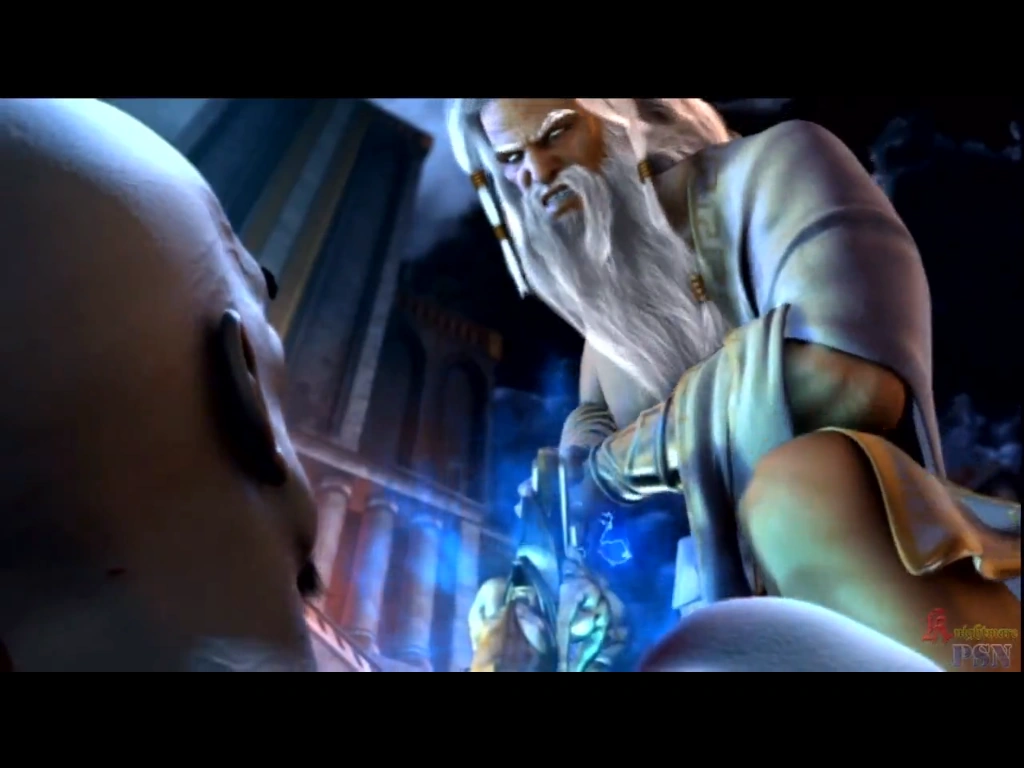
Zeus betrays Kratos
As Kratos was about to reach the Blade, Zeus finally revealed himself, admitting responsibility to Kratos for everything that had just transpired. Zeus claimed that his motivation was to "undo Athena's mistake" (presumably the act of making Kratos a God) and prevent Ares' fate from becoming his own. The King of the Gods then ordered the Spartan to submit, but an outraged Kratos refused, causing Zeus to stab him with the Blade of Olympus. As Kratos slowly died, Zeus expressed his disappointment in Kratos, insisting that the Spartan warrior had made the wrong choice. However, Kratos continued to insult the King of Olympus, and Zeus responded by stabbing him with the Blade again, telling his son that the cycle has come to an end, and everything that he ever knew would now suffer because of his sacrilege. Zeus then destroyed all of the soldiers present, while a dying Kratos promised that he would have his revenge as Zeus leaves and casts Kratos into the Underworld.
Upon leaving Rhodes, Zeus proceeded to destroy Sparta not only because the Spartan people worshipped Kratos, but to further punish Kratos himself. After destroying Sparta, Zeus believed he finally dealt with Kratos and returned to his throne on Mount Olympus.
Kratos' Revenge
| “ | Come down here and face me now, Zeus!! | ” |
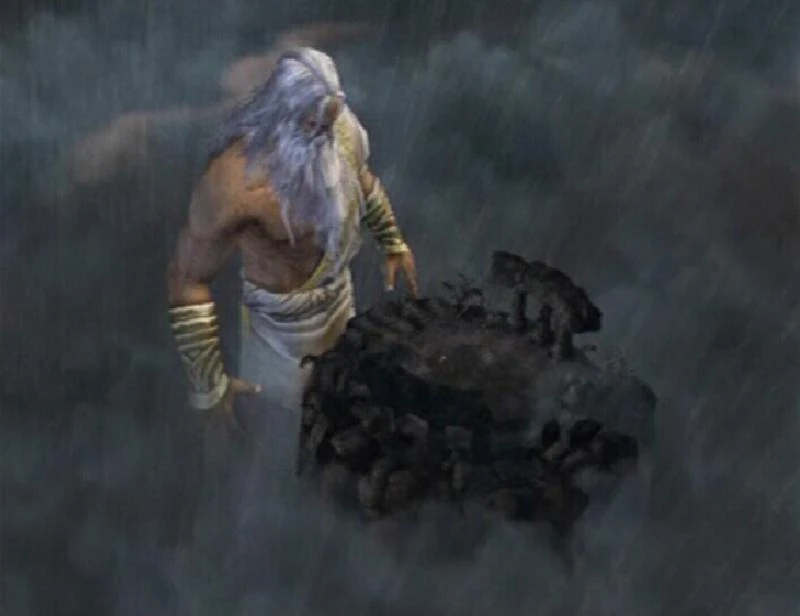

Zeus morphing into a gigantic form to combat Kratos.
Unfortunately for Zeus, Kratos was far from finished. Aided by Gaia and the Titans, he returned to life, journeyed to the Island of Creation, and killed the Sisters of Fate. With the Power of Time itself at his command, Kratos returned to the moment when Zeus tried to stab him with the Blade of Olympus, emerging from a portal and knocking the off-guard God King to the ground. Surprised at this development, Zeus presumed that the Sisters of Fate had unexpectedly aided him. Kratos, pulling the Blade of Olympus from his past self, told Zeus that the Sisters were dead. The King of Olympus declared that he had underestimated Kratos but will not make the same mistake again and the two combatants charged towards one another, taking to the skies as they fought. They ended up on the Summit of Sacrifice, where an epic battle began. Zeus magically grew in size and bombarded Kratos with attacks with the aid of several Harpies, but was forced to revert back to normal form after Kratos drained his vitality with the Blade of Olympus. Still defiant, Zeus fought back strongly, overpowering and disarming Kratos of the Blade several times, but Kratos fought Zeus furiously and managed to deliver several powerful blows, promising to kill Zeus for his actions. Enraged at his defiance and unable to finish him off, Zeus unleashed his full might on the vengeful warrior, reverting back to his giant form and unleashed a powerful lightning storm on Kratos.
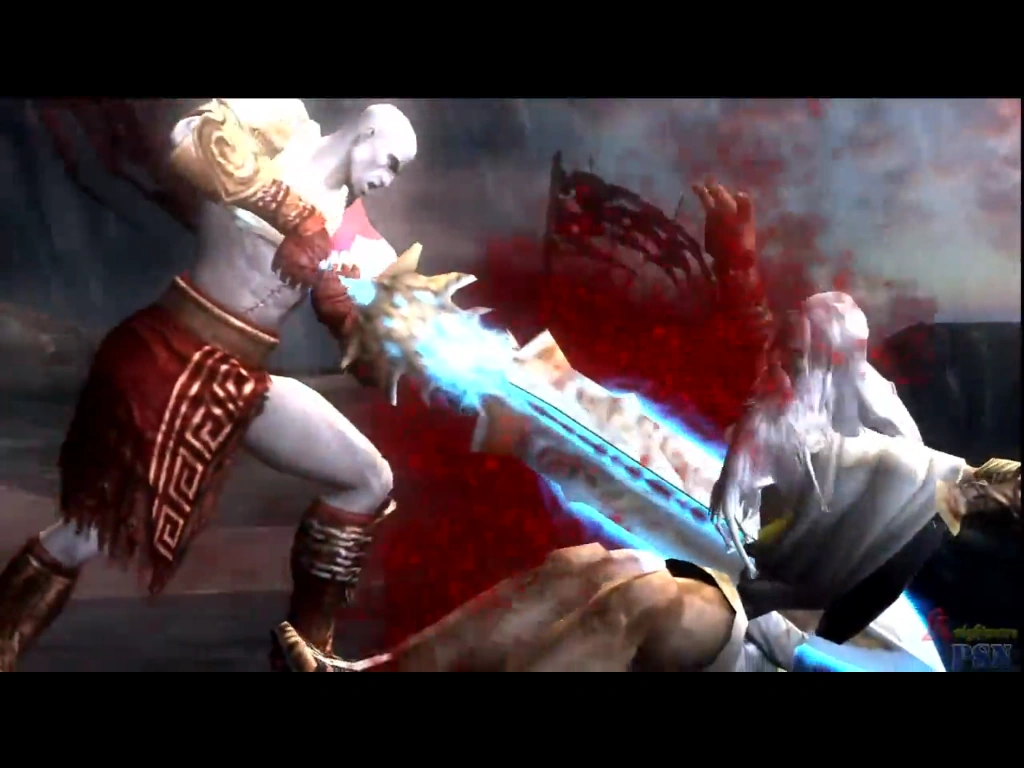
Kratos stabs Zeus with the Blade of Olympus.
Unable to overpower Zeus, Kratos resorted to military tactics, a feigned surrender that Kratos knew would immediately stop the onslaught. Kneeling in front of the Blade of Olympus, he asked Zeus to end his life and release him from his torment. Granting what he thought was Kratos' final request, Zeus agreed to release him from his life, but insisted that his torment was just beginning. The Great God was tricked, however, and the Spartan, using the Golden Fleece to deflect a small remainder of Zeus' lighting, overpowered and took the Blade from Zeus, pinning both of his arms to a rock and began to impale Zeus with the Blade of Olympus, intending to kill him the same way he did to him until Athena intervened.
Zeus took this opportunity to free himself, warning the Spartan that he had started a war he had no hope of winning. Zeus then attempted to flee, but Kratos immediately pushed Athena aside taking the Blade to make one more attempt on the severely weakened Zeus. However, Athena jumped in the way at the last second, sacrificing herself to save her father who took the moment to flee. Kratos was far more affected by Athena's death than Zeus, who coldly ignored her and narrowly escaped back to Mount Olympus though he did express concern for her later.
Just before she died, Athena told Kratos that he was compelled to kill Zeus just as Zeus did to Cronos, for Kratos was Zeus' son. This was the cycle Zeus had mentioned when he killed Kratos before. Declaring that no son should ever destroy his own father (ignoring the fact that Zeus had already done the same to his own father), Athena told Kratos that Zeus must live so that Olympus would prevail. God after God would deny Kratos his vengeance, for they would protect Zeus for the sake of Olympus. Watching the fallen Athena disintegrate, Kratos felt betrayed yet again and, using the Loom Chamber, he returned to the first Great War urging the Titans to accompany him back to his own time, where a wounded Zeus had fled back to Mount Olympus.
The Second Great War
- See also: God of War III
| “ | My Brothers, We were forged in victory. A victory that ended the Great War and brought forth the reign of Mt. Olympus. Born from the depths of the Underworld, rooted to the River of Souls, our mountain emerged out of the Chaos. As it grew, so too did the might of the Olympians. We created a world of peace, a world of prosperity, a world that lives in the shadow and safety of my mountain. A mountain that has come to be the absolute measure of strength and power. Now, on this day, that power is to be tested. The mortal, Kratos, seeks to destroy all that I have wrought. Brothers, put aside the petty grievances that have splintered us for so long. We will unite, we will stand together, and I will wipe out the plague! Olympus will prevail! | ” |
―Zeus | ||
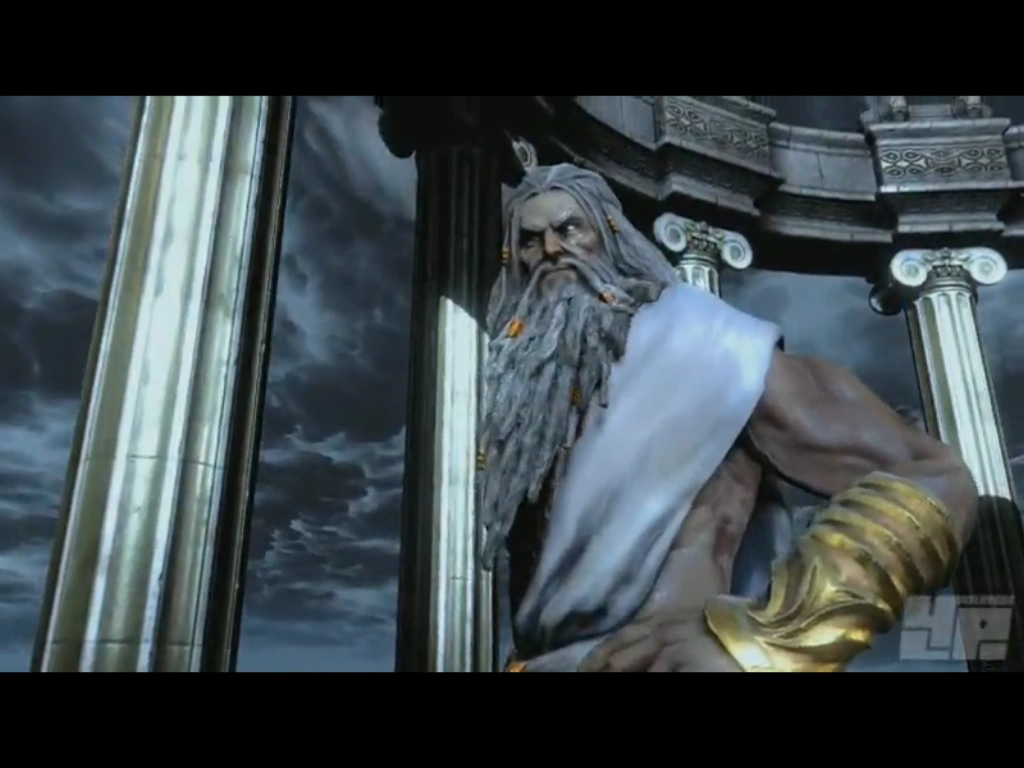
Zeus during the Second Great War
After the events of God of War II, Zeus returned to Olympus and told Poseidon, Hades, Hermes, and Helios about Kratos' intentions, telling them that they have to unite once more to preserve Olympus. When they saw the Titans ascending the mountain, the Gods immediately took action, while Zeus remained out of the front lines, likely still weak after his encounter with Kratos.
After witnessing the death of his brother, Poseidon, the King of the Gods decided to join the battle, with his Aegis being armed. As Kratos and Gaia reached the platform where Zeus was waiting for them, the Spartan approached the King of the Gods, telling his father that he could no longer hide behind Athena for safety. Zeus then chided his son by insisting that it was his blind rage that caused Athena's death, asking the Spartan how far he was willing to go to have his revenge. The Ghost of Sparta replied by listing his previous battles before stating that nothing would stand in his way and that he would stop have his revenge.
Infuriated with Kratos' defiance, Zeus charged up a devastating thunderbolt that blasted both Kratos and Gaia off the mountain, hoping that Kratos would succumb to the River Styx. Although Kratos did fall into the River Styx as Zeus hoped, he nevertheless survived and fought his way back to the top of Mount Olympus, destroying even more Gods and his son Hercules along the way.
Zeus later indirectly encountered his son through one of Pandora's Statues, warning him to stay away from Pandora. He would not encounter Kratos in person again until he raised the Labyrinth, thereby destroying much of the inner sanctum of Mount Olympus. He attempted to stop Pandora from entering The Flame of Olympus while disparaging Kratos both for his obsession with Pandora and all of the destruction he has caused.
They soon engaged in another fight, destroying more of Olympus' inner chambers. Kratos gained the upper hand and pummeled Zeus with a barrage of punches, but their battle was interrupted when Pandora made another attempt to jump into the Flame. Kratos managed to grab her, but Pandora insisted to Kratos that he needed to let her go. Zeus, however, warned that he must not let her into the Flame, telling the Spartan that for once in his "pathetic life" he cannot fail like he failed in protecting his family. This inadvertently caused Kratos to let go of Pandora and attack Zeus in blind fury. With the Flame gone, Kratos saw and opened Pandora's Box, only to discover that it was empty. Zeus mocked his own son, stating that in spite of all his efforts, they ended in yet another "stunning failure", laughing his words further drove Kratos to the brink of madness. Zeus then retreated outside to the same dias that Kratos and Gaia confronted him on earlier, with Kratos following closely behind.
| “ | Zeus: Such chaos... I will have much to do after I kill you. Kratos: Face me, father. It is time to end this. Zeus: Yes, my son. It is time. |
” |
―Zeus and Kratos final conflict | ||
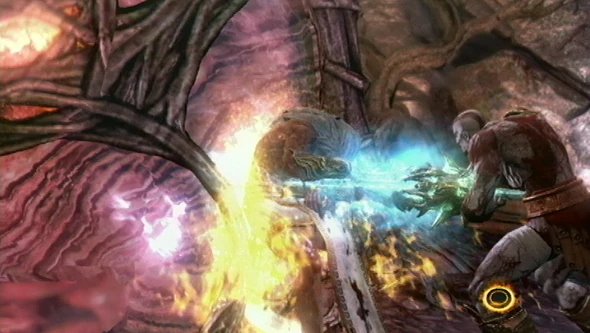
Kratos stabs Zeus (and Gaia) with the Blade of Olympus.
From the dias, Zeus witnessed the hellish chaotic state that Greece was now in due to the destruction caused by Kratos, bitterly declaring that he would have much to do after he killed him. They fight each other again until they are interrupted by Gaia, who was thought to have been killed by Kratos. She returned to kill both her grandson for vengeance and her great-grandson for destroying her world, ignoring the fact that it was the death of the Olympians that caused it and that it would have happened anyway if the Titans had won. Zeus told Gaia that her pawn has failed her, and commented that she should have chosen the other one (probably referring to Deimos). Gaia then decided to crush the platform, declaring that father and son would die together. Both of them managed to enter the large chest wound she incurred earlier from her fight with Poseidon, making their way to her heart. There the fight raged on with both fiercely struggling to gain control of the Blade of Olympus as well as using Gaia's Heart to heal themselves in the battle, Eventually, Gaia was killed when Kratos, after a tremendous effort, impaled Zeus against her heart with the Blade of Olympus, which apparently also killed Zeus. Gaia's body slowly broke apart and destroyed most of Mount Olympus.
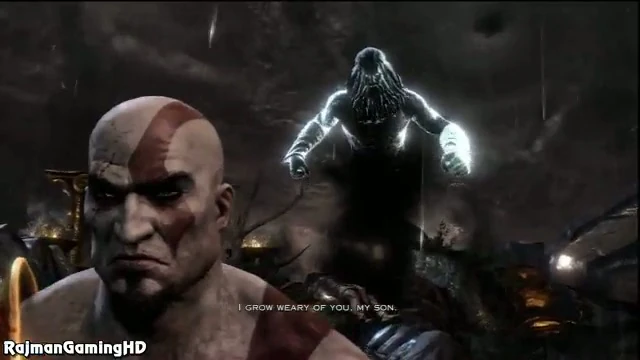
Zeus' astral projection attacks Kratos.
Regaining consciousness, Kratos retrieved the Blade of Olympus from Zeus' "corpse", but when he tries to leave, he is attacked by Zeus' still active spirit, which took away all of his magic and equipment except for the Blade of Olympus, the Blades of Exile, and the Boots of Hermes, infecting him with Fear. Kratos was thought to be finished, but with the help of Pandora's spirit, Kratos managed to forgive his sins and unleash Hope from within himself. He then briefly battled Zeus' astral form, eventually forcing it to retreat back to his body, reviving Zeus. Kratos considered of attacking him with his blades but paused and realized that Zeus was so weak he could kill him with his bare hands. He then threw his blades aside and charged at Zeus.
Death
Zeus dies at the hands of Kratos.
Terrified, Zeus backed away, and tried to stop Kratos with his arms, but was unable to resist the Spartan's fury and was thrown against a rock. A black smoke spewed from Zeus' mouth, meaning that Zeus is freed from the evil, Fear. Kratos then begins to beat Zeus uncontrollably, kicking him in the face and throwing him against rocks, ultimately grabbing Zeus' beard and beating him to a bloody pulp. Interestingly enough, Zeus does not put up any resistance when Fear left his body. It is possible he realized that by causing so much pain on others, including Kratos, he was responsible for his own demise. Regardless, all was lost for the now once King of Olympus, and Zeus already accepted his fate after failing to stop Kratos' path of destruction.
Zeus' body disintegrated and exploded in a huge blast of light, unleashing absolute chaos upon Greece as the King of Olympus was no more, forever ending the reign of the Olympian Gods.
God of War (2018)
Despite very many years having passed since his death, the thought of Zeus still haunts Kratos. After Kratos defeats the Bridge Keeper of Helheim, he soon sees the image of Zeus in the sky calling to him. Kratos, surprised by the sudden arrival of his father, reveals to Mimir that he was Zeus' son, with Mimir later realizing that Kratos is the Ghost of Sparta he had heard of from legend.
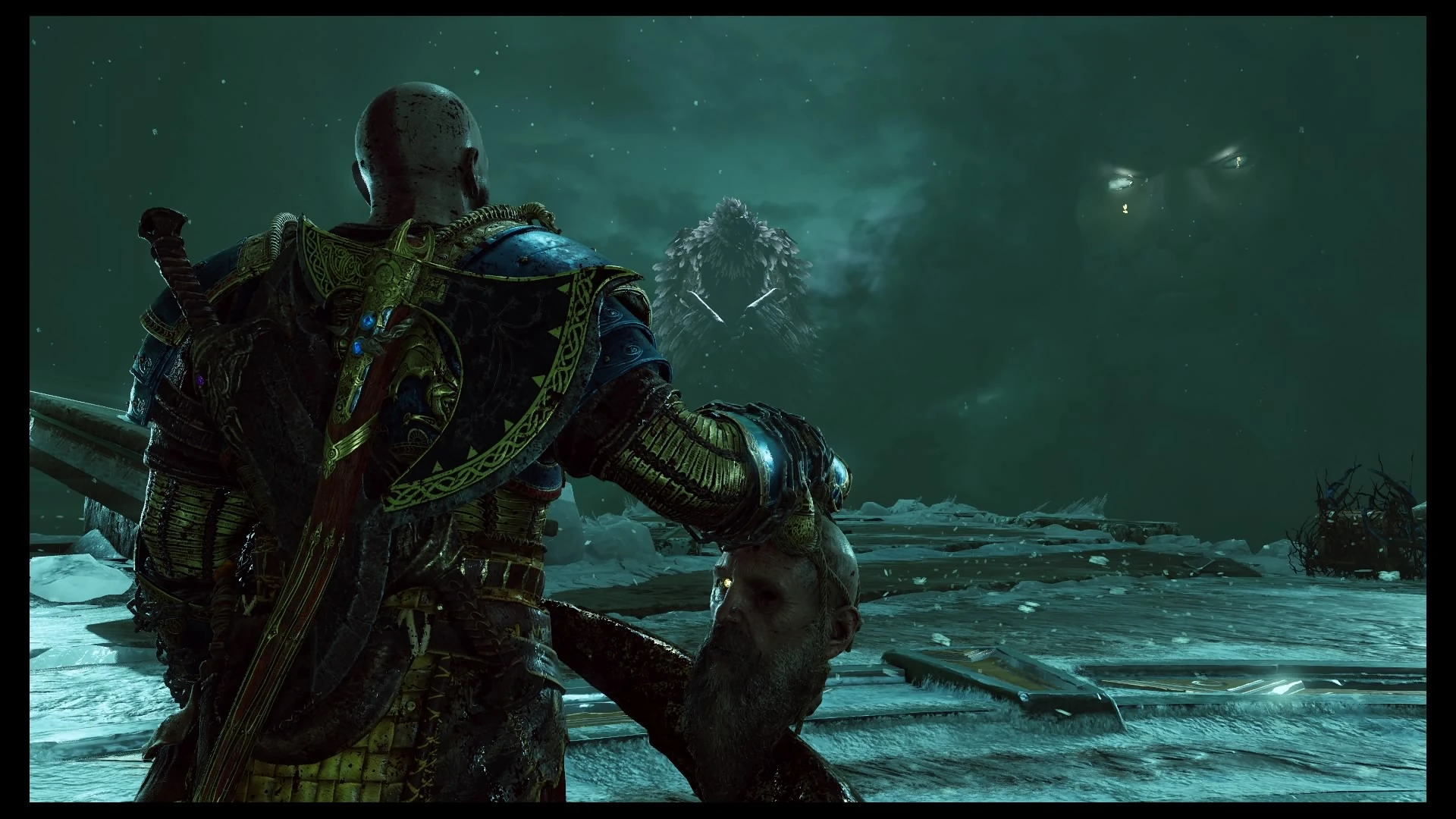

Zeus appearing in the sky in Helheim
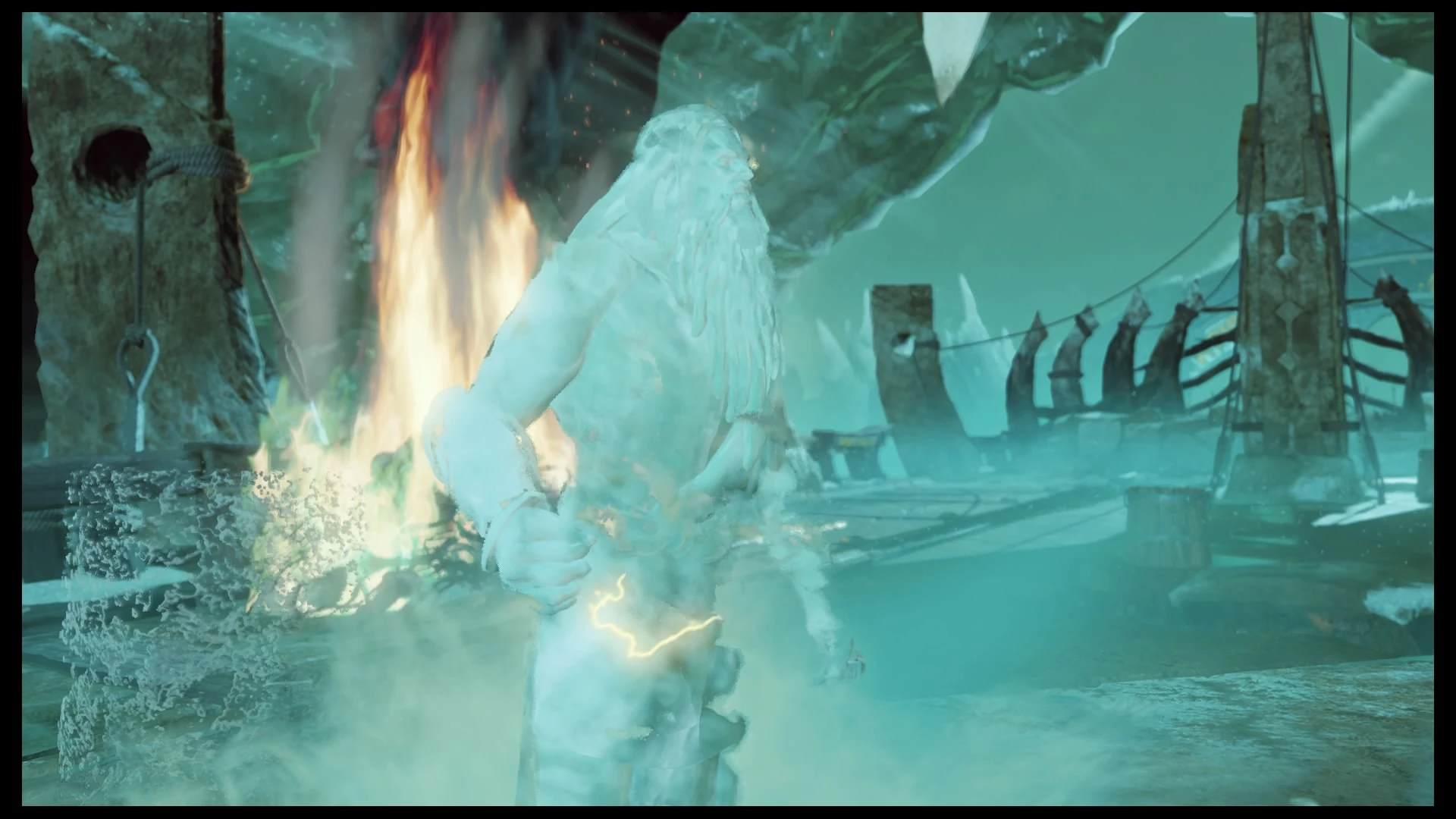

As he appears in Helheim
Kratos asks Mimir what that place was and how it's possible for the former King of Olympus to be there. Mimir tells Kratos to never venture there and that Helheim is known for torturing it's inhabitants with illusions of memories of their past. Later on in Hel, Kratos hears the past echos of Zeus speaking to him, which he ignores but would later see, along with Atreus, a ghostly reenactment of Zeus' final moments before his death, being beaten to death by Kratos.
Moments before killing Baldur, Kratos quotes his father of the cycle before breaking his neck, preventing Baldur from killing Freya in revenge.
Afterwards, Kratos tells his son of how he killed his own father as Atreus realizes the specter was his grandfather. This makes Atreus wonder if the cycle of children killing their parents is the fate of gods, although Kratos assures his son that his past doesn't define their future, and that they will be the gods they choose to be.
God of War: Ragnarök (2022)
Kratos would eventually tell Mimir and Freya about how he traveled back in time to change his death at Zeus' hands and how he used the power of the Sisters of Fate on Zeus when they refused to help him change his fate, after Mimir expressed that Kratos' story of travelling back in time was exaggerated.
Multiplayer
| “ | Align yourself with me and the light of Olympus shall be yours to wield. | ” |
―Zeus | ||
Zeus is one of the four mentors of God of War: Ascension's Multiplayer. His statue is the third one in the Rotunda of Olympus, staying right at the center of his brother's statues and face-to-face to any warrior who arrives at it.
Overview
The king of Olympus' warriors have the average physical powers and resistance from the game, but are the best in elemental damage. Their magic attacks, which come from the mighty lightning of Olympus, are incredibly strong, usually hitting opponents many times in deadly shocks and can disable some of their abilities for a short period when used.
A warrior of Zeus must count mainly on his magic bar against his enemies. Their electric attacks can overpower warriors and beasts in seconds.
Battle Mage
Impressive elemental powers.
Electric Magic
Stun opponents and disable enemy magics.
Zeus Items
Improve defense and escape.
Zeus Weapons
Can shock enemies in electric currents or strong explosions in some special attacks.
Zeus Armors
Focus on enhancing elemental powers and defenses.
Personality
Zeus' benevolent side was more prevalent in the original God of War, in which he was depicted as a caring god who sought to punish evildoers and oath-breakers, even empathizing with his son Kratos' (who at that time was unaware Zeus was his father) grievances against Ares despite all of the terrible things Kratos had done. Even though he had a benevolent side, he had some negativity within him as he placed a curse on his lover (and Kratos' mother) Callisto to transform into a grotesque monster should she ever reveal his relation to Kratos or Deimos, he also feared Deimos to the point of imprisoning and torturing him for eternity due to The Marked Warrior prophecy. He had even condemned his former ally, Prometheus, to eternal torment when the latter used the Fires of Olympus to help mortals, thus drew the ire of Zeus. After Kratos opened Pandora's box, he was possessed by one of the evils in the box: fear. This transformed Zeus into a cruel, wrathful, paranoid, and power-hungry deity, as evidenced by how he started treating the innocent Pandora with cruelty.
The evils of the box also caused Zeus to develop an intense fear of Kratos, whom he now realized was the "Marked Warrior" foretold in the Oracle's prophecy that would perpetuate the cycle of patricide which led to Zeus overthrowing his own father Cronos. Witnessing his ruthless murder of the Furies along with Ares, Thanatos, and Persephone, Zeus' fears were further exacerbated by Kratos' intense hatred for the other gods of Olympus (with Hephaestus, Athena, and Aphrodite being the only obvious exceptions) and his destructive rampages across Greece during his reign as God of War. In response, Zeus took the form of an eagle and siphoned off a large portion of Kratos' godhood powers, infusing them into the Colossus of Rhodes. He then tricked Kratos into transferring the rest of his powers into the Blade of Olympus, weakening him to the point of near-death before finishing him off for good. To prevent his followers from helping their fallen god and to punish Kratos even more, Zeus destroyed Sparta, killing hundreds of innocent people in the process. Not even his own family were safe, as he used them as mere pawns in his war against Kratos and the Titans, mourning little (if at all) about the losses of Athena (who tried to protect him, giving him a chance to escape Kratos' wrath the first time), Poseidon, Hades, Helios, Hermes, Hercules, possibly Hephaestus (even though he brutally beat him to a pulp upon learning of his deception after being infected), and Hera, his wife. But when the evils that possessed him left his body, he somehow let himself get beaten by his son, implying that he finally realized that his persecution and fear of Kratos created a self-fulling prophecy.
He was also unfaithful to Hera, having cheated on his wife countless times and fathering many bastard children (including Kratos, Hercules and Deimos). He seemed to care very little about the well-being of his own children, going as far as to dispose of his own sons Hephaestus and Kratos, caring very little to not at all for Ares' (whose destructive behaviour feared him) death and imprisoning Deimos out of fear of being dethroned. Even though his lack of care for his children was obvious, some like Ares and Hercules believed that he played favourites, as they thought Athena and Kratos respectively were given great privileges and importance that they felt were denied to them.
Despite the fact that his father Cronos committed horrible deeds, Zeus was willing to betray and turn against all Titans, including Gaia, who once saved him from his father, seemingly for the sins of the latter. He even recruited the Titans Helios, Prometheus and Hekate to join him, causing them to betray their own kind. He even condemned his own mother, Rhea into Tartarus for siding with the Titans despite she was saving him from Cronos. In addition to this, however, according to Atlas, Zeus' war against the Titans also stems from his hunger for power as he had a desire to rule over mortals.
Zeus' treatment of his fellow gods, mortals, and Titans matches nearly perfectly with how Zeus treated others in actual Greek mythos. Just as Zeus in the games was cruel, controlling and arguably quite evil, this matched how Zeus was responsible for many terrible things that were written about in real-life Greek mythos. He had zero regard for nearly anyone, and would use everyone he could as a pawn to further his personal goals, including his own siblings and first-born children, even going as far as not showing any care when his entire family was being killed by Kratos, seemingly only focused on killing Kratos himself, without any remorse or sadness for the deaths of his closest family members. In fact, one of the wandering souls that Kratos encounters in the Underworld wonders the reasons Zeus has forsaken him, before the Ghost of Sparta puts him out of his misery. While this unnatural coldness from Zeus could be blamed on the evils that infected him from Pandora's Box, Zeus was already a horrible person like this well before that, so it is safe to say that Zeus has always been a cold, heartless being with little regard for anyone but himself.
Appearance
Zeus appears as an old muscular white-haired man. His eyes are pure white, best seen in the cutscene in God of War II in which he kills Kratos. In his neutral, unaltered form, he appears to stand well over 7 feet when compared to the already especially tall Kratos. In God of War II and in the opening scene of God of War III, he wears a white toga and golden arm guards, but after the start of the Second Titanomachy, he replaces his toga with a golden side guard, possibly the Aegis of Zeus, that had similar powers to the Golden Fleece. After the first phase of his fight with Kratos in III, the Aegis is missing, presumably destroyed or flung loose and lost when Kratos buries him in rubble.
Powers and Abilities
As the King of Olympus, Zeus is the most powerful of all the Olympians, more so than even his brothers Poseidon and Hades, who he can disintegrate at will. His roars of rage causes the world to tremble to its foundations. His power is great enough to challenge Kratos to a greater degree than any other God. In his Astral Form, his power is greatly increased to the point he destroyed Kratos's equipment and easily overpowered Kratos; only yielding to the power of Hope that his son held within.
Powers
- Acausality: The laws of time and space work differently for the Gods of Olympus.
- Immortality: As a God, he was immortal and could live forever. Beyond that, as long the Flame of Olympus existed, he was truly immortal. Like his brothers and other Olympian deities, Zeus did not age and is unaffected by time or succumbing to mortal frailty as sickness or impotence of any kind, he could not be killed by earthly weapons; only divine forces and weapons like the power of Hope, the Blade of Olympus or other gods and Titans can kill him.
- Regeneration: Zeus could regenerate from almost any wound. He can heal even from wounds inflicted by other godly power and Kratos’ blades back with relative ease. Ironically, the Blade of Olympus, a weapon of his own creation can kill him but he can heal from non-fatal wounds inflicted by it.
- Superhuman Speed: Zeus could run at extremely fast speeds. He could move as fast the lightning he commands. As demonstrated in the battles with Kratos, Zeus was able to evade attacks with the speed of lightning, appearing behind his opponent to strike.
- Superhuman Stamina: Zeus had tremendous amounts of superhuman stamina, able to fight Kratos for an extended period of time without ever slowing down.
- Superhuman Strength: Zeus possessed incredible levels of godly strength. His strength exceeded that of his fellow Olympians and was strong enough to pose a fierce challenge to Kratos in both of their fights, most notably shown in how much pressure he put on Kratos’ attempts to use the Blade of Olympus against him. In his first fight against Kratos, Zeus was able to disarm Kratos of the blade several times by grabbing him by the throat, lifting off his feet, ripping the blade out of his hands and throwing him aside, with Kratos showing considerable effort in order to wrestle the blade back off of him after recovering. Even after being caught off-guard by Kratos’ fake surrender and being heavily wounded, Zeus was still able to fight back, ripping one of his hands out of the pillar after Kratos impaled both his hands there with the Blades of Athena, and was able to temporarily stop Kratos from driving the Blade of Olympus through him with just one hand. In his second fight, Zeus and Kratos both sent each other flying backwards after landing simultaneous punches on each other. Despite taking a significant beating from Kratos in the final phase and being attacked with the Blade of Olympus again, Zeus was still strong enough to disarm Kratos of the blade and overpower him, charging forward and slamming him down, with Kratos having to spend nearly a full minute wrestling with Zeus for control of the blade, even getting disarmed and pushed back again at one point.
- Superhuman Durability: Zeus was tremendously durable. He was able to withstand extreme punishment from Kratos in all their fights and could still stand up and flee in their first fight and survive long enough to access his Astral Form after a much harsher beating from his son in their final fight. It should be noted that during his battle with Kratos at the Summit of Sacrifice, Zeus was stabbed repeatedly by the Blade of Olympus by Kratos, yet Zeus was able to survive, unlike other deities who fell to the Blade's power in a single strike, such as Athena and Cronos.
- Flight: Zeus could hover and fly at amazing speeds.
- Teleportation: Zeus has shown the ability to disappear in thin air, leaving a rain of electric charges behind, only to appear seconds later somewhere else.
- Shapeshifting: Like all Olympians, Zeus was able to shapeshift. He made himself look as the oldest of the Olympians, despite actually being the youngest of his siblings. He could also transform himself into a giant eagle as well take the form of a human, or grow hundreds of feet tall, in God of War and God of War: Ghost of Sparta, he appeared to Kratos as the Grave Digger.
- Banishment: Zeus was able to banish Hades from Olympus with a simple hand gesture.
- Curses: Zeus punished the Cursed Legionares for their disloyalty and condemned them to wander the Earth forever as restless corpses.
- Animation: Zeus was able to harness Kratos' godly powers and use them to bring the Colossus of Rhodes to life. It was very intelligent and powerful, its might increasing every moment.
- Summoning: Zeus was able to summon a legion of creatures to fight at his side, examples are the Siren Widows he used to fight Kratos at the end of God of War II.
- Resurrection: Zeus along with the other gods were able to resurrect the Body Burner after he died, and condemn him to forever burn those who die in Pandora's Temple.
- Transformation: Judging from Callisto's fear of revealing Zeus' name to Kratos before her monstrous transformation, it's very likely Zeus cursed her to transform into a monster should she try to tell Kratos of his true father.
- Weapons Forgery: Zeus had the ability to create powerful divine weapons. The most powerful weapon he has ever created was the Blade of Olympus, forged from the Heavens and the Earth as well as Zeus own blood and lightning. It was able to enforce Zeus commands, banishing the entire Titan race of elder dieties into Tartarus in one attack and able to strip away and bypass the Immortality and Divinity of Olympian Gods.
- Atmokinesis: As the God of the Sky, Zeus had control over parts of the weather that involved storms, allowing him to generate thunderclouds or create a tornado. The global climate responds to Zeus’ anger and emotions, his breaths warrant storm patterns and his bad mood lowers global temperature. He can combine clouds with his electricity to make his lightning much more powerful, to the point that a single spear of lightning was able to blast down Kratos and Gaia and destroy the latter's arm. After his demise, the Heavens and the rest of Creation have fallen into Chaos.
- Electrokinesis: As the God of Thunder, Zeus could control lightning to an unrivaled degree. He is able to generate extremely powerful and fast Thunderbolts that can shatter huge mountains and kill Titans. His Thunderbolts were strong enough to nearly kill Kratos, forcing him to trick Zeus to stop him. Even his brothers greatly fear his lightning strikes. When attacked by Gaia and Kratos, Zeus charged up a thunderbolt powerful enough to blast both Gaia and Kratos off the top of Mount Olympus, nearly amputating Gaia's hand and gravely injuring her, leaving her struggling to retain her grip on the mountain, unable to help Kratos. In his Astral Form, his Thunderbolts were strong enough to destroy almost all of Kratos' equipment. In addition, Zeus can manipulate lightning to empower his attacks, move faster, generate a lightning shield, and cause an explosion of electrical energy.
- Soul Manipulation: While being on Olympus, he pulled off the soul of one of his dying worshipers on Earth and send it to the Underworld, ensuring a fair Judgement. He himself is immune to the power of the Claws of Hades, unlike Cronos, Atlas and Hades himself.
- Prayer Empowerment: Should be comparable to other gods such as Athena, who can gain power from mortals praying to them.
- Conceptual Sealing: Zeus was able to collect all the evils of the world and seal them inside of Pandora's Box.
- Conceptual Manipulation: In addition to summoning and sealing the Evil concepts away, he was able to wield Fear itself against Kratos, unlike his fellow Gods who died without wielding the Evils that inhabited them.
- Blade of Olympus Creation: Channelling all of Creation with his blood and lightning, forging the concepts of Afterlife, the Heavens etc. to create an power-absorbtion, reality-ruling instrument which ensures the Invincibility of Olympus against any challenge.
- Conceptual Embodiment: As the God of the Heavens, he controlled his supreme domain as if breathing air. As the God of Order, he primarily among the Olympians held Chaos back from the cosmos, as Athena states without him it would be impossible. At the end of God of War III, he plans to restore the World to Order, even without most of his pantheon.
- Multiple forms: Zeus has several aspects of his Godhood, split into different forms or "roles", such as the two named ones Zeus Katachthonios, the Protector of the Undergrounds and Zeus Philoxenos, the Protector of Hospitality. Similar to Ratatoskr, but more advanced as these forms arent just Zeus emotions, but his divine responsibilities of maintaining mortal existence, split into seperate forms.
- Olympian Power Distribution: Zeus, as the King of Olympus, decides and approves the roles that his fellow Gods play in his pantheon and cosmic order. As seen with Ares replacement by Kratos and later the debate on who should replace Kratos as the God of War, with him clarifying that "Kratos didn't seize Ares throne, I allowed him to ascend."
- Power Removal: Zeus was able to strip Prometheus of his Immortality. Also, as the King of the Gods, Zeus can remove the powers of other gods at will, as shown when he stripped Kratos of his godly powers, or when he made Prometheus mortal. His champions who wield a fraction of his powers can nullify magical abilities with lightning strikes.
- Healing: Zeus had made it so Prometheus would be healed every night after being mauled by the giant eagle every day.
- Power Bestowal: Zeus is capable of granting powers to others, as shown when he bestowed the Redeemed Warrior should he chose to follow him with immense magical attack power and mana reserves and regeneration, supernatural enhancements to their equipment, and great electrical powers that allow them to control space as they drape the playing field with electricity, forcing their opponents to scatter in all directions as well as disable their abilities for a time.
- Zeus' Fury: He gave Kratos the power to shoot powerful thunderbolts. In addition to that, Zeus' Fury passively empowered Kratos other powers like Poseidon's Rage and Medusa's Gaze, as well as accelerated Kratos’ natural healing process and enhanced his all his other physical attributes.
- Power Absorption: Zeus was able to drain power from other beings in order to strengthen himself, as shown when he drained Gaia's heart of her power.
- Duplicate Creation: After absorbing Gaia's heart, Zeus was able to create duplicates of himself that are much weaker but could use many of his attacks.
- Pre-Cognition: Zeus forsaw the end of Kratos quest to retrieve Pandoras Box, which led him to dig the grave in Athens. His divine foresight proved to see further than Athena, the Goddess of Foresight herself.
- Fate-Defiance: Unlike his father Cronos before him, or his Norse counterpart Odin after him, Zeus was able to defy a prophecy foretelling his demise when he outsmarted the Prophecy regarding his first wife Metis, the mother of Athena.[2] This shows that in his usual intellectual level, in addition to his supreme divine nature, Zeus can defy fate. When the time came for the Marked Warrior Prophecy to unfold, his Fear-ridden self was clearly not up to the task though.
- Incomprehensible: Zeus is trancendent to a level that even the Oracle of Delphi, who knows secrets hidden to the Gods themselves, cannot comprehend his power and nature, just as the Goddess of Foresight Athena cannot forsee his actions and plans. Atropos, the measurer of all Life-Threads had to take the time to study and analyse Zeus behaviour after the fact, in order to comprehend his plans and actions during the Downfall of Ares] and Kratos resurrection from Hades.
- Astral Projection: Zeus was able to project an image of himself to communicate to Kratos and grant him the power to use his thunderbolts.
- Astral Form: After he was almost killed by Kratos, Zeus displayed the power to manage his soul to Astral Form in means of overpowering his son and channeling the evils fueling his body, although Athena reached that potential before the evils managed to consume her. In this form, Zeus was able to easily overpower Kratos and even destroy almost all of Kratos's equipment and was only defeated by Kratos tapping into the Power of Hope.
- Mind Imprisonment: In his astral form, Zeus was able to fill Kratos with so much fear that he imprisoned himself in his own mind.
Abilities
- Master Combatant: Zeus, having centuries of fighting experience, was a highly capable fighter, extremely skilled in using his weapons but he is also an exceptional hand-to-hand combatant. His skill allowed him to challenge Kratos on almost equal footing for an extended period of time before losing. He spent the beginning of his life training to one day confront his father Cronos and release his siblings. Afterwards he was engaged in brutal physical and magical combat with the Titans for centuries. The successful divine war against the Giants is confirmed to have happened, where Zeus again proved his power and leadership skill. Finally, the challenge of Typhon after the Giants were slain, was also dealt with by Zeus, according to Kratos and Typhon himself in the God of War II novelization.
- Divine Wisdom: Zeus is a premier planner among the Gods, always working his subtle schemes. So it was during God of War 2005 where he orchestrated Ares downfall in the shadows, while using Athena and Kratos as his proxies.
- Master of War: His leadership skills, battle prowess and sense of diplomacy led himself and the rest of the Gods, from rebellious upstarts and underdogs to an unchallenged, universe-ruling pantheon that controls its entire world meta-physically, except for Fate itself.
Quotes
- "It did not have to be this way, my son. This path is of your choosing."
- "Even now, as you draw your last breath, you continue to defy me?! Everything that you have ever known, Kratos, will now suffer because of your sacrilege. You will never be the ruler of Olympus. The cycle ends here."
- "I banish you to the darkest pits of Tartarus!"
- "What?! How can this be? The Sisters of Fate have aided you. Unexpected..."
- "I underestimated you. A mistake I do not intend to repeat."
- "Now I will show you the true power of a god!"
- "Know this, my son. You have started a war you cannot possibly win. The Fates have already deemed me victorious!"
- "Yes, I am forced to attend to this matter myself. Athena refused to undo her mistake. Imagine caring for a creature such as yourself..."
- "It is you who would betray me! Am I to stand idly by while Olympus is threatened?! Your hands are already stained by the blood of a god. I will not let Ares' fate be my own."
- "I grow tired of this insolence. I am the king of Olympus! And it is my way that is the way of the gods. You must vow to forever serve me."
- " I will release you from your life, my son... but your torment is just beginning."
- "My brothers. We were forged in victory. A victory that ended the Great War and brought forth the reign of Mount Olympus. Born from the depths of the Underworld, rooted in the River of Souls, our mountain emerged out of the chaos. As it grew, so too did the might of the Olympians. We created a world of peace, a world of prosperity. A world that lives in the shadow and safety of my mountain, a mountain that has come to be the absolute measure of strength and power! Now, on this day, that power is to be tested! The mortal, Kratos, seeks to destroy all that I have wrought! Brothers. Put aside the petty grievances that have splintered us for so long. We will unite, we will stand together, and I... will wipe out this plague! Olympus... will prevail!"
- "Petulant child! I will tolerate your insolence NO MORE!!!"
- "Your pawn has failed you, Gaia. Perhaps you should have chosen the other one."
- "Kratos. I'll put an end to this chaos!"
- "I created you and I will be your end!"
- "Surrender to me, and Pandora will live."
- "That thing has used you!"
- "Why do you waste your time?!"
- "Why won't you DIE?! Die! Tremble in fear."
- "I grow tired of you, my son."
- "Your obsession with this... this... thing... has become somewhat of a nuisance, my son."
- "Don't confuse this... object... this construction of Hephaestus with your own flesh and blood! But perhaps you already have, Spartan. Your quest for Pandora - your pathetic attempt for atonement from the family you slaughtered - has caused nothing but havoc on Olympus! Look around at what you have done!"
- "Taking pity on you has been my greatest mistake, Kratos. Just as taking pity on this thing will prove to be your greatest mistake!"
- " Stop her, Kratos! Do not let her go into the flames!"
- "Don't listen to her, Kratos. For once in your pathetic life, don't fail. Don't fail her like you failed your family."
- "Empty?! After all you have sought, after all you have sacrificed, it ends in another stunning failure!"
- "Such chaos... I will have much to do after I kill you."
- "Yes, my son. It is time!"
- "Your pawn has failed you, Gaia. Perhaps, you should have chosen the other one."
Gallery
God of War 2018

.jpg "Maxresdefault (21).jpg (127 KB)")


Screenshots


.png "Zeus (GoW3).png (566 KB)")


Concept Arts


Appearances
- God of War: Ascension
- God of War (2005)
- God of War: Ghost of Sparta (non-canon) (as a costume in Combat Arena)
- God of War II
- God of War III
- God of War (2018) (Illusion)
- God of War: Ragnarök (Mentioned only)
Trivia
- In the first game and whenever he appeared as the Grave Digger, he was voiced by Paul Eiding. In God of War: Ghost of Sparta, he was voiced by Fred Tatasciore who voiced Megatron in High Moon Studios Transformers titles. In God of War II, God of War III and God of War: Ascension he was voiced by Corey Burton. Corey Burton also provided the voice of Zeus in Disney's Hercules: The Animated Series. Coincidentally, Rip Torn, the voice of Hephaestus, provided the voice for Zeus in the 1997 Disney film Hercules.
- Corey Burton returns to voice Zeus in God of War (2018).
- In one of the bonus cut-scenes from God of War, Kratos reunites with his mother, discovering that Zeus is his father, who he would later take vengeance upon for abandoning him so many years before. Although this scene is not canon, the idea of Kratos being the son of Zeus was adapted for the sequels to come. This scene was seen in Ghost of Sparta, but in the Temple of Poseidon instead of Sparta.
- In his mortal appearance, Zeus is still exceptionally tall, muscular and somewhat youthful looking for his age, due to being a god. He had white hair even whilst a new-born child, continuing into early adulthood. His eyes have no pupils, being the same when he was in his early adulthood. But when he was a baby and in God of War II gameplay, his eyes had dark blue irises and black pupils. His eyes make him appear blind, although he is clearly not, as this trait was likely added to make Zeus sinister.
- It should be noted that, even though Zeus is the younger brother of Poseidon and Hades, he seems much older than the two. Given his ability to shape-shift, however, this could just be a matter of personal taste. In some sources, the regurgitating of Zeus' siblings is regarded as a rebirth of sorts, making Zeus both the youngest and oldest of his siblings. This, and the desire to command respect through age, could explain why he chooses to portray himself as older than his siblings.
- In God of War, the Grave Digger that Kratos meets in his quest to destroy Ares has been confirmed to be Zeus in disguise, aiding Kratos in escaping the Underworld. The Grave Digger also claimed that Athena wasn't the only god watching over him, the revelation that The Grave Digger was in fact Zeus confirms this. This bears similarities to real Greek mythology, where the gods would often disguise themselves as humans in order to help them.
- When Pandora's Box was first opened, Zeus was infected with the evil Fear. This caused him to grow more and more paranoid of Kratos overthrowing him.
- According to God of War III, Zeus has had thoughts of revenge against his father Cronos since a very early age. On the ledge where Zeus' Eagle was found, a drawing of Cronos eating Zeus's siblings can be found. After taking a closer look to the right, another drawing can be seen, showing a stick figure, assumed to be Zeus, holding a sword and ripping open his father's insides to free its prisoners.
- At the end of God of War III when Kratos charged a weakened Zeus, just before pummelling him to death, a sort of black mist evaporated from Zeus' mouth. This could have been the Evil from Pandora's Box that had infected him.
- It is possible that Deimos' death in Ghost of Sparta made Zeus realize that the prophecy was not referring to Deimos as the marked warrior, but Kratos instead.
- Each time Kratos had died before he managed to kill Zeus, the son-killing-father cycle ended, yet Zeus always re-initiated the cycle one way or another.
- At the start of God of War III when Poseidon says "the death of Olympus means the death of us all", he could have meant that if Zeus dies, then all living beings on the world would perish since different gods govern different aspects of the world and as the King of the Gods, Zeus's demise would mean the end of the world and revert everything back into Chaos, as the godly king governed order itself.
- However, it is more likely that he was referring to every God on Olympus as a whole, as a warning to Kratos's willingness to kill any God who tried to stop him killing Zeus, which was most of the Olympians, regardless of the devastating consequences it would have for the Greek world.
- It is unknown why Zeus didn't suspect any of his other sons to be a threat, as there were many besides Kratos and Ares (who strangely had no marks) that held contempt against him. This could possibly be due to the lack of any strange marks on the majority of them since the Oracle foretold that his usurper would be a "marked warrior".
- In God of War III, when Kratos fights Zeus, the main theme music is Brothers of Blood.
- Zeus is one of the mentors for God of War: Ascension's multiplayer. If the warrior chooses to submit their soul to the statue of Zeus on Olympus, they will gain skills that improve defence, speed, and magic. The initial weapon received for choosing Zeus is a gold and white hammer, but it can be replaced by a large sword with similar colors. Both weapons emit a gold light.
- Zeus is ranked on 49th place of the Top 100 Video-game Villains on IGN.
- While fighting Zeus in the heart of Gaia, Zeus summons clones, although differences can be noticed between them and the original Zeus: the clones are much paler and much weaker.
- Zeus appears as the first boss in the God of War demake Bit of War.
- It should be noted that Zeus saved Kratos's life two times, once as the Grave Digger and once when the Spartan was a child: Hera states that she wanted Kratos dead as he was a bastard child and so ordered Zeus to kill him when he was born; however, Zeus took pity and spared his son from death.
- Zeus is a downloadable playable character in PlayStation All-Stars Battle Royale. That makes two playable characters and four overall (counting Kratos, Hades, and the Hydra).
- Zeus is featured in the PS Vita game Destiny of Spirits.
- Zeus' death at the end of God of War III is shown in the exact opposite to his brother Poseidon's death, with the former being seen through Kratos's perspective and the latter through Poseidon's eyes.
- Zeus' line towards Gaia saying she should have chosen "the other one" was hypocritical as he was the one who made Gaia choose Kratos when he chose to capture Deimos. Had he captured Kratos instead, Gaia would have had to pick Deimos.
- Zeus, Alrik, Charon and Thor are the only characters who have bested Kratos in a fight. Although Kratos was severely weakened due to him being crushed by the Colossus of Rhodes.
- When Zeus first appears in Helheim, he appears to Kratos as a face in the clouds, mirroring his first ever appearance in the original God of War, as just a head.
- Zeus' death is re-enacted by ghostly illusions from Kratos's memories.
- Zeus is currently the only character to have been the main antagonist of two games, moreover he is also the only boss fought more than two times combining both games. Even though Ares is the perpetrator behind Ascension, he is not the main antagonist of that game.
- Although Zeus used the Blade of Olympus to banish the Titans to the pits of Tartarus, with the exception of his father Cronos, Zeus would eventually condemn Cronos to the same fate after Pandora's box was opened by Kratos. However, it was not revealed how Zeus accomplished this; whether by using the same weapon while still in his possession, or by other means.
- Unlike many other bosses from God of War 3 (and other games in the series), there is nothing that forces the player to kill Zeus. If one desires, the player can battle Zeus until he goes down with the circle prompt during the final phase of the fight in Gaia's heart, and then let him recover health to continue the fight. If one wishes, this can go on forever, essentially letting you use Zeus as an intense test arena to hone your skills against a much more skilled enemy compared to what you can fight in the battle arena. However, care must be taken on higher difficulties as this might eventually lead to Kratos' death, but using costumes with godly possessions can make this a very fun combat arena. Simply save before the battle, and then one can load it up and fight Zeus for as long as one wishes, either for fun or test out new combos, strategies and to hone your skills against a very challenging opponent.
- According to some cut lines of dialogue in God of War 3, Zeus was originally going to bargain for his life with Kratos, promising his son shared power over Olympus in exchange for mercy. And another line has him begging for his life (or begs Kratos to kill him), apologising to him and saying he is sorry for all he did. However, this was scrapped from the final game. He presumably would have bargained before the fear left his body, and apologize afterward, and before Kratos beat him to death.
- While Kratos learned from Athena that he was the son of Zeus at the Summit of Sacrifice, actually this has been already said by Zeus himself twice. The first time was when Zeus was going to kill him and saying "I will release of your life, my son, but your torment is only just beginning". The second was when he said "Know this, my son, you started a war you cannot possibly win. The fates have deemed me victorious" right after Athena saved him of being killed. Kratos actually only realized when a dying Athena told him the truth.
- Zeus was the fourth direct family member of Kratos that he killed, the first two being his wife Lysandra and daughter, Calliope and the third being his mother, Callisto.
- Zeus is also the only one whom Kratos willingly killed, due to having a personal vendetta.
- In God of War (2018), in the scene showing Kratos beating Zeus to death in Helheim, Zeus' height is considerably shorter than his height in the original God of War III. His height is closer to the height of Norse Kratos.
- Zeus, along with Athena, and Helios is one of the three Greek gods to make cameo appearances in the Norse saga. He and Athena appeared in God of War (2018), while Helios appeared in God of War: Ragnarök: Valhalla.
| |||||||||||||||||||||||||||||
| |||||||||||||||||||||||||||||
| |||||||||||||||||||||||||||||
| |||||||||||||||||||||||||||||
- ↑ God Of War 3 & 4 Main Gods, Main Giants, Main Titan DEFINITIVE Size Comparison
- ↑ God of War: Official Game Guide by Prima, pag. 49; Image