| “ | This time, Ghost of Sparta, I will have your head! | ” |
―The Barbarian King to Kratos | ||
Alrik, better known as the Barbarian King, was the leader of the Barbarian army, a strong warrior himself and an old enemy of Kratos. He was killed by the Spartan after the latter gained the Blades of Chaos. He and his brutish army drove Kratos to beg Ares to save him, leading to the events of God of War: Ascension and thus the entire series.
Quick Answers
What role does Alrik play in the God of War series?

How does Alrik's death impact the storyline of God of War: Ascension?
Who killed Alrik in the God of War series?
What led Kratos to beg Ares to save him from Alrik?
What is the significance of the phrase 'gods of war may your hammer be mighty' in relation to Alrik?
God of War Series
Quest for Ambrosia
A contest was created by a few of the Gods of Olympus, where they choose mortals to be their champions, with the ultimate goal being the capture of the healing elixir known as Ambrosia. The God Hades chose Alrik as his champion, who went on a quest for Ambrosia after his father fell ill with the living sleep, a curse secretly placed on him by Hades. In his journey, Alrik encountered Danaus, Hermes' champion, but decapitated him with haste and pressed on. Alrik and his Barbarians then discovered that a warrior named Kratos, Ares' champion and his Spartan army was searching for the Ambrosia as well, resolving to destroy them shortly after. The Barbarians then encountered the Spartans, with Alrik first allowing the approaching Cereyon, Helios' champion fight them first to wipe each other out. However, the barbarians fought them after the Spartan's leader defeated Cereyon and acquired the Ambrosia.
In their battle, Alrik was able to acquire the Ambrosia, promising to invade Sparta afterwards. Once he saw Kratos wouldn't be halted, he told him that he'd gladly fight him but his father's condition was more important and so he unleashed the head of Danaus, who he revealed to be a commander of animals. He then used the head to command a massive army of Rocs to tear the Spartans apart. Alrik then flew away, clutching the Ambrosia in his hand. Kratos then slew the Rocs that were torturing him, yet Hades had then sent many devilish arms in order to kill the Spartans. Kratos escaped their grasp then flew on a surviving Roc to catch up with Alrik, at the cost of his own men. Kratos and Alrik then met up with each other, and fought for the Ambrosia, spilling some on themselves in their struggle.
The battle then took to the ground, as Kratos tackled Alrik over the Roc. As the spilled Ambrosia healed Alrik, Kratos took the head of Danaus and commanded more Rocs to slash away at Alrik. Kratos then flew away on a Roc to Sparta, taking the Ambrosia with him and leaving Alrik to his fate. As Alrik lay bruised, bloodied, and near-death, Hades healed him and commanded him to slay the Spartan who denied him victory in the wager. As the Barbarian left for his home, he found his dead father's body being cremated. Alrik, as the new Barbarian King, gained the mighty Barbarian Hammer and then vowed vengeance on Kratos.
Battle Against the Spartans
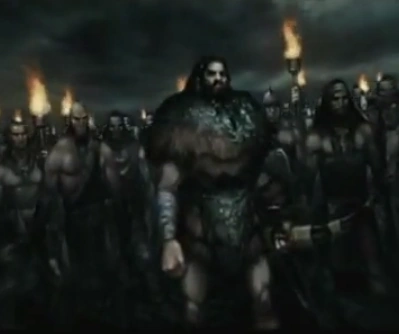
Alrik, in the War Against the Spartans
During his conquest, Kratos overcame his most powerful and ruthless opponents, until he encountered the Barbarians from the east yet again. Even with the superior combat skills of the Spartans, the Barbarians numbered in the thousands. Kratos, gazing upon the massive army, realized this was an unwinnable battle. Alrik began the battle by launching an arrow into the face of a single Spartan soldier. The furious Kratos called out to his men and led them into combat. His men were being led into a massacre. The Barbarians showed no mercy to the Spartans, leaving their dead bodies filling the battlefield.
Even Kratos, who fought against Alrik himself, was no match for the wrath of this enemy. Standing atop a hill of dead bodies, he looked into the eyes of Alrik as he raised his large hammer to end Kratos’ life. Before Alrik could deliver the final blow to the young Captain, Kratos called upon Ares. Within moments, the Barbarians were eliminated by the power of the God of War. Men were split in half, bodies were burned alive, and Kratos was granted the Blades of Chaos, which he used to decapitate the Barbarian King, who was shocked by the turn of events and the horrifying prospects of Ares answering Kratos' plea.
Return from the Underworld
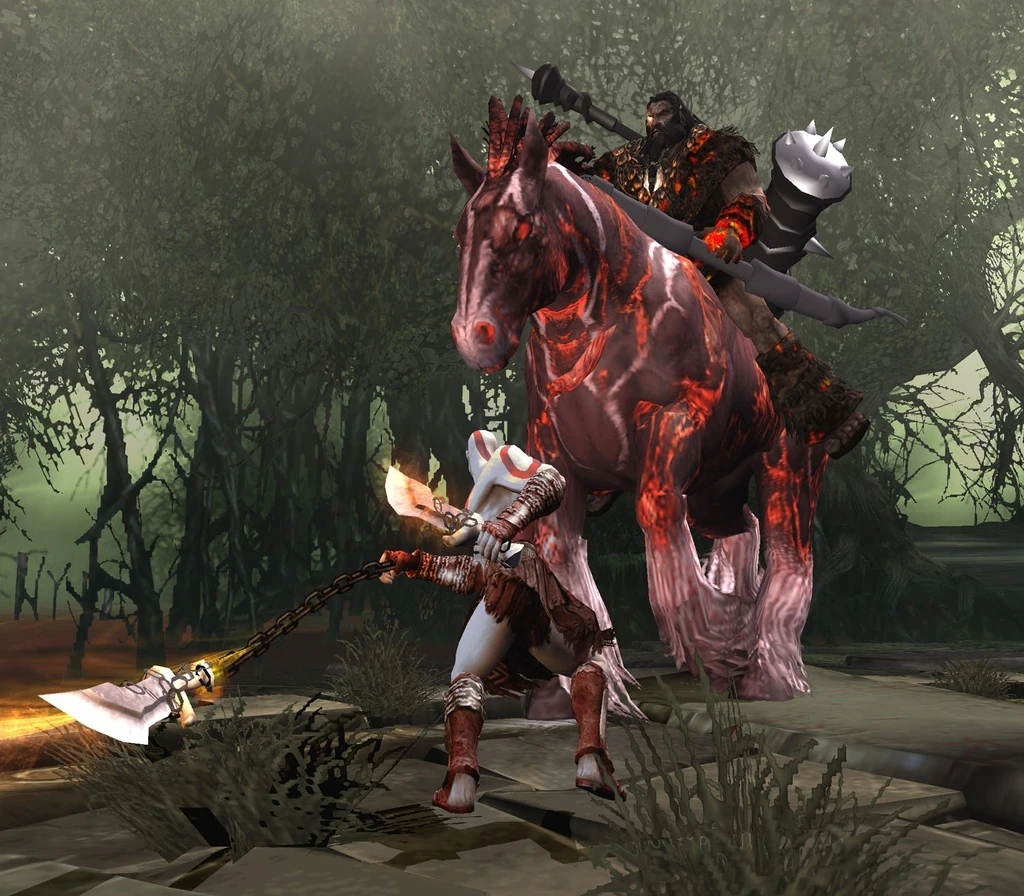
Alrik duels Kratos once more.
Like thousends of his men, Alrik fell into the Underworld, where he would remain in torment and fire for the next decades. The Barbarian King came to learn of Kratos' exploits in the world above, as the Fist of Ares and finally the God of War. It greatly enraged him to know that his arch-nemesis, who cowardly begged for divine intervention to gain victory, got the privilege of Olympian godhood, spending eternity among the Gods while he himself would rot in Hades. After spending some time on the outside of Hades' Palace and beseeching his former master for a ressurection, he decided to take matters into his own hands and battle his way through the many guardians of the Underworld. Alrik rose to life again, though his appearance was radically altered by the fires of Hades. His escape was enabled by the Sisters of Fate, particularly Lahkesis to help them stop Kratos on his quest. He gained magical abilities and journeyed to the Island of Creation where he hoped, like others, he would change his fate and gain revenge on Kratos. However, Lahkesis did not consider him worthy of an audience and and never intended to rewrite his destiny, deeming his downfall due to Ares' intervention on the behalf of Kratos to be final.
Reunion with an old enemy
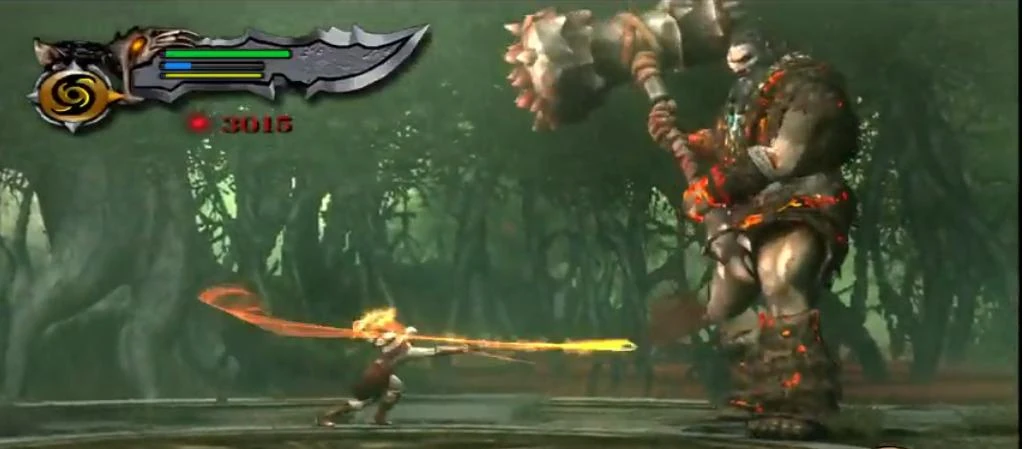
Alrik, in his giant form
During his crossing through the Bog of the Forgotten, he attacked Kratos, and dragged him through the bog with his horse. The two ended up facing one another on a platform in the middle of a poisonous swamp. Alrik laughed as he gazed upon his greatest enemy. Feeling blessed by the gods, Alrik asked if Kratos remembered the day when both warriors’ lives were changed. Kratos claimed he would never forget that day, as he looked at Alrik's scarred neck from what he had done. Alrik then declared to Kratos that this time he would have his head, and attacked him without delay. The souls of the dead were cast from the mighty hammer Alrik used in his fight against Kratos. Eventually, these souls were absorbed by Alrik and he grew three times larger than Kratos.
Death
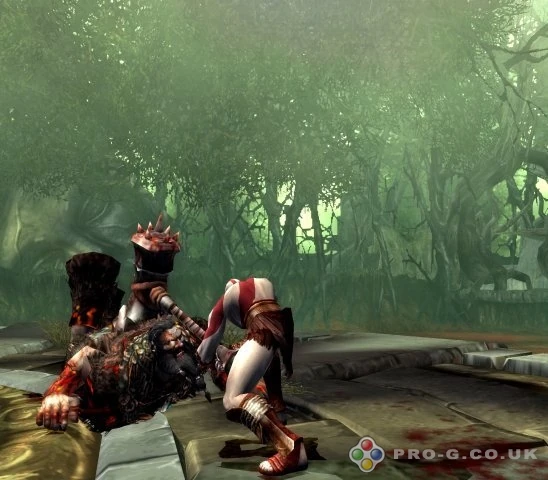
The second death of Alrik.
Ultimately, Kratos shrunk the King down to size and seized Alrik's hammer as the Barbarian tried to charge at him. His actions were for naught, as the Spartan used the mighty hammer to crush his head repeatedly therefore killing him once again. After defeating his old enemy, Kratos roared a war cry in triumph, a rare thing for the Ghost of Sparta which shows how personal this third and final battle with Alrik was. He claimed Alrik's hammer and the Barbarian warrior souls within, using it for the rest of his quest.
Indeed, in the novelization Kratos felt satisfaction at his victory, knowing that he was outfought in his last battle with Alrik and only won due to Ares' intervention, which turned out to be the beginning of his tragedy in becoming the Ghost of Sparta. However, Kratos was unsettled when looking at the scars from Alrik that brought back his nightmares before pressing on.
Meanwhile, Lahkesis was not yet aware of Alrik's death and learned of it from Atropos, who was outraged at her sisters supposed lack of attention towards her work. Atropos asks if Lahkesis thinks that Alrik would stop Kratos, to which she replied that he would indeed be stopped at the Bog of the Forgotten, and how foolish Alrik is to think that they would change his fate. Atropos then revealed to her sister that actually Alrik has just fought Kratos, along with his dead warriors and mounted on "his fine, prancing warhorse" and failed, having returned to the Underworld.
This unsettled Lahkesis and Atropos as well, as this directly defied the decree of the Fates, as already happened with the demise of the Warrior of Destiny and Kratos' resurrection in Rhodes before that. Together, the two sisters consulted on how to approach the threat of Kratos next and stop him at the Temple of Euryale.
In God of War III
A note from a tortured soul is found in the Underworld and it reads:
"Hades, I beg at your Palace gates grant me a reprieve!
Have I not become all you wanted?
Are my debts not paid in full?
How long must I hope for a rescue that will never come?
He becomes a god, while I rot and suffer. Release me so that I may have my revenge!"
This note was most likely written by Alrik as he held a vendetta against Kratos, who was responsible for his torment. He was also shown in the comics to have been a servant of Hades, which would explain the tone of the note. At the end of the game, Alrik could have escaped from the Underworld due to Hades' death, along with the other tormented souls. This note may also imply that Hades had indeed freed Alrik with the intention of killing Kratos during God of War II, but due to Kratos killing the Fates and changing history, Hades simply did not have the time, and thus, Alrik remained imprisoned in God of War III.
God of War (2018)
In God of War (2018) Kratos tells Atreus a story about revenge, being in fact a subtle re-telling of his own past, presenting himself as a Horse, Alrik as a Stag and Ares as a Hunter.
God of War Ragnarök: Valhalla
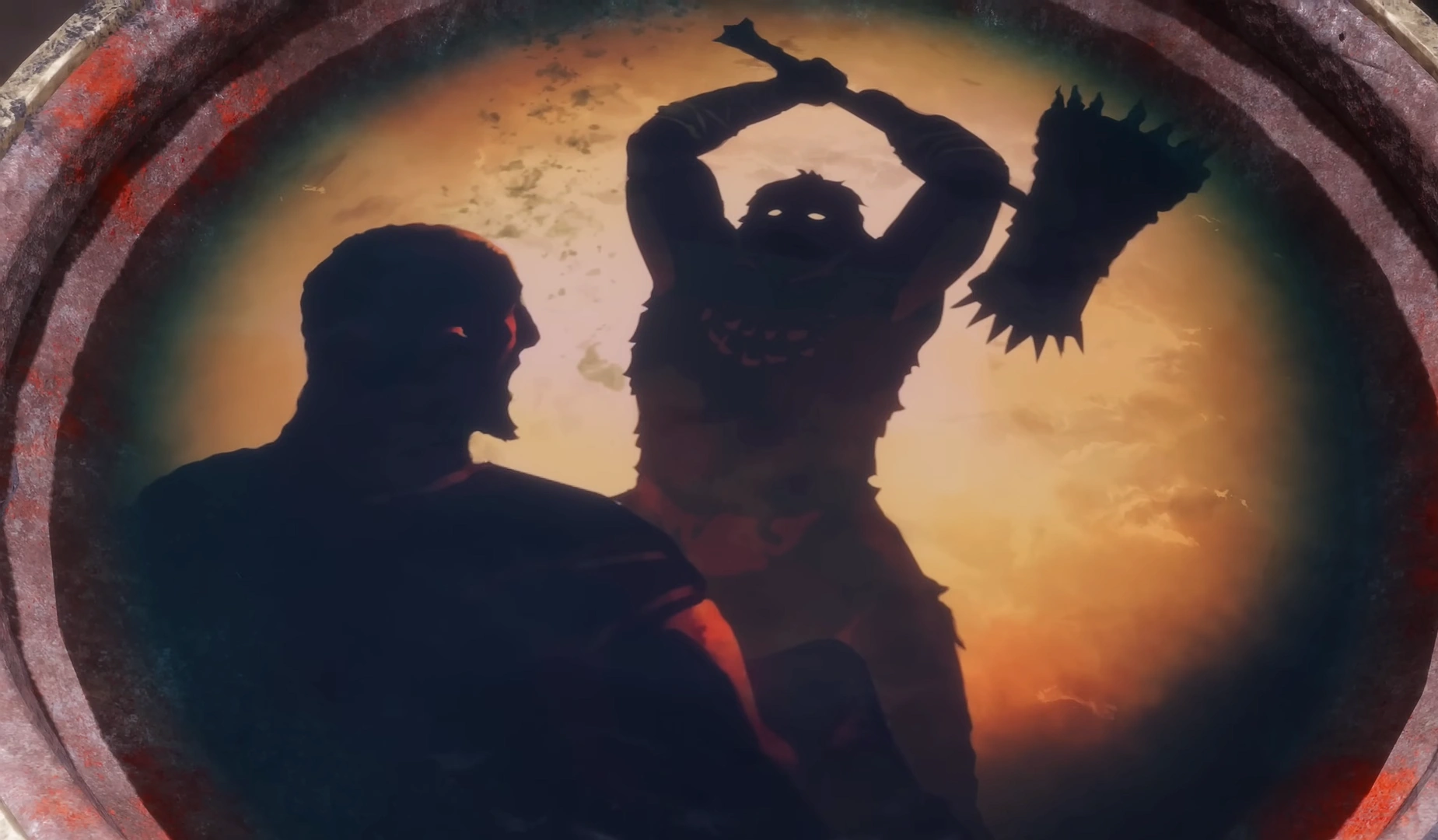
Alrik appears in a flashback in the scrying pool after Kratos' oath stone was lowered into it, as it represents Kratos' guilt and past memory of when he sold his soul to Ares. Kratos felt regret for calling up on Ares that day to help stave off Alrik and his army due to the subsequent blood pact he made with the God of War and the events that followed, but was told by Týr that his act of doing so was not cowardly or selfish but rather more complicated than he let on and that he did so in order to save Sparta in the only way he knew how. Kratos then admitted that had he not called upon Ares and died at Alrik's hands, Alrik would have eventually invaded Sparta and violate and slaughter the Spartan women and children there out of revenge.
Personality
In the comics, Alrik showed an caring side as Prince Alrik, he risked everything to save his father and grieved deeply when he returned home to only find his father dead. His tactical and strategical prowess was shown as well, with him directing the Barbarians to refrain from unnecessary engagements and instead observe the Spartans from the distance and let them face the majority of the opposition on the way to the Ambrosia.
After his fathers death, Alrik was the ruthless Barbarian King with a deep hatred for the Spartans, and especially their general, Kratos. This hatred is rooted from Kratos being partly responsible for the demise of his father, but Alrik likely never realized that Hades was the one that actually killed him. His hate towards Kratos resulted in a battle that ravaged both armies who had become equal in brutality. In the novelization's portrayal of this battle, Alrik was extremely brutal and bloodlusted, his beard full with blood, skin and flesh from Spartan necks he chewed on. Winning by the larger number, the Barbarian King was eager to strike down Kratos. However, once Ares intervened and cast his shadow over the field of battle, Alrik was shocked and seemingly overwhelmed, seeing thousends of his men die a variety of most brutal deaths and knowing that he cannot do anything about it.
His hate and thirst for revenge could not even be quelled by death as he fought his way through the Guardians of Hades and tried to change his fate, after spending decades in the Underworld and resenting the fact that Kratos was now a God. When crossing Kratos on the Island of Creation, he saw this as a token of the Fates and eagerly fought Kratos in a rematch.
Powers and Abilities
Alrik was a powerful warrior with a large variety of skills:
- Archery: Alrik used a large battle bow and enhanced arrows as a secondary weapon and had shown great accuracy with the weapon as he was able to decapitate a Spartan soldier across the battlefield with a single arrow, after hitting the soldier right in the face. He was also to fire from horseback and fire multiple arrows at once, all with high precision.
- Horseback Riding: Alrik was able to ride a horse, as seen when he took a steed with him from the Underworld. He later used it to attack Kratos, and was the first stage of the boss battle.
- Pyrokinesis: Using his hammer, Alrik could manipulate fire after he returned from the Underworld. By slamming the hammer in the ground, he could create waves of fire.
- Size Alteration: Alrik was a gigantic man but he was able to further increase his size, after absorbing enough power to do so. By doing this, he triples in size, although he is a bit slower.
- Soul Summoning: After escaping the Underworld, Alrik gained the ability to summon souls using his gigantic war hammer. They can be used to attack his enemies as well using them as a shield to protect him from harm.
- Necromancy: He also gained the ability to raise dead Barbarians and command them. He does this by moving the hammer over the ground. When he ran low on soldiers however, he accidentally summoned the boat captain from God of War.
- Soul Absorption: He was able to absorb the souls to heal himself and increase his power.
- Superhuman Strength: Even as a human, Alrik had been shown to be incredibly powerful, able to defeat Kratos, a demigod and son of Zeus, forcing the Spartan to pledge his soul to Ares. After he returned from the Underworld, his power had only increased when he faced Kratos again. In the novel, he held the strength advantage over Kratos during their final battle, with Kratos only being stronger while using the Rage of the Titans.
- Teleportation: Alrik was able to create portals that allowed him to teleport across the battlefield, when he fought against Kratos.
Alrik's Horse
When Kratos encounters Alrik on the Island of Creation, the King is riding on a large, demonic steed. When he rode the horse, cursed souls would protect and shield him; Kratos had to eliminate them in order to damage and kill the steed. The horse's body itself is bloodied, and is also wreathed in flames. It is not stated how the King obtained the horse, but chances are he got it while he was in the depths of Hades, during his escape from Hades or if in fact the horse was actually undead as barbarians also used horses. It is also possible that Hades himself gave it to him, wanting revenge for his defeat in the Gods' Wager. In the first part of Kratos' battle with the King, he actually sticks the Horse with his blades from behind, and is literally dragged through the Bog of the Forgotten. After that, Kratos fights the King while he rides on his steed and shoots arrows at Kratos. After damaging the horse, Kratos then ultimately kills it by leaping at it and plunging his blades into its head.
Trivia
- The name Alrik is of Germanic origin meaning "All Ruler".
- In the original comic he is Hades' Champion, being the direct rival of Kratos, Ares' Champion.
- It is possible that Hades helped Alrik to escape the depths of the Underworld, since he was his champion and Hades knew Alrik was thirsty for revenge on Kratos, their common enemy. Hades may also have given Alrik his new horse.
- Alrik makes another appearance in God of War: Ascension (as a flashback of the beheading scene).
- In the God of War II Novel, Kratos remarks how he and Alrik have some things in common. Their respective escapes from the Underworld and hatred of each other being what he and Alrik himself could agree on.
- Prior to the start of the battle, Alrik recalled the death of his father due to Kratos claiming the Ambrosia and that now he would make him pay for it. The Spartan retorted that Alrik is now King due to his father's death and probably made him to do his work for him. It was a provocation meant to goad Alrik into thoughtless attack, which worked. However, Kratos was initially ill prepared to face his brute force assaults, combined with skill and ferocity.
- In the first God of War novelization, it is revealed that Alrik often appeared in Kratos' visions, that fateful battle replaying itself over and over again. The Spartan would relive his defeat and call for aid, having no power to change the events of the past no matter how much he wished for Alrik to strike him dead anyway or for Ares to ignore his shameful plea.
- It is unknown how he knows of Kratos' reputation as the Ghost of Sparta, as he was killed long before Kratos earned his nickname (or before he even gained his pale appearance).
- In God of War III, he writes a note in the Underworld, mentioning that Kratos is become a god and that he still suffers. If he knows Kratos is become God of War, he likely knows how he earned the reputation as Ghost of Sparta.
- In Greek mythology, the dead were often said to have great knowledge on the affairs in the world of the living, so that may be the case for Alrik's awareness of Kratos' life after his death.
- Due to Hades' death in God of War III, Alrik could have escaped the Underworld, along with the other tormented souls of Hades.
- The breed of his undead horse in God of War II is a draft horse.
- When Kratos falls into The Pool of Blood in God of War III, Alrik's voice can be heard.
- Alrik and his eastern Barbarians may be a reference to the Goths of Late Antiquity. Hailing from Eastern Europe, a branch of the Gothic people, called the Visigoths, led by a King Alaric, was known famously as the barbarians who sacked the city of Rome and led to the downfall of the Western Roman Empire.
Gallery


Video
God of War 2 Barbarian King Boss