
This article contains lore based on real-life sources of the Greek mythology as introduced from the God of War Greek era.
| “ | Kratos, so glad you could carve out some time for us! You know we need it. I sense some bad blood between us, Kratos. Oh, all the memories. They're overwhelming, really. Let's see... How many sins have you committed against me? Oh, that's right, you murdered my niece, Athena! And what else. WHAT else? Ah, and you killed my brother, Poseidon. And I have not forgotten that it was you who butchered my beautiful Queen! I will see you suffer as I have suffered. Your soul is MINE. | ” |
―Hades before engaging Kratos in battle. | ||
Hades (Greek: ᾍδης), also known as Háidēs or Pluto, was the Olympian God of the Dead and the Ruler of the Underworld. Eldest son of the mighty titan Cronos and the goddess Rhea, he was most notoriously known as the brother of Zeus and Poseidon as well as Demeter, Hera and Hestia. Furthermore, Hades was the husband of Persephone and the uncle of Kratos himself—a family bond that the latter has long been unaware of.
His early life didn't exactly begin under the best auspices, as like his unfortunate siblings, Hades was the first victim of his father's madness and ended up swallowed by the Titan in a desperate attempt to prevent his demise at the hands of one of his children. Hades spent such a long time in Cronos' stomach that it would seemingly alter his physical appearance for the rest of his life. When his younger brother Zeus finally freed him, Hades willingly took part of the rebellion against the Titans, playing a decisive role in what would became known as the First Titanomachy.
In the wake of the rebellion of the Gods led by Zeus against the Titans and their decisive victory during the First Titanomachy, Hades was deemed to become one of the most important and powerful Olympians by gaining full authority over the Underworld and the Dead, a status that made him particularly feared among the Mortals. Although he viciously enjoyed the pain of his subjects, his total control over the souls nevertheless ensured the balance of power between life and death in the Greek World.
Hades is introduced in God of War (2005) as a minor supporting character. Despite Kratos' actions that led to the death of his beloved wife ten years ago, the Lord of the Dead nevertheless aided his nephew in his quest for the Pandora Box by granting him a fraction of his powers. The God of the Underworld then returns in God of War II once again as a minor character, where he is shown battling the Titans during the First Titanomachy alongside his fellow gods, successfully stealing the soul of the gigantic Atlas. Hades is notably present in Mount Olympus when Zeus summons his fellow gods and urge them to unite against this new challenge posed by the Spartan.
Following the actions of Kratos — who deliberately started the Second Titanomachy in his quest for vengeance, Hades comes to the fore in God of War III as a major antagonist in order to aid Olympus win this war. While Hades successfully battles the Titans with the help of his fellow Olympians, he finally meets his demise against all odds at the hands of Kratos, who manages to steal Hades' soul by turning his own weapons against him. His unexpected and brutal death brought utter chaos in the Underworld, who no longer had its ruler to watch over the souls.
Quick Answers
Who are the parents of Hades in Greek mythology?

What is Hades known for in the God of War Greek era?
Who is Hades' wife in the Greek mythology?
What role does Hades play in the God of War series?
How is Hades related to the main character, Kratos, in God of War?
Greek Mythology
Haides (Hades) was the king of the underworld and god of the dead. He presided over funeral rites and defended the right of the dead to due burial. Haides was also the god of the hidden wealth of the earth, from the fertile soil with nourished the seed-grain, to the mined wealth of gold, silver and other metals.
Haides was devoured by Kronos (Cronus) as soon as he was born, along with four of his siblings. Zeus later caused the Titan to disgorge them, and together they drove the Titan gods from heaven and locked them away in the pit of Tartaros. When the three victorious brothers then drew lots for the division of the cosmos, Haides received the third portion, the dark dismal realm of the underworld, as his domain.
Haides desired a bride and petitioned his brother Zeus to grant him one of his daughters. The god offered him Persephone, the daughter of Demeter. However, knowing that the goddess would resist the marriage, he assented to the forceful abduction of the girl. When Demeter learned of this, she was furious and caused a great dearth to fall upon the earth until her daughter was returned. Zeus was forced to concede lest mankind perish, and the girl was fetched forth from the underworld. However, since she had tasted of the pomegranate seed, she was forced to return to Haides for a portion of each year.
Haides was depicted as a dark-bearded, regal god. He was depicted as either Aidoneus, enthroned in the underworld, holding a bird-tipped sceptre, or as Plouton (Pluton), the giver of wealth, pouring fertility from a cornucopia. The Romans named him Dis, or Pluto, the Latin form of his Greek title Plouton, "the Lord of Riches."
In the God of War Series
The First Titanomachy

Hades during the Great War
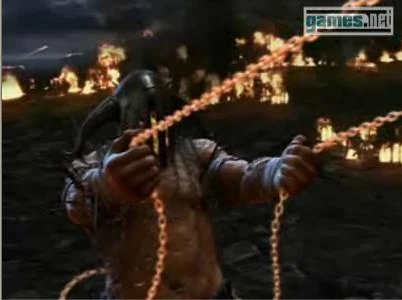
When it was prophesied that one of his own children would rise against him and overtake his rule of Greece, Cronos, the King of the Titans, had resorted to imprison his children inside his belly in order to keep this from happening. Hades was the first to endure this horrendous fate until he, along with the rest of his siblings, were released and saved by his brother Zeus. Declaring themselves as the Olympians, Hades and his family had raged war against the Titans, engaging in what would be known as "The Great War".
Hades appears in cut scenes in God of War II, during the Great War, when the Gods defeated the Titans. He is seen fighting his father Cronos trying to take Cronos's soul until Atlas comes and uses a ground attack on Hades to save Cronos. This causes Hades to turn his attention to Atlas and with his brother Poseidon coming to help him Hades is able to take Atlas's soul placing it within him thus defeating the Titan leader. After the Titanomachy he becomes a prominent figure among the Gods as there is a statue of him in the Garden of the Gods along with Athena, Ares, Zeus, Helios, and Poseidon. At the end of the game, he is seen with Poseidon, Helios and Hermes standing in front of Zeus, before the second Great War (when Kratos uses the Loom of Fate to rescue the Titans before they were defeated and imprisoned in the first Great War) begins.
Wager of the Gods
In the comics, Hades is seen in flashbacks competing in the wager of the Gods, a contest in which Gods choose various mortals as their champions, with the goal being the capture of the healing elixir known as Ambrosia. Hades chose Alrik, a warrior who sought to capture the Ambrosia in order to save his ill father, as his champion.
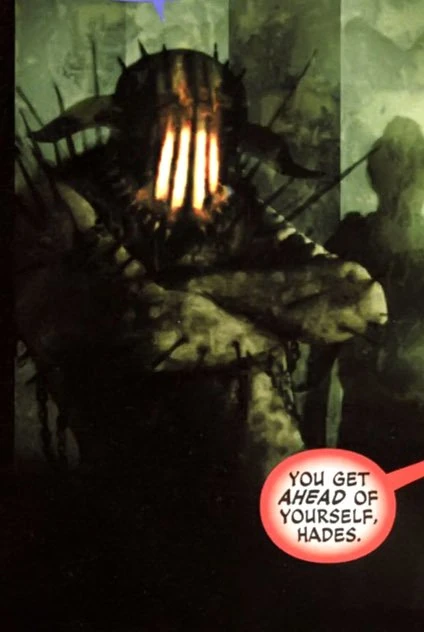
Hades as seen in the comics
After which, in fear that Kratos may best his champion, Hades sent a torrent of great fires from the sky onto Kratos' army. He was still unable to kill Kratos. After Alrik was defeated by Kratos and torn apart by Rocs, Hades revived him and sent him to destroy the Spartan who defied him. After being saved from death, Alrik then discovered that his beloved father had died, and so, the new Barbarian King vowed to exact vengeance on Kratos.
Kratos' Tiring of Ares
In God of War: Ascension, Ares, the God of War, sent The Furies to capture Kratos and imprison him in a Titan-sized prison for the living damned, where he is tortured for months on end, driven insane, and constantly haunted by the visions of the night he lost everything dear to him. Fueled by a desire for revenge against Ares, along with a need to redeem himself among Hades to earn salvation, Kratos manages to break free of his imprisonment and sets out on a journey to kill the Furies. If he can successfully defeat them, he can sever all ties to Ares without consequence.
Persephone's Betrayal
In God of War: Chains of Olympus, one of the final challenges is called Challenge of Hades. Hades himself does not appear, although Kratos does enter his realm of the dead, the Underworld. Hades does, however, play a background role, as husband to Persephone, the main antagonist of the game. Persephone doesn't love him but is forced to remain in his dark realm. Because of this, she had chosen to end both her life and that of the Gods by freeing Atlas and commanding him to kidnap Helios, the God of the Sun, from the sky and use his power to destroy the Pillar of the World.
Aiding Kratos
In God of War, he manifests in Pandora's Temple in a translucent form, like the other gods, and gives Kratos a magic called the Army of Hades. Only his fiery, demonic face is seen. There is also a giant statue of him in the section of the Temple called The Challenge of Hades, as well as another statue of Hades alongside Zeus and Poseidon in Pandora's Box's Elevator.
Moving in Shadows
While Hades doesn't appear in Betrayal, he is, again, a background character. When Kratos starts chasing the mysterious Assassin, the Undead Legionnaires and Cerberus appear from Underworld to stop him. Kratos wondered why Hades sent these beasts to attack him, speculating that Hades is the one who is plotting to ruin Kratos' relationship with the other gods. This would have made sense since Hades already had a legitimate reason to hate Kratos for the death of his wife Persephone.
The Second Titanomachy
| “ | I knew you would be back Spartan. Did you miss me? | ” |
―Hades | ||
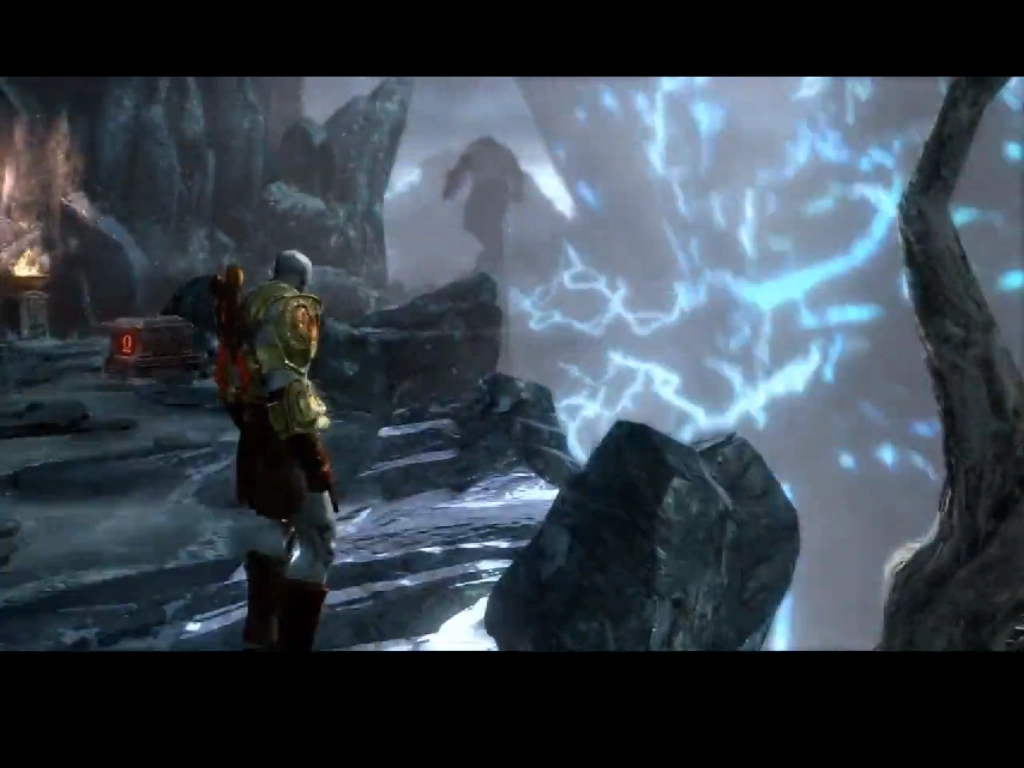

Hades pulling Oceanus off of Mount Olympus.
Hades is first seen amongst the congregation of Gods on Mount Olympus, dropping down to join Hermes and Helios in the battle against the Titans saved and led by Kratos scaling the mountain. He is briefly seen dislodging his uncle Oceanus from the mountain after Kratos disabled one of the Leviathans attacking Gaia. It is presumed he killed the latter off-screen, before returning to his domain. Kratos encounters Hades personally in the Underworld, who seeks to prevent him from escaping again. After first entering, Hades periodically comments Kratos' actions, often in a sarcastic, humorous or taunting tone of voice.
As soon as Kratos enters his Palace, Hades takes a more hostile stand, claiming he senses "some bad blood" between them. Before the battle, Hades reminds Kratos how he has wronged him in the past: by killing Athena (his niece), by killing Poseidon (his brother), and specially butchering Persephone, his wife and "Beautiful Queen". Hades then threatens, "I will see you suffer as I have suffered! Your soul is mine!".
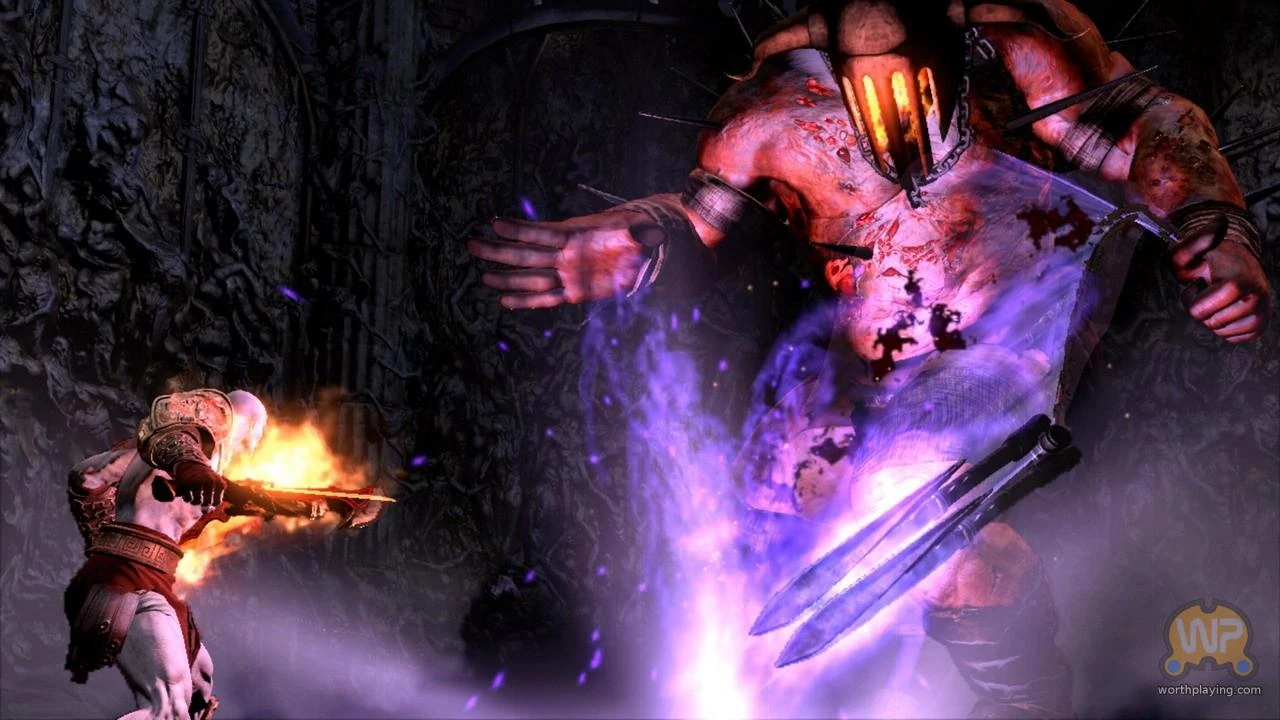
Hades fighting Kratos.
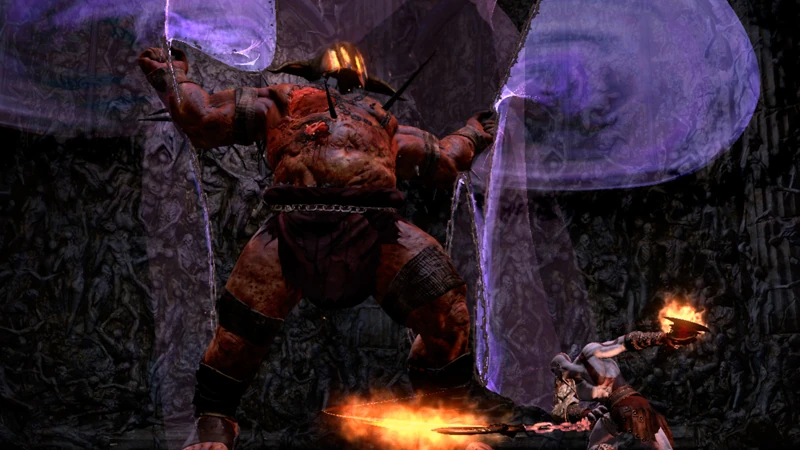
Emerging from the darkness, Hades immediately attempts to steal Kratos' soul but fails. An intense battle ensues, during which Kratos and Hades do battle with their respective chain blades. Eventually, the blades become entangled, and Hades attempted to pull Kratos into the River Styx. Eventually, Kratos gains the upper hand and uses both weapons to form a noose around Hades' neck, repeatedly slamming his uncle's head into the ceiling and knocking him into the River Styx seemingly killing him. From this, Kratos obtains the Claws of Hades allowing him to steal souls. Eventually, a significantly bigger Hades bursts out of the river using the souls to maintain himself, no longer sporting his helmet, revealing a deformed, devilish, cracked skull.
Death
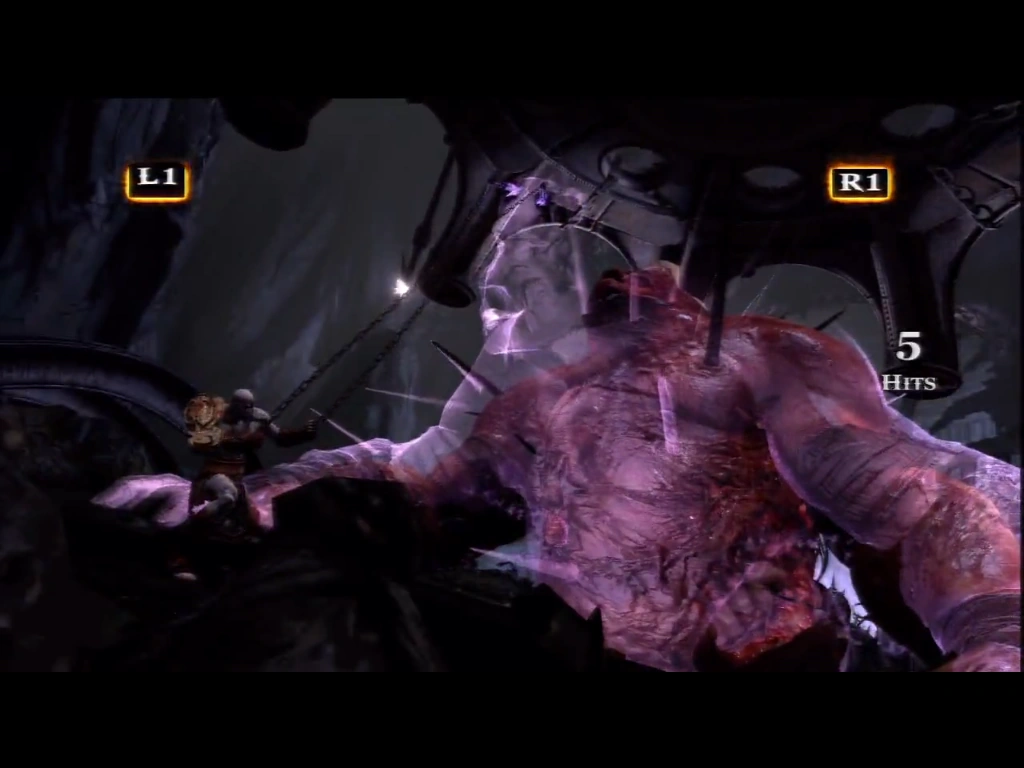
Kratos stealing Hades' soul.
After a fierce duel, Kratos manages to rip out his soul using his own Claws, killing the God of the Underworld once and for all. As Hades' rule of the Underworld lifts, the tormented souls of the Styx swarm over Hades' corpse, dragging him into the depths of the river. Kratos, in possession of Hades' soul, is now free to traverse the river Styx unharmed. As a result of Hades' death, the souls of the dead that reside in the Underworld were able to roam freely, with many escaping the Underworld itself. After diving into the river, the godly possession, Hades' helmet, can be retrieved at the bottom, near the point of entry. It then becomes available during Bonus Play. Before leaving, Hades' corpse can be seen at the bottom of the Styx, mutilated, as the tormented souls tore a passage through his gut to escape the river.
Swimming through Hades' now open torso, Kratos follows them and returns to The Forge of Hephaestus, the Blacksmith God. Hephaestus asks how Kratos could be alive and if "Lord Hades" rules no longer, to which Kratos responds, "The God of the Underworld is dead!" Hephaestus is shocked by this and states that he thought that the death of Hades was impossible, to which Kratos responds, "Olympians overestimate themselves." Hephaestus replied, "I will keep that in mind, Spartan".
Description
Hades was depicted as a red skinned, large and muscular male, who donned little clothing, consisting of a tattered red fabric tied with a chain to his waist, bandages in both his thighs, wrists and biceps, and a pair of sandals with armored sections on his lower legs which were wrapped with chains. His most striking features, by far, were his horned helmet, with cavities in the front of his face with what appeared to be "flames" within, which made it impossible to discern any facial features whatsoever. In conjunction with that, were the numerous black spikes across the entirety of his body. In the God of War II cinematic CGI cut scenes featuring Hades, he is additionally seen with a number of small hooks dangling from chains draped across his spikes and flesh. These appear to be miniature versions of the Claws of Hades, though they are absent in God of War III.
His own flesh appears to be grotesquely scarred and damaged, possibly a side effect of being stored on Cronos' belly for the longest out of his brothers, which is evidenced by his deformed true face and fragmented skull. In the first God of War, only his face appears which is loosely based on his appearance with his helmet. In this setting, Hades is a monstrous being with horns to the side of his face, with an open mouth with several sharp teeth.
Personality
| “ | I will see you suffer as I have suffered. Your soul is MINE! | ” |
―Hades | ||
Unlike his brother Zeus and many of the other Gods of the series, Hades is mostly unconcerned with the affairs of the mortal realm, preferring to focus his energies on the Underworld. He is, however, quick to anger if someone crosses him or his family, which makes him an enemy of Kratos. As Kratos is traveling through his palace, Hades comments that there is bad blood between them, as Kratos had murdered his niece (Athena) and his brother (Poseidon). He also appeared to have deeply cared for Persephone, despite her words and treachery. Indeed, he has restored her remains and created a massive memorial to her. Because of his devotion towards Persephone, Hades did not seem to be promiscuous, unlike his brothers, Zeus and Poseidon, both whom are notoriously unfaithful to their wives. He doesn't comment on the loss of his nephew Ares, indicating that Hades, much like the other gods, did not care much for Ares. Thus in contrast to most of the other Gods, Hades cared for his family.
Hades had a sinister, sadistic, mock-playful humor, evident in the way he taunts and intimidates Kratos throughout the Underworld. This is similar to the mythological Hades, who often gave out ironic punishments to particularly unfortunate souls. He also appears to be a sadomasochist, voicing his pleasure at seeing Kratos hurt by his minions but also claiming to enjoy the pain that the spartan brought on him by beating him senseless and tearing away chunks of flesh.
Like most Olympians, he has no respect for mortals, as shown in the wager of the gods. He sent a plague to Alrik's father to force him to compete in the wager just for his own amusement and when he lost, he convinced Alrik to seek revenge on Kratos, unintentionally setting in motion the events of the series.
Powers & Abilities
Powers
As the ruler of the Greek Underworld and everything that resides within it, Hades is both the oldest of his siblings and one of the most powerful of the Olympian Gods, surpassed only by his brothers Zeus and Poseidon. Hades is naturally a force to be reckoned with by any being who is foolish enough to anger him. His will alone is the absolute authority in both the gloomy realm itself as well as all other areas that are under his control; Nothing happens in the realm without his knowledge of it.
- Acausality: Similar to Athena, the Gods of Olympus function on a different level of space and time compared to the normal laws. Furthermore, all Gods of Olympus were not affected by the changing of the timeline caused in God of War 2.
- Immortality: Like all Greek Gods, Hades was immortal. Only a sufficiently powerful weapon or an extremely powerful being can kill him.
- Regeneration: Hades possessed great regenerative powers, such as when Kratos ripped a piece of his flesh out, he could heal himself simply by placing the flesh back, he is also capable of regenerating by stealing the life-force of others.
- Invulnerability: Hades was invincible to certain forms of attacks, all mortal weapons, and able to take significant amounts of force. Kratos only managed to defeat him by ripping his own soul out of his body and had to destroy the pieces of flesh he tore from Hades twice, lest the Ruler of the Underworld keep recovering.
- Superhuman Agility: Despite his appearance, Hades is quite agile, being able to scale down Olympus with his Claws alone and being able to back-flip over Titans who are taller than skyscrapers with no effort.
- Superhuman Stamina: Hades showed no sign of fatigue in his battle with Kratos or during the battles with the Titans.
- Superhuman Strength: As a God, Hades has incredible strength, able to overpower Titans with ease, and match Kratos in battle. While scaling Mount Olympus, Hades pulled down a Titan with one heave. While fighting Kratos, Hades' stomps were enough to create shock waves.
- Invisibility: Despite not using it in battle, he possibly used it when Kratos entered his palace where he wasn't able to be seen in the dark and walks right in as opposed to fall from the ceiling during the battle.
- Teleportation: Hades could teleport from Olympus, the Underworld and to mortal world.
- Shapeshifting: Hades could also shapeshift, which he demonstrated during his battle with Kratos, as he increased his size throughout the battle, eventually growing to the size of a giant. This was also shown during the Great War of the Gods and Titans.
- Power Bestowal: Followers of Hades are granted a fraction of Lord Hades' powers and become Warriors that literally fight with Spirit. They are capable of using their abilities to steal life-force from others and emit dangerous elemental attacks that target the Soul of another enemy. Followers of Hades can also use teleportation to surprise his enemies and can also use stealth to become invisible or become spirits to protect themselves temporarily. They are capable of summoning a few hands of Hades to aid them in battle. Due to Hades granting these powers, they should be able to replicate them (some of which they did) on a smaller scale. Hades also granted Kratos with the power to summon souls to help him fight.
- Telekinesis: Hades possessed great telekinesis; he was able to make the flesh Kratos tore out of him move back to him.
- Pyrokinesis: In the comics, he was capable of launching massive fireballs, indicating his ability of Pyrokinesis. Likewise, when really hurt by Kratos during their battle, his realm would ignite with a burning inferno, this is possibly due to his connection to Phlegethon, the river of fire in The Underworld.
- Halysikinesis: Hades could manipulate the Claws of Hades with high precision and proficiency. He could teleport the claws, attacking people over long distances and at high-speed, as well cover whole areas with his chains.
- Umbrakinesis: Hades was also able to manipulate and control shadows and darkness as he demonstrated in his fight with Kratos. Hades could also breath dark energy from his mouth.
- Disease Manipulation: Hades was able to infect Alrik's father with a disease that would eventually kill him during the wager of the gods.
- Soul Manipulation: As the ruler of the Underworld, Hades has absolute control over the souls of the dead and his world, to the degree where he was able to gift them to worthy mortals, Hades can also instantly steal souls from mortals or magical beings from afar. The best example of this is seen when Hades stole Atlas's soul and absorbed it. While Kratos traversed the dangers of Pandora's Temple, Hades gifted him with the souls of the Underworld to aid him in his journey. These souls are much stronger if they are summoned from the deepest depths of Tartarus. These souls can viciously maul Kratos’ enemies to death or weaken them enough for him to finish them off. Hades is able to resurrect those who have died, such as Alrik during the wager of the gods.
- Soul Removal: Hades, using the Claws of Hades, could remove the soul of any living being: mortals, beasts, fellow gods and even Titans.
- Soul Materialization: Hades was able to summon souls to attack his enemies, fighting for him. This ability was even more outspoken, when he used the claws, as he could use it to summon the souls of powerful monsters, utilizing their abilities briefly.
- Soul Absorption/Soul Empowerment: Every removed soul can be absorbed by the user of the Claws of Hades, bestowing certain abilities on the user or increasing their power. This allowed Hades to become more powerful, with every taken soul.
- Death-Force Manipulation: Hades could kill or manipulate death forces to his will and since he was the God of the Underworld, he had secondary authority and representative of death; the primary authority and representative of death was Thanatos, God of Death, who was killed by Kratos for killing the Spartan's brother Deimos. It is unknown whether Kratos now represented death, but all death forces the Spartan had been reclaimed by Hades, The Underworld God.
Multiplayer
| “ | Offer your soul to only me, and the minions of the Underworld will be yours to command. | ” |
―Hades | ||
Hades is one of the four God mentors of God of War: Ascension's Multiplayer. His statue is the second one in the Rotunda of Olympus.
Overview
Warriors aligned to Hades have great physical powers (being rivaled only by warriors of Ares) and increased cooldown reduction, too, but lack defenses (again, only being less weak than Ares). But these are not their best advantages: warriors aligned with Hades are granted the ability to steal health from enemies as well as having specialty in escape and stealth techniques. A particular item offered by the Underworld God is Hades' Helmet, which allows players to stay invisible from other players for some time.
Warriors of Hades are literally the living nightmare to anyone from the opponent team when fighting seriously and must focus on using surprise attacks in order to have an advantage in battle. Before taking strong blows, they can use their items to perform effective escapes and when injured, they can also use their magic to drain nearby enemies' vitality.
Assassin
Stealth abilities.
Soul Magic
Drains vitality from opponents.
Hades Items
Reduce cooldown and increase mobility.
Hades Weapons
Can drain health from enemies and perform surprise attacks in certain special attacks.
Hades Armors
Focus on increasing cooldown reduction.
Gameplay
Hades appears as the second major boss of God of War III and the first one which depends on the player's progression after having their power reset at the start of the game. Hades has a relatively long battle in general making him a decent challenge to players.
Phase 1
This phase is quite long. Although Hades changes tactics every so often, there is no reprieve to the player as they have to go through the ordeal before reaching a checkpoint. The first part of the fight has Hades do one of two attacks, which is to swing his chains twice or stomp into the ground. The former can be blocked, the latter cannot be blocked. Upon taking some damage, Hades will cling to the ceiling and then jump back which produces a giant shockwave which must be jumped over. He will position himself at the back of the arena, where he will either swing his chains to the sides or do frontal swings. The side wings cannot be blocked and must be evaded. He tends to swing his chains several times, from one direction to the other, before stopping. Hades can do a variant of this attack which airborne which is used when Hades turns back before swinging. If Kratos is too close, Hades can grab him with his claws and toss him, though this is not triggered often.
When weakened, the player has to trigger an O button sequence which has them spam the O button to tear flesh from Hades. The severed flesh will try to rejoin with Hades which will regenerate him. The player has to permanently destroy the flesh part which will flee upon taking hits. For further harassment, some Arms of Hades will appear as well to hinder the player, but they are easily killed. Both the flesh and the Arms yield Green Orbs. Once the flesh part is destroyed, Hades will charge power into his chains while the arena's floor blackens. Only a small safe spot will be visible, mere seconds before Hades overwhelms the arena with chains which can deal a lot of damage.
Hades will now fight akin to the start of the battle, using chain swings and stomps which are now slightly faster. Hades incorporates a new combo swing, in which he crosses his chains before unleashing and upper swing. For this technique the two first strikes can be blocked, but the third cannot be blocked. Upon being weakened further, Hades will use a side swing in an attempt to extract Kratos' soul which must be countered by pressing L1 and R1 repeatedly just like before the fight started.
After jumping from the ceiling, he will be at the back of the arena. Now his attacks are his usual frontal swing combo which is now of three hits rather than two. He will also swing his chains from the sides in order to summon souls which will home in at Kratos. Both of these attacks can be blocked. Further injury to Hades will prompt a second flesh rip sequence, followed by the same chain swarm tactic as before.
Now Hades will remain at the back of the arena, where he will use two attacks. One in which he will rotate his chains before burying them underground. The chains will repeatedly pursue Kratos before emerging at his location and will do so for several strikes. This attack cannot be blocked and being close to Hades as he uses this attack is also damaging. His second attack involves summoning Cerberus souls, which will pounce at Kratos for one hit each before dissolving. This attack can be blocked. Upon being weakened further, it will prompt a sequence in which Kratos will stab his head, following by another event in which both Kratos and Hades' chains end up tangled. In this part of the fight, Kratos can only use evasion to avoid damage while hitting with Square or Triangle. Hades will try to pull Kratos into the River Styx, so try to walk back to get more room. If Kratos is at the edge, it will prompt him to mash the O button to return to the ground. With further damage done, another O button sequence plays, and Kratos will steal the Claws of Hades.
Phase Two
The second phase has now an enlarged Hades. In this phase all of Hades' attacks are unblockable. Hades can swing one of his arms which reaches up to his front. He can slap the ground with his hand, directly where Kratos is. Hades can slam the ground with both his fists and charge up power before breathing dark flames in the whole area. To avoid both these attacks Kratos must go to the sides and grapple away so they end up at the back of Hades who will turn back to face Kratos. Keep weakening him until the O button prompt appears again. Completing it, the Quick Time Event will end the battle.
Strategy
Hades can take significant punishment before going down, with a long fight before getting a checkpoint. The start of the fight is fairly easy, just block whenever the chains come, and roll away before he stomps, which only affects its immediate vicinity and a fairly slow attack all in all. Be alert of his jumps to not take the damage from the shockwave. Once he jumps to the back of the area, be on alert so as to not fall prey to his side swing attacks, and pay attention as to whether Hades turns further, as it will signal his upper swing, meant to trap on jumps. A fairly cheap but effective way to harm Hades in fundamentally all parts of the fight involves the Bow of Apollo. Simply spam it and you can deal a lot of damage over time, which is more effective when trying to get a combo on Hades might prove difficult.
Whenever the flesh rip sequence plays out, players can consider killing some arms for extra Green Orbs. Army of Sparta can work well to destroy the surroundings quick. The flesh must be destroyed quick, or Hades will regenerate. Whenever attempting to do his chain swarm arena-wide attack, it is best to be at the center of the arena, as one can roll much easier from this position into either side of the arena or towards the player's direction, opposite to Hades as those are the only three potential safe spots which activate at random.
For the next part of the fight do typically the same. Stay away from his stomps, block the chain swings and attack whenever possible. Be wary of his new three chain combo attack as the last hit cannot be blocked. Since Hades is not a more active fighter, the Bow of Apollo provides comfortable safety and means of damage with no real risk. Beware of his soul grabbing attempt as it can end the battle.
After returning to the back of the map, Hades will be more relentless with his attacks, as he now swings his chain thrice and summons souls which pursue Kratos. Fortunately, his attacks can be blocked now, so he is easier to handle this time, before the O button sequence plays again. Hades now becomes more aggressive and less forgiving, providing less room for attacking. This could be a good time to use the Rage of Sparta to hack at the God of the Underworld for a lot of damage quick. Otherwise, the Bow of Apollo remains a good option.
The chain tangling confrontations is fairly straightforward, just hit at Hades repeatedly and avoid his attacks as Kratos cannot block. Hades will swing to the front or from the sides but rolling to the side allows Kratos to avoid damage. Walk back as Hades constantly tries to pull you into the river. This part of the fight is a battle of patience, until a new O button plays again. Dodge when required and attack when possible.
For the second phase, players need to be on alert at all times as Hades' attacks are unblockable. Saving some Magic for Army of Sparta might a good way to deal damage and avoid it from Hades in one fell swoop. Hades is deceptively fast with his slap attack which deals a lot of damage. Be careful with the grapple as it cannot be spammed, only use it whenever Hades will pound the ground with both hands or breathe fire as both cannot be blocked, cover all the area and deal massive damage. Hades will do a slap from the side each time he turns back, use that chance to evade in the opposite direction while dealing free damage. In due time, the God of the Underworld should fall.
Gifts and Objects
- Army of Hades: Given to Kratos after defeating Pandora's Guardian.
- Shield of Hades: Used in Pandora's Temple, with the Shield of Zeus, to progress further into the temple.
- Claws of Hades: After Kratos bashes Hades' head through the ceiling, he takes away his claws, using them to extract his soul and exacting his revenge.
- Hades' Helm: Swimming down the River Styx to the very bottom at point of entry, and retrieving the Helm, will grant use of this Godly Possession in Bonus Play.
- Soul of Hades: Allows Kratos to swim in the river Styx and allows Kratos to pass through the portals required for entry (the soul of a God).
Appearances
- God of War (DC Comic)
- God of War: Ascension (Multiplayer only)
- God of War (2005)
- God of War II (Cinematic only)
- God of War III
Trivia
- Many modern adaptations of Hades have often unfortunately tend to erroneously portray him as being corrupt, greedy, or evil, similar to the underworld gods of other mythologies or the fallen angel/demon Satan from the Bible. In terms of appearance, adaptations portray him to have a demon/disfigured looking appearance. In actual Greek mythology, however, Hades was not inherently evil, and was in fact portrayed as more passive than evil. He merely gained the unpopular position of being lord of the dead after drawing lots with his brothers, Zeus and Poseidon. Over time, however, living in the underworld made a recluse out of him, and ancient myths do not count him among the Twelve Olympians, as Hades spent most of his time away from Olympus tending to the dead. Also in terms of appearance, he is just as human looking as any other Olympian or any other human. He was also portrayed as very strict, especially when it came to letting the living in, or the dead out, of his kingdom.
- Despite being mostly just a side character until God of War III, Hades is possibly the God who Kratos had the largest amount of conflict with within the entire franchise, as Kratos' conflicts with other major Gods and Antagonists came from a single isolated incident (e.g. Zeus's Betrayal). By contrast, the grudge between Kratos and Hades had been built up for years across almost every single game in the series:
- In God of War Comics, during The Wager of the Gods Hades causes the death of some of the Spartan warriors who were with Kratos. But Kratos survives and defeats Hades's Champion The Barbarian King and after kill him in a battle.
- In God of War: Chains of Olympus, Kratos kills Hades's wife, Persephone.
- In God of War Betrayal, Hades makes an alliance with an unknown assassin to ruin Kratos' reputation on Olympus.
- In God of War II, Hades frees Alrik to kill Kratos but Kratos kills Alrik again and later Kratos kills his niece, Athena.
- In God of War III, Kratos kills his brother, Poseidon.
- Hades is one of the only Gods in God of War III who actually tries to fight Kratos completely by himself rather than summon his minions at the start, showing his conflict was more personal than other gods.
- The Evil from Pandora's box that infected Hades was most likely Wrath; evidenced by his desire to have his revenge on Kratos for killing his family members.
- The same statue of Hades, in his horrific visage in God of War, appears in God of War III whilst Kratos is in the Underworld, and in God of War: Ghost of Sparta, in the Hades arena setting.
- Hades is sometimes confused with Thanatos, the personification of Death. Hades was the ruler and judge of the dead, but not the god of death itself.
- Hades was one of the few gods to remain faithful to their spouse. He, in fact, won Persephone over with gifts after having abducted her. She was only abducted as Demeter, her mother, did not agree to the marriage.
- During the fight in God of War III, Hades uses an attack similar to what Persephone did in Chains of Olympus, where they would conjure items from the ground; the only difference is that Persephone summoned pillars of light in her battle while Hades summoned dark chains in his.
- In PlayStation All-Stars Battle Royale the Underworld is a stage with Hades acting as a background character. He interacts with the players fighting in the foreground until his domain is invaded by the Patapon army who subdue him. In that game, his voice was provided by Matt Prescott Morton.
- Hades serves as one of the mentors for God of War: Ascension multiplayer.
- His masochistic nature, his claims about enjoying pain and his own metallic implants make him quite similar to Pinhead from the Hellraiser franchise. Other similarities are his weapons, the Claws of Hades, which are a like to Pinhead's hooks; the fact he can pull out someone's soul as contradiction to Pinhead famous quote: "I will tear your soul apart." The spikes on his back are similar to the spikes driven in Pinhead's head.
- Hades shares the line "Your soul is mine" with the villain Shang Tsung of the Mortal Kombat franchise.
- The voice actor for Hades in the first game was Nolan North.
- Clancy Brown, the actor who voiced Hades in III, is famous for his roles as Dr. Neo Cortex and Uka Uka from the Crash Bandicoot series, the Kurgan from Highlander [1], Mr. Krabs from SpongeBob SquarePants and Lex Luthor from Superman: The Animated Series. Hades is similar to the Kurgan during his fight with Kratos, fighting savagely and giving sadistic taunts.
- It is currently unknown why Hades gave Kratos the Army of Hades as he hated him for killing Persephone. This could be because he had put aside his grudge to help Kratos destroy Ares or that his feeling towards Kratos for killing Persephone were quite neutral, knowing the Spartan had no other choice. However, when Wrath infected him, it amplified his suppressed feelings of hatred towards the latter. It could also be due to the fact Kratos was under Zeus' and Athena's protection. Another possibility is that Hades was only helping Kratos as a way to get his revenge in time, as in God of War Betrayal, Hades actively tries to ruin Kratos reputation on Olympus through a meticulous plan, and considering his actions did lead to Zeus "Killing" Kratos in God of War II, had the Titans not intervene, it may be possible that Hades did indeed get the last laugh.
- The most plausible explanation might be purely technical. Indeed, God of War (2005) came out before God of War: Chains of Olympus, which means that the events leading to the death of Persephone never technically happened when Kratos was granted the Army of Hades by the God of Underworld. Back then, the developers simply didn't plan - yet - to create any more God of War games, leading to inconsistencies when they further explored Kratos' past.
- Because he is one of the oldest of his siblings, Hades suffered longest inside of his father Cronos which would explain his grotesque appearance. The case may be the same for Hestia, one of his sisters.
- The reason for his cracked skull may be due to his head being repeatedly smashed against the ceiling during his fight with Kratos. He was shown to fight without hindrance when chunks of his own flesh had been cut out of his torso, so it's possible he could have fought all the same even with the damage.
- Hades and Helios are the only major gods in the God of War series to not have any children.
- When Kratos told Hephaestus that Hades was dead, he replied that he thought the death of Hades impossible. This might either imply that Hades was harder to kill because of his rule over the afterlife and was only defeated because Kratos pulled his soul out or allude to the fact that "Olympians overestimate themselves" (Kratos' immediate response).
- Hades was one of the few gods whose body didn't disappear after being killed by Kratos. The others are Helios and Hera.
- Hades' Helm, his Godly Possession, is coherent with the original Greek mythology, since Hades possessed a helmet which could make the user invisible.
- Hades and Persephone are the only Gods in the Greek series to be killed by the Ghost of Sparta while in the midst of combat. Every other God is weakened by Kratos beforehand before he delivers the final blow.
- Despite holding immeasurable hate against Kratos, Hades was still able of recognizing one of his nephew's qualities, saying that he can see why Zeus is so taken with the Spartan and realizing that he is a capable warrior. This might gave been said because Kratos was capable of defeating Hades's champion, Alrik. Although this is unlikely, as Kratos couldn't actually defeat Alrik by himself, since he needed the help of the God of War to bring the Barbarian King down.
- His Norse equivalent is Hel.
- Like Hel, Hades also shares his name with the realm that he rules over.
- If Loki is or will be Hel's father, that will make Hel his great-grandniece.
Sources
Gallery


Video
God of War III Walkthrough - Hades Boss Fight HD
Kratos vs. Hades
| |||||||||||||||||||||||||||||
| |||||||||||||||||||||||||||||
| |||||||||||||||||||||||||||||
| |||||||||||||||||||||||||||||