Nike (Greek: Νίκη) is the Olympian Goddess of Victory. She is the daughter of Goddess Styx and Titan Pallas.
Greek Mythology
In Greek mythology, Nike was a goddess who personified victory, also known as the Winged Goddess of Victory. The Roman equivalent was Victoria. Depending upon the time of various myths, she was described as the daughter of Pallas (Titan) and Styx (Water) and the sister of Kratos (Power), Bia (Force), and Zelus (Zeal). Nike and her siblings were close companions of Zeus the dominant deity of the Greek pantheon. According to classical (later) myth, Styx brought them to Zeus when the god was assembling allies for the Titan War against the older deities. Nike assumed the role of the divine charioteer, a role in which she is often portrayed in Classical Greek art. Nike flew around battlefields rewarding the victors with glory and fame.
Nike as the daughter of Styx and the Titan Pallas, and the sister of Zelus, Kratos, and Bia. In one of the Homeric Hymns, Ares the god of war is said to be the "father of warlike Victory [Nike]". According to Dionysius of Halicarnassus, the Arcadians had a legend that Nike was the daughter of Pallas (the son of their legendary king Lycaon), to whom Zeus gave Athena when she was born to be raised by him, and so was Athena's foster-sister. Or like Athena, Nike could be thought of as the daughter of Zeus himself.
Nike has little to no independent mythology. She was closely associated with both Zeus and Athena, and can appear as a constant companion or attribute of either god. In her earliest mention, by Hesiod, Nike is said to have received honors from Zeus for her support in his overthrow of the Titans, but no details are given. Following Hesiod, Nike's next several mentions occur, not in connection with military victory, but rather in the granting of victory in other kinds of contests (agones), including athletic or theatrical competitions. The fifth-century AD Greek poet Nonnus gave Nike a minor role in Zeus's battle with Typhon.
The first mention of Nike occurs in the Theogony of Hesiod (c. 730–700 BC). According to Hesiod's account, in preparation for the Titanomachy, the Olympians' war against the Titans, Zeus called all the gods to Mount Olympus to determine their allegiance. He declared that any god that chose to align with him against Cronus would receive his honor and favor. The first to do so was Styx, who brought Zeus her children: Nike, the personification of victory, and her brothers Zelus, Kratos, and Bia, the personifications of glory, power and strength. Nike and her brothers all represented qualities which would be invaluable to Zeus in the coming war. As a result, Zeus forever honored Nike and her brothers keeping them always with him. And as such, the qualities represented by Nike and her brothers would become attributes of Zeus himself.
In Nonnos' Dionysiaca, Nike comes to aid Zeus in his battle against the many snake-headed giant Typhon, who has stolen Zeus's weapons the thunderbolts and begun a concerted attack on the heavens and the seas. When Typhon discovers that Zeus has, through trickery, retrieved his thunderbolts, Typhon renews his attack, laying waste to the earth. The day ends with Typhon unchallenged, while Zeus waits through the night for the approaching dawn.
Nike expresses here her particular concerns (as her attendant) for Athena, the motherless maiden daughter of Zeus. She goes on to tell Zeus that many gods have already given up and fled the battle including Ares, Hermes, Apollo, Aphrodite, and Hephaestus. She also reminds Zeus of the terrible consequences if Typhon were to win, mentioning again the rape and enslavement of Athena, as well as that of Zeus's other maiden daughter Artemis.
When in the morning Typhon again issues his challenge, Zeus gathers the clouds around himself for armor and answers the monster's threats. Nike leads Zeus into battle, as Eris (Strife) leads Typhon. During the fighting, Nike "lifted her shield and held it before Zeus", while Zeus, armed with "his aegis-breastplate", attacked with his thunderbolts. After a long and cataclysmic battle, Zeus is able to defeat the monster and claim victory. As the victorious Zeus rides off the battlefield in his golden chariot, Nike is "by his side" driving "her father's team with the heavenly whip". In Hesiod's Theogony, this battle is described differently. There is no indication of Zeus being hesitant or fearful and Nike makes no appearance to encourage or aid Zeus in his battle with Typhon.
Nike is next encountered several times in the early fifth-century BC Greek lyric poetry of Bacchylides and Pindar. Bacchylides describes Nike as the "giver of sweet gifts", and standing next to Zeus judging "the achievement of excellence (arete)" for both gods and men. For both these poets, Nike is the giver of victory in athletic contests. Pindar has the victorious athlete collapse "into Victory's arms" or fall "on the knees of golden Victory". While Bacchylides has athletes winning honor and fame "by the will of Victory", or by "glory-bringing Victory".
God of War Series
Birth and early days
She was born from Styx and Pallas along with her younger siblings. She became the embodiment of Victory.
After Cronos overthrew and slew his father Ouranos. She, along with several titans, became his close ally. She pledged herself to Cronos, but she didn't agree with his cruel methods.
Great War
When the sixth child, now known as Zeus, came of age, he freed his brothers and sisters from Cronos. Nike did not take part in the Titanomachy on the side of the Titans. Now declared themselves as the Olympians, the Greek gods would ultimately declare war against the Titans. Instead, she allied herself with Zeus and his fellow Olympians to his newly established pantheon of Grecian gods.
Aftermath
After the gods won the war against the titans then Zeus gave her the status as a goddess.
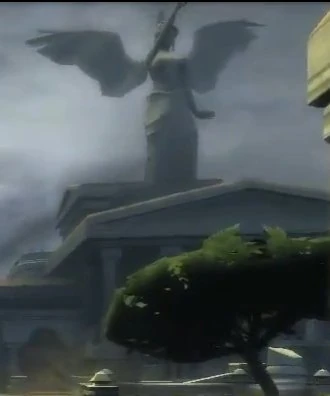
A statue of Nike in Attica.
God of War: Chains of Olympus
The people of Attica have constructed a giant Statue of Nike on one of the rooftops in her honor and for victories in wars and battles.
God of War II
In the Island of Creation a carving of Nika was made on a wall in her honor.
While in the Temple of Lahkesis, Kratos reaches a small courtyard with an elevator, he finds a carving of Nike on the wall. The elevator leads down to the chains of the Steeds of Time.
God of War III
Second Titanomachy
In Mount Olympus the Olympians have made a mural of Nike in her honor for fame and victory also being a close ally to Zeus.
Later Kratos saved the Titans from their banishment to Tartarus and allowed them to scale the mountain to exact vengeance after traveling back in time. Due to Zeus' paranoia and cruel behavior, Nike, along with several other gods including Artemis and Apollo, did not aid the Greek gods in the Second Titanomachy.
Powers & Abilities
- Immortality: As a Titan and Goddess, she is immortal. Only a sufficiently powerful weapon or an extremely powerful being can kill her.
- Flight: She has wings growing out of her back, using them to hover above the ground or fly.
- Telekinesis: She can lift stuff and can use it against anyone.
- Pyrokinesis: She had fire abilities as well.
- Superhuman Speed: As a god, she possessed speed that surpassed that of any mortal, most demigods & most gods.
- Superhuman Stamina: As a god, she had incredible stamina and could keep fighting without tiring.
- Superhuman Strength: As a god, she was far stronger than any mortal and even stronger than most demigods and possibly many Gods.
- Superhuman Durability: Nike is able to withstand immense and powerful attacks.
- Armies Control: She has control over the armies of humanity, and can grant them victory and fame.
- Teleportation: She can teleport to any place at her will.
Trivia
- Though she makes no appearance in the games, it is possible that she has graced Kratos' victories in battles, including Kratos' victory over Zeus and Olympus. Ironically in mythology she was the sister of Cratos (Strength).
- Though Nike herself is absent in the games, statues, paintings, and carvings of her can be sighted.
Gallery


| |||||||||||||||||||||||||||||
| |||||||||||||||||||||||||||||
| |||||||||||||||||||||||||||||
| |||||||||||||||||||||||||||||