This article contains lore based on real-life sources from Norse mythology as introduced from the God of War Norse era.
| “ | To grieve deeply is to have loved fully. Open your heart to the world as you opened it to me, and you will find every reason to keep living in it. | ” |
―Faye to Kratos | ||
Laufey (Nordic: ᛚᚨᚢᚠᛖᛁ), known by her alias Faye, was a Jötunn warrior of Midgard. She was the second wife of Kratos and the mother of Atreus.
She will be titular main protagonist of the upcoming God of War Laufey.
Quick Answers
Who is Laufey in Norse mythology?

What role does Laufey play in the God of War Norse era?
How is Laufey related to Kratos and Loki?
What is known about Laufey's alias, Faye?
What is the significance of Laufey in the Prose Edda?
In Norse Mythology
Laufey (also known as Nál) is a figure in Norse mythology, best known as the mother of Loki and the consort of Fárbauti.
Laufey is mentioned in the Prose Edda, written in the 13th century by Snorri Sturluson. In Gylfaginning (chapter 33 in most editions), the figure of High introduces Loki, stating that he is the son of Fárbauti and that “Laufey or Nál” is his mother. Loki’s brothers, Býleistr and Helblindi, are also named in this passage.
Elsewhere in Gylfaginning, Loki is referred to using the matronymic Laufeyjarson (“Laufey’s son”), which appears in chapter 33 and again in chapter 42. This naming is notable given the predominantly patronymic conventions in Old Norse society. The same matronymic also appears in Skáldskaparmál (chapter 1), where Loki is likewise identified as the son of Laufey.
In the God of War Series
God of War (2018)
Faye is only seen in-game as a corpse wrapped in sheets and later cremated, but is a crucial character mentioned extensively in God of War. She is the second wife of Kratos and the mother of Loki. Although she lived as a mortal, Faye was, in fact, a Giant (Jotünn) of Jötunheim—concealing her true nature from her family for reasons unknown.
Her real name was Laufey, and, according to Mimir, she was renowned as a great giant heroine, known as Laufey the Just, for her deeds in helping the weak and helpless and opposing the cruel Aesir and their king, Odin. She was also known to be a fearsome and respectful warrior in her own right, even drawing the attention of Thor, one of the most powerful Aesir. Even Kratos, her future husband, respected her fighting skills, saying she fought beautifully. At some point, she cooperated with Týr in hiding the Realm Tower to Jötunheim, cutting her off from her home in an effort to preserve her kin from Thor's genocide.
Having the foresight of the future regarding her son's journey, Faye met Kratos, her future husband, fourty years ago. They briefly fought but ceased as they shared world weariness and soon after got to know one another and eventually fell in love. Five years later they built a house in the Wildwoods and Kratos divulges his past to his wife and hides the Blades of Chaos under the floorboards, still being unable to be rid of them. When Faye spoke about the Aesir Gods, Kratos decided to listen to her stories. Faye even learned about her husband's true nature as a god as well as his tragic and complicated past and kept it a secret from their son. Twenty-two years pass as Faye gives birth to a son named Atreus, although she initially wanted to name him Loki. The boy was raised mainly by Faye, who taught him how to hunt and how to read the Nordic language, among other things. Every day, Faye would teach her son about the different languages around the Nine Realms, or at least the ones she knew, and she also taught him archery. She was also the one who made Atreus his bow. She would teach him about the gods and the different creatures of the Norse wilds.
Before she died, she instructed Kratos and Atreus to cremate her body and scatter her ashes atop the highest peak of the Nine Realms. Unbeknownst to them, the highest peak wasn't in Midgard, but in Jötunheim, where a mural telling her life and a prophecy about Atreus, mentioned as Loki, was and would explain her origins to them. To ensure events turned out as she wanted, she also instructed Kratos to cut down specific trees marked with a golden, glowing hand sign that would disable the protection around her woods and alert the Gods to her presence in Midgard. Sure enough, Odin sent Baldur to track and find her, not knowing she was already dead, driving her husband and son to Jötunheim to learn the truth as they bonded in their journey.
When the pair eventually reach to Jötunheim, they discover a mural of all the past events that had occurred on their journey, beginning with Faye who was arguing with her kin. Kratos and Atreus realize that Faye was a Frost Giant, learning that she had foreseen everything before she died and that she was not a mortal. After her ashes were scattered, the pair return to Midgard where Brok and Sindri reveal they knew Atreus was part Frost Giant due to Faye, leading Mimir to conclude that she was none other than Laufey the Just, someone he wished he'd gotten to meet.
God of War Ragnarök
Faye makes a few appearances to Kratos in his dreams, where he reminisces his last moments with her even before Atreus' birth. Yet three years into Fimbulwinter, Kratos still carries the pouch that contained his wife's ashes, often caressing it and implying there are few bits of ashes remaining.
The first dream was of Faye and Kratos hunting together. As they hunt, Faye questions Kratos' simple concept of hunting of predators killing because it is the natural order of things and believes his words to be misguided. They stumble upon a wolf, and despite appearing friendly and wanting to help, the wolf runs away. As Faye reveals that the sick wolf found its way inside their stave as she predicted and that they should have acted, Kratos remarks that though the problem became theirs when it reached their home, it was not theirs in the first place. Faye however questions that a problem doesn't need to reach the doorstep of their home to be their responsibility, for if they have the power to limit the harm it can cause, they should act instead of hiding and doing nothing. But Kratos believes they are not hiding. After helping Faye past some broken tree trunks, Kratos loses her briefly before she appears and touches his forehead, warning him of how time is running out and that there is much to do. While Kratos most certainly did not believe he was talking to ghosts again as Mimir suggested, he did believe Faye was trying to tell him something. That the dream was more than just a memory of the past.
The second dream was the birth of Atreus, where Kratos takes his wife and child down a river via a boat, passing near the area where Kratos and Faye first met and fought. As Faye takes care of a baby Atreus in her arms, vowing to teach him language and hunting, she questions Kratos' silence and asks him to let Atreus learn his voice and remember it, and not grunt all the time. Though Kratos insists that their son, innocent and fearing for him, should be left without knowing Kratos' past, Faye affirms that Kratos is not his own failure nor is he what he once was in the past. That they must be better. She hands their baby over to him before dissipating, along with the baby, but not before urging him to take care of and protect Atreus as he is their future.
The final dream was of Kratos helping Faye mark the trees used for her funeral pyre, along with the last instructions to spread her ashes in the highest peak of the realms, with Kratos not knowing it would be in Faye's home of Jötunheim. When she asks of Kratos' thoughts of her funeral, Kratos reveals he would've chosen to entomb Faye so as to keep her close to him as is customary in Greece. Faye however jests that her rotting corpse would offer him such comfort, finding it touching . She remarks how Kratos tried to take control of his ending, but it was done so in circumstance, not in purpose. Kratos though sees that Faye is preparing for a distant future and wants to spend however much time ahead before it comes, but Faye clarifies that she wishes to better a future, one that will exist without her when the day comes for her husband and son. Though Kratos would miss her absence dearly, having experienced the loss of his first wife as a part of him that dies, Faye assures him that she will be with him always. That the culmination of love is grief and that they open their hearts to love despite the inevitable. That to grieve deeply is to have loved fully and that she pleads with Kratos to open his heart to the world as he did to her, so that he will find every reason to keep living in it.
After Ragnarök, Kratos and Atreus are led by Angrboda to a hidden Jötunn shrine where they learned more about Faye. It is revealed that she destroyed the 3rd mural of Atreus' shrine in Jötunheim as she didn't want her son and husband to know their fate, allowing them to forge their own path. According to Angrboda, Faye turned against her own people to protect her family, hence why she argued with the giants in the first mural and destroyed the rest of the shrine in Jötunheim. She also foresaw Kratos' arrival into Midgard and his journey with Atreus.
Kratos later learns that Faye had once fought Thor in Vanaheim, leaving a frozen lightning mark like in Kratos' first fight with the God of Thunder and destroying a local village and all its residents in the aftermath. The spirits of village residents who had witnessed the event saw the valley torn apart by a drunken Thor and an enraged Faye as they fought, respectively Mjölnir against the Leviathan. The battle had ended in a stalemate, leaving many spirits trapped and lost.
God of War Laufey
Following her death and cremation, the soul of Faye arrives in a different afterlife, one for all gods from across all mythologies known as the Everywhen. Upon awakening in this strange realm, one that she was not expecting and instead thought that she would be in the Light of Alfheim, Faye set about to make sense of her predicament and soon realizes that the plans she had laid out to protect Kratos and Atreus are now at risk. She then becomes entangled in the schemes of other deceased gods from different pantheons, all vying for power in the Everywhen.
Appearance
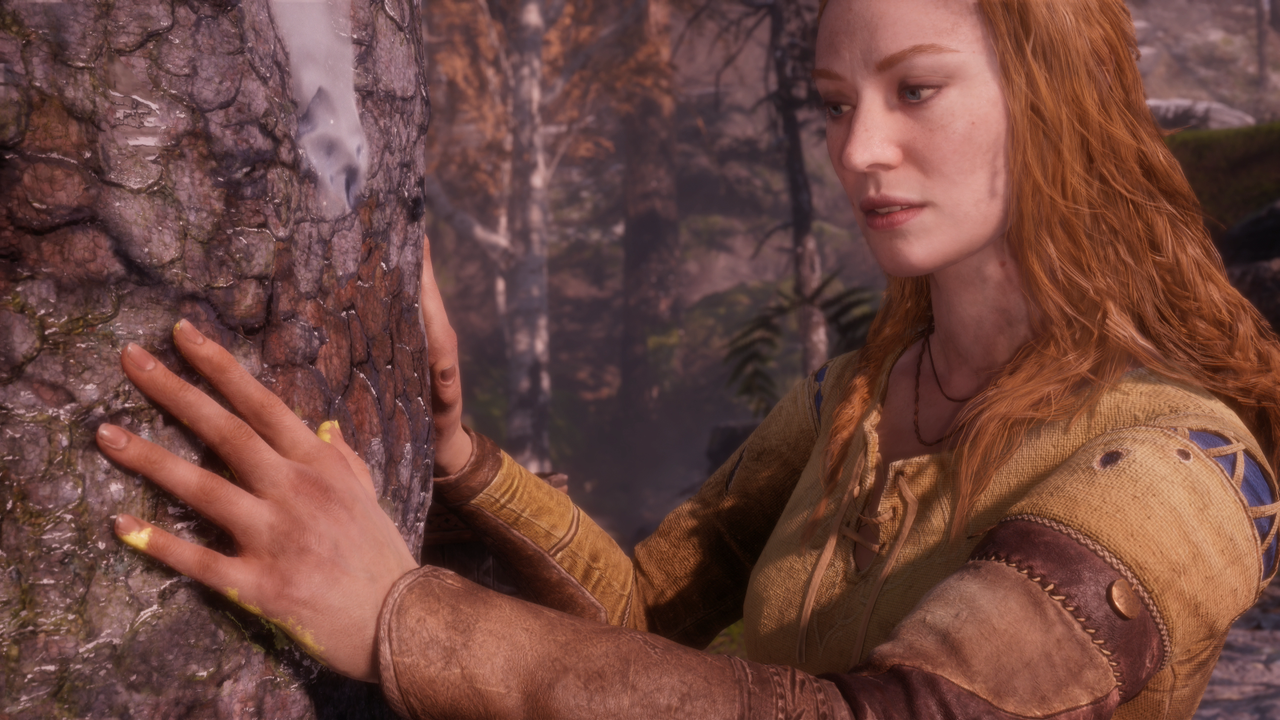
Laufey was a beautiful tall woman with bright blue eyes and medium length strawberry-blonde hair that cascades down her back with braids strewn in random locations, the most notable ones being three large braids. The three large braids are interwoven along the top of her head. The braids appear to be a type of repeating, reverse-braid with a slightly tousled or windswept appearance, and contribute to the voluminous and wavy movement of her hair. In addition to these features, Faye also had a mole next to her upper lip on the left side of her face. Her skin is a light, fair tone with faintly visible freckles. Her lips are a light reddish-pink. In terms of dress, Faye was wearing two necklaces that appear to either be gold or light brown with a layered design on it. She is wearing a loose-fitting, light cream-colored/yellow tunic, the tunic has some decorative patterns, possibly embroidered or woven, along the neckline and sleeves and around the shoulder area. A dark, brownish-red leather pouch or satchel is slung across her waist, with a knife sheathing into it. The leather part of the pouch has a slightly worn/aged look. She also appears to have brown fabric/leather material hanging at her hips. She is also wearing brown puffy pants that are wrapped near the calves and medium length brown boots.
Personality
| “ | A problem doesn’t have to reach our doorstep for it to be our responsibility. If we have the power to limit the harm it should cause, we should act. Who are we to hide and do nothing? | ” |
―Faye to Kratos, God of War: Ragnarök | ||
While Faye was not shown extensively within the game, it is clear that she cared deeply about her son, and taught him as many things as she could before dying and raised Atreus to be a kind soul. She also appeared to be a very close and loving wife to Kratos, as Kratos wondered if he could raise Atreus without her and reprimanded Atreus whenever he spoke ill of his mother, showing anger when Atreus accuses him of not mourning Faye. Despite thinking that she was a mortal, Kratos still described her as "better than a god". The Huldra brothers, Brok and Sindri, also thought highly of Faye, making the Leviathan Axe for her. Sindri, in particular, considered her a special woman and was saddened upon learning of her death.
Kratos and Atreus have both noted that Faye always wanted to help those in need, without any personal benefit to gain from the action. Atreus had clearly learned and inherited her kind nature and desire to help others from Faye. While Kratos would very much like to stay out of the affairs of others, Faye would always help those in need, a trait which endeared her to the Huldra brothers.
According to Atreus, Faye shared her husband's mistrust of gods, though not without reason. As the last Guardian of the Jötnar, Faye had the opportunity and the hope of her fellow Giants to restore balance to the world following Thor's rampage. Instead, Faye placed her hopes in her family. Using her ability of foresight, Faye undertook the journey her son and husband would and left markings to help guide them.
In Kratos' dreams, Faye reveals a more fun loving side, often teasing her husband and calling him Grumbles in response to his grunting and gruff demeanor and even poking his nose with yellow paint or thanking him for removing a dead tree and calling him a good boy. Never have the two argued once as Faye often provides her wisdom to Kratos' ideals and concerns about himself and the world around him, something that Kratos wished he had taken heed sooner with his first wife Lysandra. She even jokes about Kratos' choice of burial for her, opting for a tomb instead of a pyre to which she responds that her rotting corpse would bring him such comfort.
Upon learning of her fight with Thor in Vanaheim, Kratos was shocked to see Faye had contributed to the destruction of the valley and its residents, on a level of rage he thought her incapable of. Despite Thor being drunk and sloppy with his hammer, Faye was capable of such wrathful emotions that she engaged Thor in combat with the Leviathan, their duel ending in a stalemate and leaving behind a frozen lightning mark.
Powers & Abilities
| “ | It is a tale of combat! Of a fair-haired woman doing battle with the most powerful of all gods. | ” |
―Magnus upon meeting Kratos | ||
As the finest warrior her race has ever known, Faye is an extremely powerful being, enough to gain the attention of Thor, the physically strongest of the Norse Gods, and Kratos, the former God of War from another land, and contend with them. The combination of her might, combat abilities, and cunning, would make her an extraordinarily dangerous opponent.
Powers
- Supernatural Strength: Even for a warrior giantess like her, Faye's strength was utterly enormous, with elegance and precision to match. She was notably able to face even Thor, the physically strongest Norse God, and give him a fight for his life, to where Thor considers her a worthy challenge, albeit it should be noted that he was drunk and sloppy at the time. In her first encounter with Kratos, she was also able to match the Ghost of Sparta and stated that "they nearly took each others' heads off".
- Precognition: Another ability giants can have is the ability to foresee future events. Faye saw her own death, her family's journey to spread her ashes, and even their possible future.
- Magical Mastery: Faye possessed an almost supernatural proficiency with magic that nearly rivals that of a god, allowing her to recognize and neutralize scorn poles and create a protective barrier around her house that was potent enough that no Aesir God, including Odin, despite his phenomenal mastery of magic, was ever able to find her and her family until she dispelled it, despite the fact that Odin later had no trouble breaching the same defense when Atreus put it up. It was possible that she used her magical power to hide her true nature, as Kratos didn't suspect her status as something other than mortal even after her death.
- Spell Casting: Faye's supreme skill with magic extends to being able to cast several powerful spells which not even the Aesir Gods could break or see, specializing mainly in concealment spells, having taught her son a little.
Abilities
- Master Combatant: Faye was known to be a fierce and highly capable warrior, with her skills being praised by even her husband Kratos, a highly trained and accomplished Spartan warrior who became a God of War in his own right, who described her fighting style as "beautiful", with Faye having been able to hold Kratos to a stalemate in their first meeting until he finally stopped attacking her. Her skills are so renowned and formidable that she once managed to give Thor, the greatest warrior on Asgard who has killed numerous Giants before, what was described as a "fight for his life". Freya, a powerful Goddess in her own right, admitted to having once met Faye, and deemed the latter's fighting prowess as "extraordinary". Her skills also made her a competent teacher, as she successfully trained Atreus into becoming a decent warrior before her death.
- Master Swordsman: Even in death, in an unknown place, Faye still retains her immense mastery of the sword, allowing her to dispatch multiple enemies with relative ease while simultaneously parrying and counter-attackting.
- Master Hunter: Both Kratos and Atreus had said Faye was a better hunter than both of them, with her teaching her son who to hunt while her husband was following her lead in one of his flashbacks.
- Skilled Bowyer: Faye was a skilled bowmaker and crafted a bow of yew for her son, sizing it so he would not end up outgrowing it. It was sturdy enough to be used as a blunt weapon.
Weapons
- Leviathan Axe: Forged by Brok and Sindri, this magical axe was Faye's weapon of choice during her time as heroine and the guardian of the Jötnar. She gave it to her husband moments before her death.
- Talon Bow: She made a bow out of a yew tree and instruct Atreus in its usage. It was strong enough to be used as a blunt weapon.
- Knife: Faye also possessed a knife, but after her death it was given to Atreus as a secondary weapon. It was destroyed when Atreus used it to save his father's life from a trap by stabbing it into a gear mechanism.
- Guardian Shield: Faye once wielded this shield before she gifted it to Kratos on the anniversary of the first night they met.
Gallery


Concept Arts


Trivia
- Her alias "Faye" is a play on the name "Laufey," who in Norse mythology is the mother of Loki. Similarly, Faye wanted to name her son Loki but was convinced otherwise by Kratos.
- In the mythology Laufey had an alternate name, Nál, however in the God of War universe Nál is a separated character who was the wife of Bergelmir.
- While the cause of Faye's death is never revealed, fans have come up with several theories:
- She might have become gravely ill due to some kind of disease.
- Her battle with Thor may have caused lasting damage to her body which eventually killed her.
- She may have encountered Hel-Walkers in the Wildwoods and, due to lacking proper armor and the Leviathan Axe being ineffective against them, sustained fatal injuries during battle with them.
- She also could have died from simply old age. The Jötnar known are not immortal/ageless. Instead only possessing highly extended longevity (although, dying of old age is rare for a Jötunn, according to Mimir.)
- A writing in Jötunheim reveals that two Giants remained in Midgard after the remaining Giants fled. They referred to the World Serpent and "the Guardian", who was Faye herself. Faye was destined to return home near the beginning of Ragnarök, which she did in the form of ashes.
- It is revealed that Týr and Faye once cooperated to hide the Jötunheim tower.
- Faye had a Gyrfalcon named Jöphie. Atreus would call her, but she would only respond to his mother. (God of War, J.M Barlog, Chapter 3 page 19.)
- Freya is believed to have met Faye before, having learned of an extraordinary warrior that would be on par with Thor. Though she also remarks that Faye didn't carry the Leviathan when Freya first saw her.
| |||||||||||||||||||||||||||||||||||||||||||||||||||||||||||||
| |||||||||||||||||||||||||||||||||||||||||||||||||||||||||||||
| |||||||||||||||||||||||||||||||||||||||||||||||||||||||||||||
| |||||||||||||||||||||||||||||||||||||||||||||||||||||||||||||
| |||||||||||||||||||||||||||||||||||||||||||||||||||||||||||||
| |||||||||||||||||||||||||||||||||||||||||||||||||||||||||||||
Template:Navbox GoW Laufey