| “ | Come forward. Let us finally see who is the greatest warrior in all of Greece. | ” |
―Theseus. | ||
Theseus (Greek: Θησεύς) was a Greek Demigod hero, son of Poseidon, and founder-king of the city of Athens. He acts as a boss in God of War II.
Quick Answers
Who were the parents of Theseus in Greek mythology?

What role does Theseus play in the game God of War II?
What city did Theseus famously found according to Greek mythology?
Is Theseus considered a god or a demigod in Greek mythology?
What is the story behind Theseus's dual patronage from Poseidon and Aegus?
Greek Mythology
Theseus was one of the most famous heroes and founder-king of Athens. He was the son of both the god Poseidon and a mortal man Aegus (his mother laid with both on her wedding night), the dual patronage of which still bestowed godliness unto him. (However, he may only be the son of one of them, most likely Poseidon). Although not his only one, his most famous exploit was killing the Minotaur, son of King Minos of Crete's wife and a sacred bull. Earlier, Theseus' father had sent one of King Minos' sons to his death and in return, the Cretans had defeated the Athenians in war. The Athenians then had to pay tribute; a nine-yearly sacrifice of seven young men and seven young girls to be sent to Crete to be eaten by the Minotaur. Theseus travelled on one of the ships to Crete, and with the help of Ariadne, Minos' daughter, he bested the Labyrinth and defeated the Minotaur. This myth might have referred to a change in the Athenian constitution when the historical Minoan Empire came to an end.
Theseus had a bad history with women. After helping Ariadne escape with him to Athens, he abandoned her en route on the island of Naxos. As he was the son of Poseidon, and his best friend Peirithous was the son of Zeus, they decided that each should marry daughters of Zeus. Theseus decided on Helen (of Troy, but currently Helen of Sparta and only a child) and Peirithous on Persephone. They managed to kidnap Helen but lost her to the Spartans while trapped in the Underworld by Hades for attempting to kidnap Persephone. Heracles eventually saved Theseus but had to leave Peirithous. Later, while visiting the Amazons, Theseus claimed their queen, Hippolyta, to be his wife. This sparked a war between Athens and the Amazons. They did marry and have children though, but Theseus then remarried again, only to have his second wife, Phaedra, fall in love with his son from his marriage with Hippolyta.
God of War series
Becoming a hero
Theseus was born a demigod son of Poseidon, the Ruler of the Oceans. As a child he was adopted by Aegeus, the King of Magara whom he loved as his father. Theseus' legend began when he, while on a quest for the Goddess Athena was thrown into the labyrinth of King Minos to be sacrificed to his Minotaur, along with a number of other Athenians. The kings daughter Ariadne was in love with Theseus and it was through her twine that he and his people were able to escape the labyrinth prison. For his act of bravery he became honoured as a hero of Athens and eventually became its king.
Tragedy
After slaying the Cretan monster the demigod planned to stay at Ariadne's side, being in love with the princess who risked her life to save him. However, the Wine God Dionysus claimed her for himself and forced Theseus to leave his love behind on the island of Naxos. Ariadne was heartbroken and cursed him as he left for Athens on his ship. Upon his return to his home from the successful quest on Crete, his father was worried that he might return a failure. When Aegeus saw his son's ship hoisting a black flag, he cast himself from the cliffs into the sea thinking to have lost his son.
The bitter loss of his father was hard for Theseus. As the years passed he left behind the life of a hero and king, increasingly dwelling on the past tragedies of his life, most importantly the loss of his father and Ariadne's love. At some point, the aging demigod made a desperate choice to serve the Sisters of Fate, all in hope of them granting him an audiance and changing his fate. The former hero king of Athens became the Keeper of the Horse Key and Guardian of the Steeds of Time.
God of War Novel
After easily killing the first Minotaur he encountered during the Siege of Athens, Kratos thinks about Theseus and how pathetic the Athenians are for making a hero of a man for slaying such a puny little beast. Overall, the Spartan had a rather condescending opinion on the former Athenian king and his reputation as a hero.
God of War II
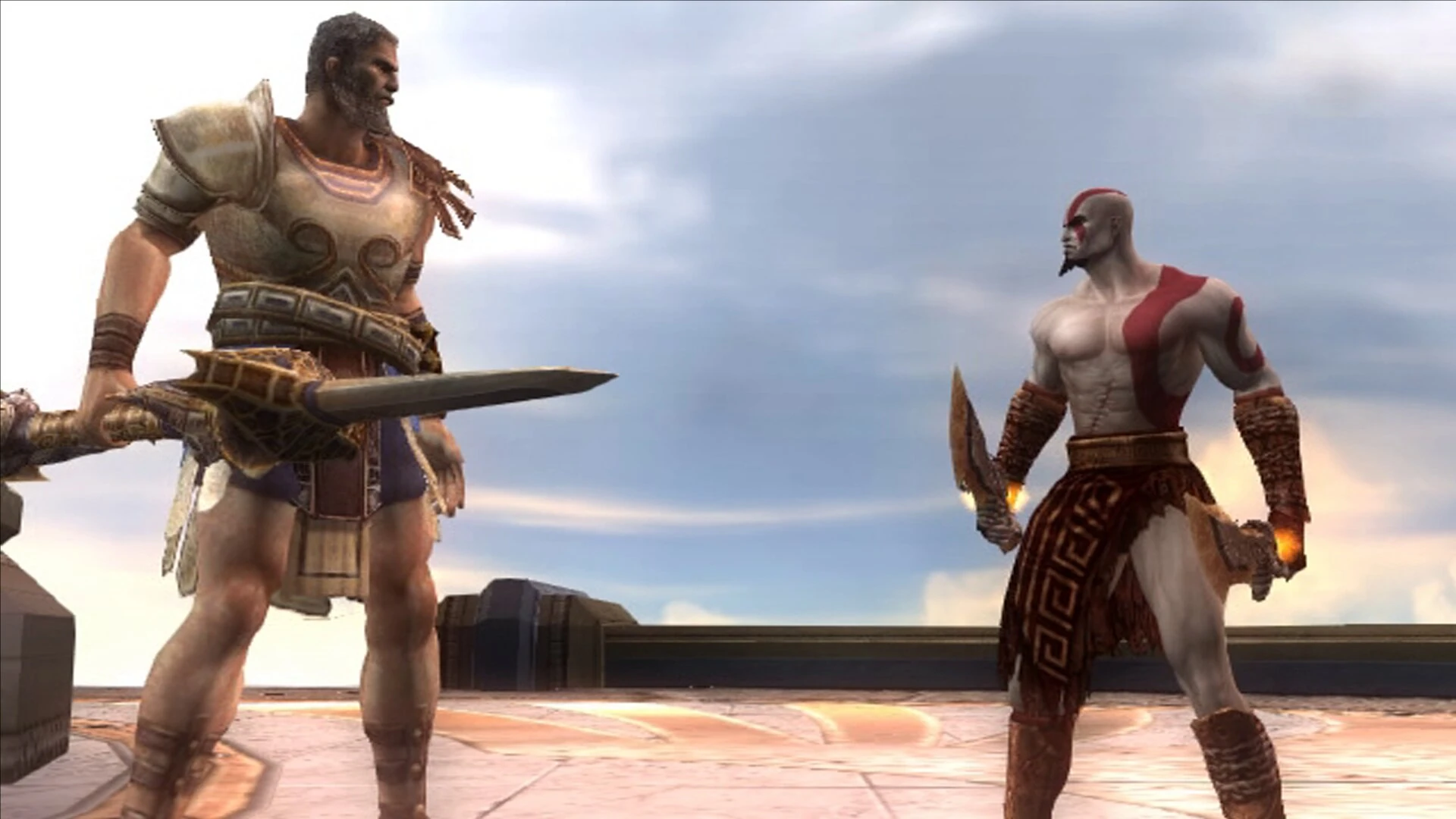
Theseus challenging Kratos into battle.
In God of War II, Theseus served the Sisters of Fate as the 'Horse Keeper' and kept the Key to the various locks placed throughout the Steeds of Time. When Kratos arrived on The Steeds and met their guardian, the two studied each other in silence for a few moments. Theseus then snorted at Kratos’ presence, and correctly deduced his purpose on the island. After some sharp bickering, Kratos proposed Theseus to hand over the key, in exchange for his life. Theseus, however, was unmoved and amused by Kratos' intentions and mocked him, claiming that he was no match for Zeus or even Theseus himself. He then challenged Kratos to a duel to the death, in order to prove who was "the greatest warrior in all of Greece".
In the novel, the dialogue before the fight got extended with Kratos inquiring about the old hero's motives for serving as the Sisters' minion. Theseus revealed his past with Ariadne, his father and desire to change his fate and regain his loved ones by an audiance with the Fates. Kratos asked him how long he already waits for the Sisters to hear his plea, which made him tense. The hero answers that perhaps he will gain his desired reward if he now kills a former god - to which the Ghost of Sparta replies that he would be deluded to think that he can take him on.
Battling Kratos with the sword, Theseus proved a tough fighter, however, the Spartan proved to be too powerful for Theseus, who wielded a double-ended sword, taking punishment from his cousin and retaliating with vicious slashes and stabs. After taking a certain amount of damage in the battle, Theseus became even more dangerous after igniting the magical powers the sword held, increasing its power and enabling Theseus to summon massive spikes of ice to erupt from the ground in various formations. Kratos however, kept the upper hand.
Significantly weakened, Theseus climbed a doorway above Kratos, out of the Spartan's reach, forcing him to shoot him with arrows from a distance with Typhon's Bane. However, the Horse Keeper started firing projectiles of blue magic from his sword while periodically summoning Erebus Minotaurs to attack Kratos directly.
Ultimately, Kratos knocked Theseus off the roof, leaving him hanging by a single arm, The Spartan then latched his blade into him and pulled him down to the ground. Kratos subsequently turned Theseus' own sword against him by punching him in midair to take it from him and impaling him to the door with it.
Death
Taking the key from him, he then used it to open the door Theseus was guarding. When the wounded Theseus attempted to stop Kratos, Kratos repeatedly smashed his cousin's head in with the door, then kicked him through the doorway and into the newly opened room, thus killing him. Upon Theseus' death, Kratos obtained the Horse Keeper's Key. In the novelization, as Theseus made a weak attempt to grab Kratos' foot while getting his head smashed in with the metal door, Kratos looks down at him with utter disgust and flatly tells him that he is pathetic.
Due to Kratos' reversing of time at the end of God of War II, it can be assumed that Theseus' demise was undone, however it is unlikely that he survived the cataclysmic events that started with the Second Great War, beginning with the global flood that followed with the death of his father Poseidon.
In Valhalla
In a conversation during Valhalla DLC, Mimir mentions attending a Greek King's wedding as part of Oberon's entourage, and his description of the king's story matches closely that of Theseus and Hippolyta. This reveal seems to conflict with an earlier statement by Mimir in the main game that had him having no idea what an olive was (Kratos brought olives up as a food he missed), when such would have certainly been served at a Greek king's wedding. It seems possible that while olives were served and eaten, the Celtic Fair Folk did not realize what they were eating, being a food far outside their experience.
Powers and Abilities
| “ | I doubt you're capable of killing me, let alone the King of Olympus! | ” |
―Theseus | ||
Theseus had numerous powers and special abilities. As a Demigod, he was gifted with superhuman strength, agility, stamina, ice/water manipulation (an ability most likely passed down from his father, Poseidon), endurance, accuracy, and durability (as he was able to take numerous blows from Typhon's Bane and the Blades of Athena). He also carried a large double-bladed sword along with him. He was able to infuse it with power so that the sword could then become more powerful, as well as wielding magical ice abilities.
He also had the power to summon icy spikes (which may be a form of water control), and pairs of Erebus Minotaurs, (possibly a reference to his legendary battle with the beast) to aid him in battle. While upon the doorway above Kratos, he could also use his spear to shoot projectiles in his direction.
Personality
Theseus has a very high opinion of himself and shows undying loyalty to Zeus and to the Sisters of Fate. Judging by his conversation with Kratos, Theseus did respect him at one point due to his belief that Kratos would never need to change his fate, but now that Kratos is on this mission, Theseus sees him as a weak fool, especially after he lost his godhood. However, this was before he realized Kratos' true strength, when overwhelmed.
Theseus has no respect for people deemed weaker than himself and belittles anyone who tries to change their fate. Theseus also appears to be a hypocrite, as he retreats to the top of the doorway and summons Minotaurs to assist him when it appears that Kratos was getting the upper hand in their fight.
Trivia
- It is interesting that Theseus is the "Horse Keeper", since, as the son of Poseidon, god of horses, and founder hero of Athens, a city with strong ties to both Poseidon and Athena, and he, therefore, does have strong connotations with horses in myth. In the game, Theseus has many horse decorations in the arena and on his person.
- His ability to summon Minotaurs is regarded as an ironic twist on the legend of Theseus.
- In Titan Mode, the ice spikes he creates will instantly kill Kratos if they hit him.
- During Bonus Play, using the L2-Circle attack of Typhoon's Bane on Theseus just as he strikes Kratos with one of his attacks will cause the game to freeze, making a restart necessary.
- If Kratos knocks Theseus off the roof when there are any Minotaurs left, the creatures will disappear.
- Theseus seems to be an aged hero since his hair is gray and his features are roughened, also Kratos addresses him as an old man ("Let me pass, and I will let you live, old man."). However, the PS4 incarnation of God of War complicates Theseus's age since Kratos was able to reach 150 years old and not show any sign of age. Wether or not Kratos' curse affected his age or all demigods have a longer lifespan is unclear.
- Despite Kratos' tendency to take valuable exploits from many of his fallen powerful enemies, he did not take Theseus's spear. This strange "choosy" habit is also evident from the fact that he did not take any of Perseus's magical belongings after he killed him as well, but then he claimed the Spear of Destiny which he left behind earlier. A mere speculation is that Kratos uses his own judgement (out of personal taste or evaluation of a weapon's effectiveness if used by him being possibilities) to determine which weapon/tool he should pick (other than the ones given/offered to him) and so far this method proves to be effective for him, but in God of War: Ascension he is able to acquire any of his enemies weapons - however, since that game was a prequel, it may be that, as he aged and gained experience, Kratos became more adept in his skills in the later games to the point where he could effectively judge what weapons he did or did not wish to keep. Kratos also might've felt as he got older that he did not need to use more common weapons as he does in Ascension, as he had become more comfortable with using less weaponry other than his chained blades.
- Due to Kratos using the power of the Sisters of Fate to return in time to the moment Zeus killed him, it's possible that Theseus, as well as everyone else killed by Kratos after this moment, are alive due to changing the timeline. This might explain why Poseidon didn't vengefully mention his death in God of War III.
- Kratos's respect towards Theseus has a real-life explanation. In Sparta, the elderly are actually venerated because it meant they survived enough battles to live to reach old age. Since Theseus is an old man and Kratos recognised him, it's enough for Kratos to show respect towards him by offering to spare him and he does honour Theseus's request for a duel to the death.
Gallery


Video
God of War 2 - Titan, Theseus
Kratos vs. Theseus
| |||||||||||||||||||||||||||||
| |||||||||||||||||||||||||||||
| |||||||||||||||||||||||||||||
| |||||||||||||||||||||||||||||